
Sustainable Biomaterials Lab

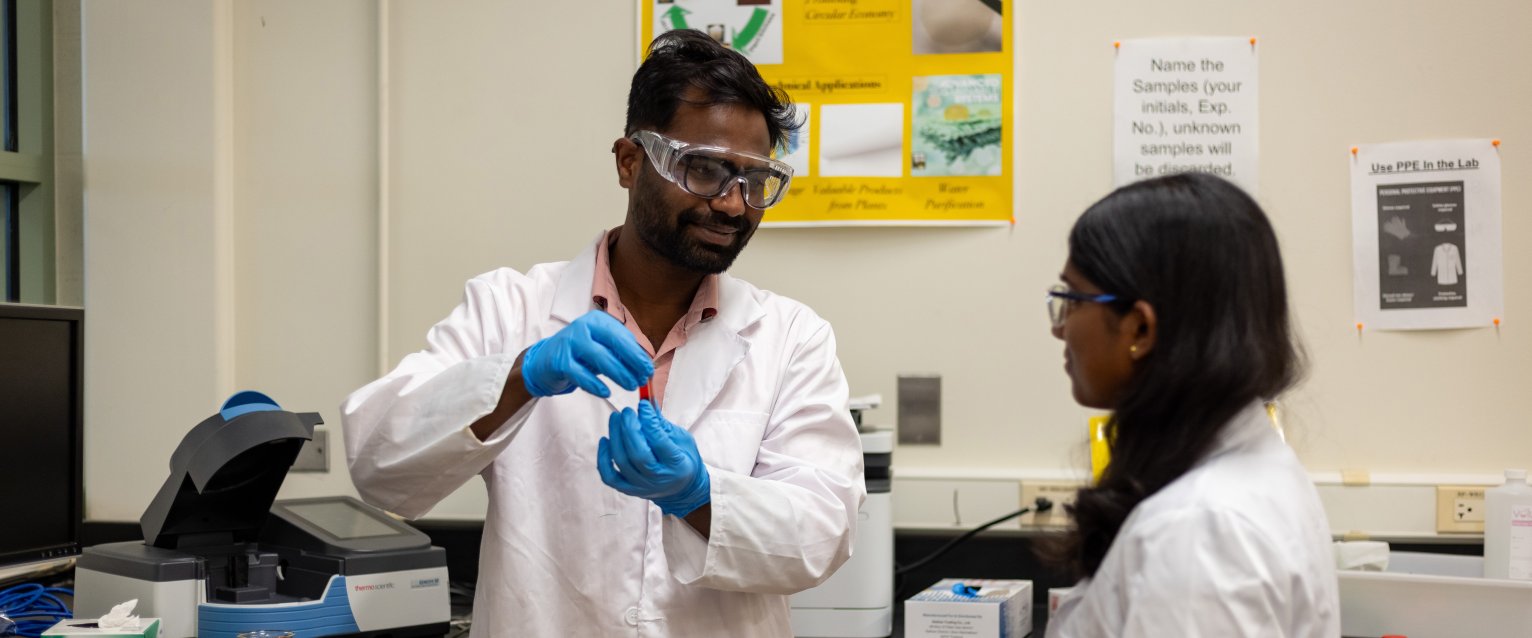
WMU's Sustainable Biomaterials Lab investigates sustainable pathways to convert all types of plant biomass, including underutilized agricultural residues, paper waste and invasive plant fibers, into valuable products such as adsorbents, additives, foams, paperboard, cellulose fibers, nanocellulose, hydrogels, aerogels and coating formulations for environmental remediation, energy and packaging.

Our projects

The primary focus of our lab is to develop sustainable ways to synthesize and extract various bio-based polymers  and nanomaterials, with an emphasis on their applications in water purification, environmental remediation, sensing, packaging and energy harvesting.

Current projects in the lab include the following:

Fabrication and structural characterization of different types of nanocellulose: Nanocellulose is produced from renewable cellulose sources, most commonly wood pulp. Our lab focuses on fabricating nanocellulose mainly from non-wood sources, including jute fibers, hemp fibers, invasive phragmites grass, and agricultural residues, to promote sustainability and upcycling of such biomass. We develop methods to produce cellulose nanofibers, cellulose nanocrystals, microfibrillated cellulose, and spherical cellulose nanoparticles from both wood and non-wood biomasses, and investigate their functional, structural, chemical, optical, and flow properties using advanced microscopic, spectroscopic, and synchrotron techniques.

Science Direct publication

Nitro-oxidation process (NOP): Nitric acid-sodium nitrite method to develop the carboxycellulose nanofibers from virgin plant fibers.

​Updated TEMPO-Oxidation Method: Excess use of sodium chlorite can lead to the fabrication of carboxycellulose nanofibers from virgin non-wood plants.

Nanocellulose is an emerging, eco-friendly material used to capture and recycle agricultural nutrients like nitrogen, phosphorus, and potassium from wastewater. We are producing different types of charged nanocellulose (which is plant-derived and biodegradable) this bio-based scaffold closes the agricultural loop by allowing the exhausted, nutrient-loaded adsorbent to be directly reused as a slow-release fertilizer

We explore various chemical and mechanical methods to transform nanocellulose suspension or hydrogel into different structures, such as sponges, nanopaper, and aerogel, to enhance their performance in environmental cleanup by improving their mechanical stability, porosity, and surface binding properties.

We develop nanocellulose with various functionalities and their composites using our own patented methods, transforming them into membranes with suitable properties for fuel cell applications. We collaborate with Prof. Miriam Rafoloivich at Stony Brook University for membrane performance testing.

We are developing metal oxide and biopolymer composites to replace PFAS coatings in paper and food packaging applications.

Nanocellulose enables energy harvesting by serving as ion-selective membranes for osmotic power, reinforcing piezoelectric materials for vibrational energy, and forming components for solar cells and flexible electronics

We envision that upcycling non-woody plant fibers into valuable products can significantly help us meet sustainability goals, promote the circular economy, lower carbon footprints, and reduce the environmental impact of piles of plant, paper, plastic, and textile waste. Wood fibers have irreplaceable applications in paper, construction, and furniture. It's time to also look for the other underutilized, and zero-value plant fibers.
— Dr. Priyanka Sharma, lab director and assistant professor of chemical and paper engineering

Meet our team

Priyanka Sharma headshot

Dr. Priyanka Sharma

Sharma is the director of the Sustainable and Biomaterials Lab and an assistant professor of chemical and paper engineering at WMU. She teaches courses in bioprocess engineering and chemical reaction engineering. Her research interests include cellulose, nanocellulose and hydrogels.

Saikumar Muddapu, Ph.D. student in chemical engineering

Saikumar Muddapur

SaiKumar Muddapu is a doctoral student in chemical engineering. He joined the lab in Spring 2025 and works on cellulose modification for packaging and water purification. 

Syed Muhammad Shazil, graduate student in chemical engineering

Syed Muhammad Shazil

Shazil is an M.S. in chemical engineering. He joined the lab Fall 2025 and works on cellulose-metal-ion chemistry for paper-coating applications.

Colton Hicks

Colton Hicks

Hicks is an undergraduate student majoring in biochemistry and chemical engineering at WMU. He joined the lab in fall 2023 and works on the structural transformation of cellulose fibers to gels, hydrogels and foams.

Published Works

  1. Nitro-oxidized Carboxylated Cellulose Fibers: Highly Efficient Sustainable Bio-Nanomaterials for Removal of Lanthanum (La3+) from Water.  ChemSusChem:5611877.
  2. Functionalized Nanocellulose for Efficient Removal of Ammonium Impurities from Contaminated Water. RSC Applied Polymers – DOI https://doi.org/10.1039/D5LP00201J
  3. Terry, L. R.; Jain, M.; Kruel, J. W.; Das, A.; Sharma, P.; Hsiao, B. S.; Guo, H. Dual-Functional Nanocellulose-Based plasmonic membrane for both detection and removal of organic contaminants. ACS ES&T Engineering 2025. https://doi.org/10.1021/acsestengg.4c00945.
  4. Raut, A.; Fang, H.; Lin, Y.-C.; Rahman, M. F.; Fu, S.; Yin, Y.; Fang, Y.; Sprouster, D.; Isseroff, R.; Sharma, S. K.; Sharma, P.; Bhardwaj, D.; Garaga, M.; Greenbaum, S.; Zhang, S.; Rafailovich, M. H. Designing a micro-cellulose membrane for hydrogen fuel cells. RSC Sustainability 2025. https://doi.org/10.1039/d4su00728j.
  5. Seetharamiahsrinivasaraju, C.; Shetty, R.; Saxena, S.; Sharma, P.; Cohen, D.; Springstead, J.; Oldenzijl, R. Durable Thin‐Film DLC on wafer surfaces of gravure cylinders for Roll‐to‐Roll printing of 1‐Bit electrodes and microtext in flexible electronics and graphic security. Advanced Materials 2024. https://doi.org/10.1002/adma.202413551.
  6. Sharma, P.; Hicks, S.; Ruggiero, A. R.; Sharma, S. K.; Hsiao, B. S.; Springstead, J. Extraction and analysis of carboxycellulose nanofibers from virgin plant fibers using updated TEMPO-mediated oxidation. Cellulose 2024. https://doi.org/10.1007/s10570-024-06328-3.
  7. Terry, L. R.; Kruel, J. W.; Jain, M.; Lara, A.; Sharma, P.; Hsiao, B. S.; Guo, H. Detection of pesticides in sprayed droplets by using biowaste-derived nanocellulose-based SERS nanosubstrate. Cellulose 2024, 31 (18), 10915–10929. https://doi.org/10.1007/s10570-024-06271-3.
  8. Seetharamiahsrinivasaraju, C.; Shetty, R.; Cohen, D. K.; Sharma, P.; Springstead, J. R. DLC-engineered flat gravure surface: enabling sustainable fabrication to replace chrome for printing conductive line electrodes in flexible electronics. Materials Advances 2024, 5 (16), 6535–6553. https://doi.org/10.1039/d4ma00562g.
  9. Seetharamiahsrinivasaraju, C.; Shetty, R.; Sood, S.; Cohen, D. K.; Sharma, P.; Levenson, H.; Fleming, P. D.; Springstead, J. R. Sustainable and Eco-Friendly DLC fabrication for replacing chrome on a gravure cylinder surface. Langmuir 2024, 40 (6), 2849–2861. https://doi.org/10.1021/acs.langmuir.3c02177.
  10. Johnson, K.I.; Sharma, S.K.; Sharma, P.R.; Alhamzani, A.G.; Hsiao, B.S. Aluminum-Crosslinked Nanocellulose Scaffolds for Fluoride Removal. Nanomaterials 2024, 14, 1032. https://doi.org/10.3390/nano14121032
  11. Johnson, K.I.; Borges, W.; Sharma, P.R.; Sharma, S.K.; Chang, H.-Y.; Abou-Krisha, M.M.; Alhamzani, A.G.; Hsiao, B.S. Cellulose Sulfate Nanofibers for Enhanced Ammonium Removal. Nanomaterials 2024, 14, 507. https://doi.org/10.3390/nano14060507
  12. Ken I Johnson, Grenalynn Ilacas, Rasel Das, Hao-Yen Chang, Priyanka R Sharma, Christian O Dimkpa and Benjamin S Hsiao. A circular solution to enhance the food-water nexus by nanocellulose technologies for ammonium recovery and reuse. Sustain. Sci. Technol. 1 014001, 2024. DOI 10.1088/2977-3504/ad6cdf
  13. Chen, H.; Chi, K.; Cao, R.; Sharma, S.K.; Bokhari, S.M.Q.; Johnson, K.I.; Li, D.; Sharma, P.R.; Hsiao, B.S. Nitro-oxidation process for fabrication of efficient bioadsorbent from lignocellulosic biomass by combined liquid-gas phase treatment. Carbohydr. Polym. Technol. Appl. 2022, 3, 100219
  14. Wang, R.; He, H.; Sharma, P. R.; Tian, J.; Söderberg, L. D.; Rosén, T.; Hsiao, B. S. Unexpected gelation behavior of cellulose nanofibers dispersed in glycols. Macromolecules 2022, 55 (21), 9527–9536. https://doi.org/10.1021/acs.macromol.2c01035.
  15. Ngo, A.; Brahamhatt, I.; Hsiao, B. S.; Sharma, P. R.* (2021) Nanocellulose-enabled membranes in CO2 gas separation. Trends Carbohydr. Res. 13(4), 19-27.
  16. E.; Johnson, K. I.; Li, W.; Borges, W.; Chi, K.; Sharma, S.K.; Madan, Y.; Sharma, P. R.,* Hsiao, B. S. (2021) Study the use of activated carbon and bone char on the performance of gravity sand-bag water filter. Membranes 88(11), 1-12.
  17. Sharma, S. K.; Sharma, P. R.; Wang, L.; Patel, M.; Raut, A.; Johnson, K. I.; Gu, K.; Bae, C.; Rafailovich, M.; Hsiao, B. S. Plant-based highly proton conductive nanopaper and their PEM fuel cell performance. Sust. Energy Fuels 2022 DOI: 10.1039/D2SE00442A.
  18. Das, R., Lindstrom, T., Sharma, P. R., Chi, K., Hsiao, B. S. (2021) Nanocellulose for sustainable water purification. Chem. Rev. 122(9), 8936-9031.
  19. Sharma, P. R.*; Sharma, S. K.; Nolan, M., Li, W., Kundal, L., Hsiao, B. S. (2021) Sequential oxidation on wood and its application in Pb2+ removal from contaminated water. Polysaccharides 2(2), 245–256.
  20. Chen, H., Sharma, S. K., Sharma, P. R., Chi, K., Fung, E., Aubrecht, K., Kerolestwe, N., Chigome, S., Hsiao, B. S. (2021) Nitro-oxidized carboxycellulose nanofibers from moringa plant: effective bioadsorbent for mercury removal. Cellulose 28, 8611–8628.
  21. Sharma, S. K.; Sharma, P. R.*; Lin, S.; Chen, H.; Johnson, K.; Wang, R.; Borges, W.; Zhan, C.; Hsiao, B. S. (2020). Reinforcement of natural rubber latex using jute carboxycellulose nanofibers extracted using nitro-oxidation method. Nanomaterials 10 (4), 706.
  22. Wang. L.; Zuo, X.; Raut, A.; Isseroff, R.; Xue, Y.; Zhou, Y.; Sandhu, B.; Schein, T.; Zeliznyak, T.; Sharma, P.; Sharma, S.; Hsiao, B. S.; Rafailovich, M. H. (2019). Operation of proton exchange membrane (PEM) fuel cells using natural cellulose fiber membranes. Sust. Energy Fuels 3, 2725-2732.
  23. Gu, K.; Kim, E. J.; Sharma, S. K.; Sharma, P. R.; Bliznakaov, S.; Hsiao, B. S.; Rafailovich, M. R. (2021). Mesoporous carbon aerogel with tunable porosity as the catalyst support for enhanced protonexchange membrane fuel cell performance. Mater. Today Energy 19, 1000560.
  24. Zhan, C.; Sharma, P. R.; He, Hongrui; Sharma, S.; McCauley-Pearl, Alexis; Wang, R.; Hsiao, B. S. (2020). Rice husk nanocellulose as an effective adsorbent for Lanthanum(III) recovery and lead(II) removal. Environ. Sci.: Water Res. Technol. 6, 3080–3090.
  25. Wang, R.; Rosén, T.; Zhan, C.; Chodankar, S.; Chen, J.; Sharma, P. R.; Sharma, S.; Liu, T.; Hsiao, B. S. (2019). Morphology and flow behavior of cellulose nanofibers dispersed in glycols. Macromolecules 52(15), 5499–5509.
  26.    Zhan, C.; Li, Yanxiang; Sharma, P. R.; He, Hongrui; Sharma, S.; Wang, R.; Hsiao, B. (2019). A study of TiO2 nanocrystal growth and environmental remediation capability of TiO2/CNC nanocomposites. RSC Adv. 9, 40565–40576.
  27.    Hui, C.; Sharma, S.; Sharma, P. R.; Heidi, Y.; Johnson, K.; Hsiao, B. S. (2019). Arsenic (III) removal by nanostructured dialdehyde cellulose-cysteine microscale and nanoscale Fibers. ACS Omega 49(26), 22008–22020.
  28.    Sharma, P. R.; Sharma, S. K.; Lindstrom, T.; Hsiao, B. S. (2019). Nanocellulose‐enabled membranes for water purification: Perspectives. Adv. Sust. Systems 4(5), 1900114. (Selected for journal’s cover page). Top Cited paper 2020-21
  29.    Chengbo, Z.; Sharma, P. R.; Geng, L.; Sharma, S. K.; Wang, R.; Joshi, R., Hsiao, B. S. (2019). Structural Characterization of Carboxylated Nanofibers extracted from underutilized sources. Sci. China Technol. Sc. 62, 971–981.
  30.    Sharma, P. R; Sharma, S. K.; Antoine, R.; Hsiao, B. S. (2019). Efficient removal of arsenic using zinc oxide nanocrystals decorated regenerated microfibrillated cellulose scaffolds. ACS Sustain. Chem. Eng. 7(6), 6140–6151.
  31.    Geng, L., Mittal, N.; Zhan, C.; Ansari, F.; Sharma, P. R.; Peng, X.; Hsiao, B. S.; Söderberg, D. L. (2018). Understanding the mechanistic behavior of cellulose nanofibers with different charge density in aqueous suspensions. Macromolecules 514, 1498–1506.
  32.    Sharma, P. R., Chattopadhyay, A., Chengbo, Z., Sharma, S. K., Hsiao, B. S. (2018). Lead removal from water using carboxycellulose nanofibers prepared by the nitro-oxidation approach. Cellulose 25(3), 1961–1973.
  33.    Sharma, P. R., Chattopadhyay, A., Sharma, S. K., Geng, L.; Amiralian, N.; Martin, D., Hsiao, B. S. (2018). Nanocellulose from spinifex as an effective adsorbent to remove cadmium (II) from water. ACS Sustain. Chem. Eng. 6(3), 3279–3290.
  34.    Sharma, P. R; Zheng, B.; Sharma, S. K.; Zhan, C.; Wang, R., Bhatia, S.; Hsiao, B. S. (2018). High aspect ratio carboxcelluose nanofibers extracted using nitro-oxidation method and their nanopaper properties. ACS Appl. Nano Mater. 1(8), 3960–3980.
  35.    Geng, L., Li, L., Mi, H. Y., Chen, B. Y., Sharma, P. R., Ma, H.; Hsiao, B. S., Peng, X. F.; Tairong, K. (2017). Superior impact toughness and excellent storage modulus of Poly(lactic acid) foam reinforced by shish-kebab nanoporous structure. ACS Appl. Mater. Interfaces 9(25), 21071–21076.
  36.    Geng, L.; Peng, X.; Zhan, C.; Naderi, A.; Sharma, P. R.; Mao, Y.; Hsiao, B. S. (2017). Structure characterization of cellulose nanofiber hydrogel as functions of concentration and ionic strength. Cellulose 24, 5417–5429.
  37.    Sharma, P. R., Chattopadhyay, A., Sharma, S. K., Hsiao, B. S. (2017). Efficient removal of UO2 2+ from water using carboxycellulose nanofibers prepared by the Nitro-oxidation method. Ind. Eng. Chem. Res. 56(46), 13885–13893.
  38.    Sharma, P. R., Joshi, R., Sharma, S. K., Hsiao, B. S. (2017). A simple approach to prepare carboxycellulose nanofibers from raw biomass. Biomacromolecules 18(8), 2333–2342.
  39.    Sharma, P. R., Kamble, S., Sarkar, D., Anand, A., Varma, A. J. (2016). Shape and size engineered cellulosic nanomaterials as broad-spectrum anti-microbial and anti-tuberculosis compounds drugs. Int. J. Biol. Macromol. 87, 460–465.
  40.    Sharma, P. R., Trimukhe, K. D., Varma, A. J. (2015). Spherical shaped nanoparticles of cellulose and cellulose derivatives. A short review. Trends Carbohydr. Res. 7(3), 1–5.
  41.    Sharma, P. R., Trimukhe, K. D., Varma, A. J. (2013). Some aspects of cellulose hydrolysis. Trends Carbohyr. Res. 5(2), 7–11.
  42.    Sharma, P. R., Varma, A. J. (2014). Thermal stability of cellulose and their nanoparticles: effect of incremental increases in carboxyl and aldehyde groups. Carbohydr. Polym. 114, 339–343.
  43.    Sharma, P. R., Varma, A. J., Rajamohanan, P. R. (2014). Supramolecular transitions in native cellulose I during progressive oxidation reaction leading to quasi-spherical nanoparticles of 6-carboxycellulose. Carbohydr. Polym. 113, 615–623.
  44.    Sharma, P. R., Varma, A. J. (2013). Functionalized celluloses and their Nanoparticles: morphology, thermal properties, and solubility studies. Carbohydr. Polym. 104, 135–142.
  45.    Sharma, P. R., Varma, A. J. (2013). Functional Nanoparticles obtained from Cellulose: Engineering the shape and size of 6-carboxycellulose. Chem. Commun. 49, 8818–8820.
  1. Geng, L.; Naderi, A.; Mao, Y.; Zhan, C.; Sharma, P. R.; Peng, X.; Hsiao, B. S. (2017) Rheological properties of jute-based cellulose nanofibers under different ionic conditions in Nano-celluloses, their preparation, properties and applications (Ed(s). Agarwal, U. P.; Atalla, R. H.; Isogai, A.). Ch. 6, 113–142.
  2. Sharma, S. K.; Sharma, P. R.; Chen, H.; Johnson, K., Zhan, C.; Hsiao, B. S. (2020) Cellulose supported nanosized zinc oxide: Highly efficient bionanomaterial for removal of arsenic from water in Current status of environmental research on water contaminants (Ed. Ahuja, S.). Ch. 12, 251–267.
  3. Sharma, P. R.*; Sharma, S. K.; Borges, W.; Chen, H.; Hsiao, B. S. (2020) Remediation of UO2 2+ from water by nitro-oxidized carboxycellulose nanofibers: performance and mechanism in Current status of environmental research on water contaminants (Ed. Ahuja, S.). Ch. 13, 269-283.
  4. Sharma, P. R.; Huang, X.; Yang, M.; Sharma, S. K.; Hsiao, B. S. (2020) Cellulose nanofibers for sustainable separations in Sustainable separation engineering (Ed. Gyorgy Szekely). Accepted Nov. 30, 2020, Wiley.
  5. Sharma, P. R.*; Sharma, S. K.; Hsiao, B. S. Hsiao (2021) Nanocellulose in membrane technology for water purification in Separation of water pollutants with nanotechnology (Ed. Ahuja S.) Accepted Jun. 2021, Newman, Cole (Elsevier).
  6. Sharma, S. K.; Sharma, P. R.; Johnson, K.; Madan, Y.; Li, S.; Cai, G.; Brahmbhatt, I.; Borges, W.; Hsiao, B. S. (2021) Plant-derived carboxycellulose: Highly efficient bionanomaterials for removal of toxic lead from contaminated water in Separation of water pollutants with nanotechnology (Ed. Ahuja S.) Accepted Jun. 2021, Newman, Cole (Elsevier).
  1. Varma, A. J., Sharma, P. R., Sarkar, D. (2018). Synthesis of nanostructured carboxycellulose from nonwood cellulose. U.S. Pat. 10017583.
  2. Hsiao, B. S., Chu, B., Sharma, P. R. (2021). Production of carboxylated nanocelluloses. U.S. Pat. 10894838.
  3. Hsiao, B. S., Sharma, P. R. (2021). Gaseous Nitro-Oxidation Process (G-NOP) for Upcycling the Biomass Waste Using the NOx Gases. Filed in SUNY-Stony Brook (050-9250) filed on Jun. 28. 2021.
  4. Hsiao, B. S., Sharma, P. R. (2017). Purified agents derived from raw biomass. U. S. Application (Ser. No. 62/567450).
  5. Hsiao, B. S., Sharma, P. R., Sharma, S. K., Johnson, K. I. (2018). Nitrogen removal and nitrogen salts recovery using carboxylated cellulose extracted by Nitro-oxidation method”, Filed in SUNY-Stony Brook (050-9016), U.S. Provisional Application (Ser. No. 62/724129) filed Aug. 29, 2018.
  6. Hsiao, B. S., Sharma, S. K., Sharma, P. R., Johnson, K. I. (2018). Removal of negatively charged impurities using metal-cellulose fiber composite. Filed in SUNY-Stony Brook (050-9037), U.S. Provisional Application (Ser. No. 62/752,465) filed Oct. 30, 2018, PCT/US19/58703.
  7. Hsiao, B. S., Sharma, S. K., Sharma, P. R., (2018). Cellulose-based substrate derived from biomass to remove arsenic and other toxic impurities. Filed in SUNY-Stony Brook (050-9051), dated Dec. 27, 2018.
  8. Hsiao, B. S., Sharma, S. K., Sharma, P. R., Johnson, K. I. (2020). Compositions and methods for removal of negatively charged impurities using metal-cellulose fiber composite. US2021380726A1, publication date 2021-12-09.
  9. Hsiao, B. S., Sharma, P. R., Sharma, S. K., Johnson, K. I. Method for nitrogen removal and nitrogen salts recovery using carboxylated cellulose extracted by nitro-oxidation. PCT Int. Appl. (2020), WO 2020047122A1, publication date 2020-03-05.
  1. Upcycling plant biomass for water purification and energy storage applications. Global Conference on Biomaterials (Virtual), Nov. 8-9, 2021. (Invited Speaker)
  2. Nanocellulose from sorghum stalk: An effective substrate to remove Thallium(I) impurities. ACS Fall 2021 National Meeting & Exposition (Virtual), Division of Environmental Chemistry, Aug. 22-26, 2021.
  3. Upcycling biomass waste for water purification. 9th International Conference on Water Resources and Arid Environment(Virtual).Mar. 29-31, 2021.
  4. Nanocellulose from synthesis to application in environmental remediation. ACS Fall 2020 National Meeting & Exposition (Virtual), Division of Environmental Chemistry, April 5-16, 2021.
  5. A simple approach to prepare carboxycellulose nanofibers from untreated biomass and its application. 4th Edition of International Conference and Exhibition on Polymer Chemistry, EuroSciCon (Rome), March 28- 30, 2019, Poly. Sci. 2019, Volume 5.
  6. Nanocellulose scaffold for water purification. ACS Fall 2019 National Meeting & Exposition (San Diego), Division of Environmental Chemistry, Aug. 27, 2019.
  7. Nitro-oxidized carboxycellulose nanofibers. ACS Fall 2019 National Meeting & Exposition (San Diego), Division of Cellulose and Renewable Materials, Aug. 28, 2019.​
  8. Sustainable synthesis of carboxycellulose nanofibers, with application in water purification. Blavatnik Symposium 2019 (New York). July 15, 2019.
  9. Nanocellulose derived bionanomaterials for removal of arsenic from drinking water. International Conference SUSCOM-2019 (Rajasthan), Amity University, Feb. 26-28, 2019.
  10. Nanocellulose for the removal of heavy metal ions from water. International Conference on Global Trends & Prospects in Multidisciplinary Research (Rajasthan), Poddar International College, Feb. 4-7, 2019.
  11. Study the effect of nitro-oxidized cellulose nanofibers on the growth of fibroblast and dental pulp cells. ACS Spring 2019 National Meeting & Exposition (Orlando), Mar. 31-Apr. 4, 2019.
  12. Efficient removal of arsenic from water using regenerated microfibrillated cellulose supported zinc oxide/hydroxide. ACS Fall 2018 National Meeting & Exposition (Boston), Division of Cellulose and Renewable Materials, Aug. 19-23, 2018.
  13. A novel one-step method to prepare carboxycellulose nanofibers from raw biomass and their applications to remediations for heavy metal ions. TAPPI 2017 PEERS Conference (Virginia), Non-Wood Fiber Production Session, Nov. 6, 2017. (Speaker)
  14. A novel one-step method to prepare carboxycellulose nanofibers from raw biomass and their applications to remediation for heavy metal ions. 253rd ACS National Meeting & Exposition (San Francisco), Division of Cellulose Renewable Material, April 2-6, 2017.
  15. One-step approach for the synthesis of carboxycellulose nanofibers from untreated biomass. Rajasthan Science Congress 2017 (Amity University Rajasthan), Oct. 13-15, 2017.
  16. A novel one-step method to prepare carboxycellulose nanofibers from raw biomass and their applications to remediations for heavy metal ions. Early Career Research Symposium 2016 (Brookhaven National Laboratory), Dec. 13, 2016.
  17. Study the polymorphic transition in 6-carboxycellulose and their nanoparticles by using derivative thermogravimetric analysis. RAICS 2015 (MNIT Jaipur), Aug. 21-23, 2015.
  18. Controlling the shape and size of functionalized cellulosic nanoparticles. MACRO 2014 (Chiang Mai), July 6-11, 2014.
     
  19. Controlling the shape and size of functionalized cellulosic nanoparticles. International Conference on Challenges in Chemistry and Biology of Carbohydrates (Dehradun), Jan. 2014.
  20. Controlling the shape and size of functionalized cellulosic nanoparticles. National Science Day Celebration 2013 (CSIR, NCL Pune), Feb. 26-27, 2013. 21. Functionalization of cellulose via oxidation. International Indo German Symposium (ICT, Mumbai), Oct. 2012.
  21. Brahmbhatt I., Sharma S., Sharma P. R., Hsiao P. R. Removal of rare earth metal ions from contaminated water by sustainable carboxycellulose nanofibers derived from agave through the nitro-oxidation process. ACS Spring 2020 National Meeting & Exposition (Philadelphia), Division of Cellulose and Renewable Materials, Mar. 22-26, 2020.
  22. ohnson K. I., Borges W., Sharma P. R., Sharma S., Jefferson H. Y., Liu M., Hsiao B. S. Cellulose sulfate nanofibers for ammonium removal and water purification applications. ACS Spring 2020 National Meeting & Exposition (Philadelphia), Division of Cellulose and Renewable Materials, Mar. 22-26, 2020.
  23. Li S., Wu S., Cai G., Raut A., Wang L., Sharma S., Sharma P. R., Rafailovich M. Sustainable nanocellulose membranes for PEM fuel cells. ACS Spring 2020 National Meeting & Exposition (Philadelphia), Division of Environmental Chemistry, Mar. 22-26, 2020.
  24. Johnson K. I., Sharma S. K., Sharma P. R., Chang H. Y., Hsiao B. S. Ammonium remediation using nitrooxidized cellulose nanofibers as a slow-release fertilizer. ACS Spring 2019 National Meeting & Exposition (Florida), Division of Cellulose and Renewable Materials, Mar. 31- Apr. 4, 2019. (ACS Best Poster Award)
  25. Chen H., Sharma S. K., Sharma P. R., Yeh, H., Hsiao, B. S. Efficient removal of Arsenic(II) by novel micro and nano dialdehyde cellulose-cysteine complex extracted from wood pulp cellulose. ACS Spring 2019 National Meeting & Exposition (Florida), Division of Cellulose and Renewable Materials, Mar. 31- Apr. 4, 2019.
  26. Sharma S., Sharma P. R., Johnson K. I., Hsiao B. S. Bionanomaterials derived from carboxy cellulose nanofibers -Al+3 composite for effective removal of fluoride from water. ACS Spring 2019 National Meeting & Exposition (Florida), Division of Cellulose and Renewable Materials, Mar. 31- Apr. 4, 2019.
  27. Sharma S., Sharma P., Chen H., Hsiao B. Highly proton conductive nitro-oxidized cellulose nanopaper for polymer electrolyte membrane (PEM) fuel cell. ACS Fall 2018 National Meeting & Exposition (Boston), Division of Cellulose and Renewable Materials, Aug. 19-23, 2018.
  28. Zhan C., He H., Sharma S., Wang R., Sharma P., Hsiao B. Nanosized titanium dioxide embedded in nanocellulose scaffold as photocatalyst for dye degradation and bacterial inactivation. ACS Fall 2018 National Meeting & Exposition (Boston), Division of Cellulose and Renewable Materials, Aug. 19-23, 2018.
  29. Johnson K. I., Borges W., Sharma P. R., Sharma S. K., Chang H. Y. J., Lin J. J., Hsiao B. S. Cellulose sulfate nanofibers for ammonium removal and water purification applications. 253rd ACS National Meeting & Exposition (San Francisco), Division of Cellulose Renewable Material, April 2-6, 2017.

News and Activities

  • Dr. Priyanka Sharma is editing a cross-journal themed collection on ‘Nanocellulose and hybrid materials for environmental applications to be published in Materials Advances: published by the Royal Society of Chemistry (RSC).
  • Biobased high barrier coating for food packaging application. IP disclosure: US Prov. 64/017,745 filed 3/26/26
  • Dr. Sharma accepted Associate Editor Position in Frontiers in Nanotechnology.
  • The team of Taylor Nixon, Li En Foo and Ted Henry. presented their work, Investigating the Cost and Efficiency of Two Chemical Pathways to Produce the Plant-based Coagulants, at the spring 2026 Senior Engineering Design Conference at WMU's College of Engineering and Applied Sciences.
  • High Cationic Cellulose Adsorbent (+2148 µ eq/g) Developed by Prof. Sharma's research group. IP disclosure: US Prov 63/886,809 filed 9-23-25
  • Flotation Remediation System for the control and facile use of cellulose hydrogel for water purification.
  • Congratulations to undergraduate student Colton Hicks and his team for winning the first poster prize at the Research Day Event at WMU's College of Engineering and Applied Sciences.
  • Congratulations to graduate student Sai Kumar Dandampalli and his team for winning the 19th Annual Research, Innovation and Creative Scholarship Graduate Student Poster Presentations at WMU.
  • Recent research article in Royal Society of Chemistry Applied Polymer by the Sustainable Biomaterials Lab team.
  • Environmental Engineering Class tour of Kalamazoo Water Reclamation Plant.
  • Dr. Priyanka Sharma organized a Symposium at the Division of Environmental Chemistry, American Chemical Society, Fall 2025, in Washington, DC.
    June 4-6, 2025: Dr. Priyanka Sharma presented her current research on Tackling the nutrient impurities in a controlled way using cellulose fibers) at ACS Great Lakes Regional Meeting June 4 - 6 | Appleton, WI.
    Local ACS Chapter (Kalamazoo), Seed Grant Winner Students and Mentors visit WMU Pilot Plant.
  • Doctoral student SaiKumar Muddapu successfully completed the 2025 TAPPI Aqueous Barrier Coating for Paper and Paperboard Course in Marietta, GA (October 07, 2025 to October 09, 2025).
  • Doctoral student SaiKumar Muddapu presented his work on bio-based high barrier coating for food packaging at C3PS meeting.
  • Special Issue Edited by Dr. Priyanka Sharma for Polymer Journal: Cellulose and Its Composites: Preparation and Applications. The scope of this Special Issue is focus on all areas where fundamental and applied research is being conducted on cellulose-based polymers.