


spacer
What we do
WMU’s Automotive Systems Lab is a central research and training facility supporting the College of Engineering and Applied Sciences' mission of increasing knowledge through collaborative discovery, teaching and application. The Automotive Systems Lab supports academic and research activities through student engagement, faculty involvement, and active collaboration with industry. The primary technical objective of this laboratory is to advance the transportation industry by supporting current and upcoming technologies through experimental research, testing and validation.
We welcome opportunities to participate in collaborative, applied automotive research and development.
Contact Claudia
Questions about the auto lab?
Lab details
Lab equipment
- Engine Dynamometers: 3
- Chassis Dynamometer: 1
- Collaborative Fuel Research Engines: 2
- Vehicle Lift: 1
- Equipment for fuels and lubricants characterization
Data acquisition system: The data acquisition system is an engine control and data acquisition system. This National Instruments CompactRIO Engine Control System has the ability to fully control and take data from an engine with up to eight-cylinders, measure emissions such as NOx, analyze combustion using pressure sensors, and read additional sensors that were not supplied by the original engine manufacturer.
Lab details
Automotive Systems Laboratory G-114
- 5000 square feet.
Engine Dyno Test Cell is 750 square feet
- Qty. 1—Stuska Model 700 Water Brake Dynamometer
- The 700 was the predecessor to the 800. The capacity of the 700 is approximately 20 percent less than the 800.
Chassis Dyno Test Cell is 750 square feet
- Qty. 1—Model 224 with 4WD
Research
The Automotive Systems Lab has supported many industry-sponsored research projects aimed at the design, validation and testing of automotive systems and components. Past research collaborators include DENSO, Toyota Motor Corp. and the US Army’s Tank Automotive Research Development and Engineering Center. Additional projects have been sponsored through the Center for Advanced Vehicle Design and Simulation (CAViDS).
Through synergistic collaboration on automotive projects our research partners benefit from:
- Dedicated space for testing automotive components and systems.
- Faculty expertise on a wide range of engineering disciplines.
- Direct faculty involvement in research projects.
- Laboratory technicians proficient in the maintenance and instrumentation of automotive components and systems.
- Training a new generation of engineers through direct participation of students in research projects, internships and co-op opportunities.
Research projects are conducted under faculty guidance and with support from skilled laboratory personnel (instrumentation specialists, machinists and automotive technicians). Undergraduate and graduate students are key contributors to the success of these projects, which augment classroom instruction by providing students practical technical training and opportunities to develop interpersonal skills.
Teaching
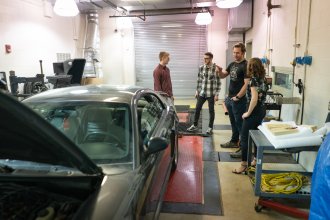
The Automotive Systems Lab is committed to educating a new generation of engineers on a platform that integrates theoretical knowledge and practical experience by supporting:
- Undergraduate laboratory courses
- Extracurricular, automotive-focused activities
- Graduate student learning