

Accounting for major-league success: Two-time World Series champion David Dombrowski reflects on his time at Western

KALAMAZOO, Mich.—There’s an old adage that “statistics are the food of love, the music of the spheres, the very breath of life to the true baseball fan.”
It’s a line that speaks to the divine harmony of the baseball diamond, highlighting the interconnectivity of America’s pastime and numbers. It’s also a direct representation of what’s made David Dombrowski, BBA ’79, so successful throughout his baseball life.
When Dombrowski was a 21-year-old senior studying accounting at Western, he needed to complete a thesis project in order to graduate. But Dombrowski didn’t write about fiscal reporting, revenue recognition or the matching principle—he wrote about baseball.
“They granted unusual permission: They let me write my paper on the [Major League Baseball] general manager,” Dombrowski says.
The end result was “The General Manager: ‘The Man in the Middle,’” a 63-page thesis tracing the history of the position while also forecasting the future of the sport. The paper culminates with a few prescient points about international diplomacy in baseball, concluding with “No matter where baseball does go, one can be sure the General Manager will be there, in the middle of everything.”
Roughly a decade after Dombrowski typed that line, punctuating the end of his college career, it was he who found himself in the middle of everything, serving as the general manager of the Montreal Expos. At 31 years old, he was the youngest person to ascend to the role in baseball history.
In 10 years, he’d gone from writing a WMU honors thesis about his dream job to living it.
Baseball and business school
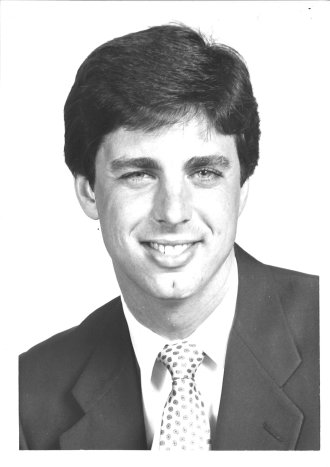
As far back as Dombrowski can remember, he always wanted to be a baseball general manager.
“When you’re in eighth grade and people say they want to be doctor, lawyer, dentist, I said I wanted to be a general manager of a Major League Baseball team,” Dombrowski recalls.
After a year spent playing football at Cornell, Dombrowski, who had Midwestern roots, sought an education closer to home, at an institution that had a high-quality baseball program. Western checked both boxes.
Dombrowski arrived on campus without the benefit of knowing any other Broncos, but that didn’t last long as he quickly became chummy with his Ellsworth Hall classmates.
“We were like anybody else: On a snow day in January, you’d spend the day at home and play cards with your roommates,” Dombrowski says of the friendships forged. “We attended football games, basketball games, hockey games—some of the best memories of my life, from a friendship perspective.”
With a good group of guys and a satisfying social calendar, Dombrowski committed himself to his studies, majoring in accounting. Not long after came a fortuitous invitation and acceptance into Western’s honors college, which put Dombrowski on the path to greatness.
Home run research
The senior thesis is a time-honored tradition in the Lee Honors College. What was unique about Dombrowski’s thesis work is that it was slightly left of center field with regard to subject matter: Instead of accounting, Dombrowski opted to focus on baseball.
With Dr. Bruce Kemelgor, management faculty member, and David Rozelle, professor of accountancy, as advisors, Dombrowski pored over texts, absorbing the history of the game much like the dirt on a ballfield absorbs April showers. He sent questionnaires to each team, requesting details on their day-to-day business operations. Half responded.
“The thesis was key for me getting into baseball,” Dombrowski says. “It made me explore my thought process—what would you really like to do? I’d always been interested not only in baseball but the transactions, the trading, the general manager role.”
In a clever bit of networking, Dombrowski asked two pointed questions near the end of his survey.
“One question I asked was whether I could follow up with them in the future. Another was ‘How would you recommend getting into professional baseball?’”
Those final two questions led to Dombrowski’s being offered a position with the Chicago White Sox 12 credits shy of his degree, but faculty flexibility at Western allowed him to finish his classes from afar and graduate while he worked in the game he loved most.
Of that professorial support, Dombrowski says, “They were very understanding that the reason you go to college is to get into this area you want to participate or be involved in.”
For the love of the game
Dombrowski’s career began in his hometown of Chicago. Working under the tutelage of baseball greats Bill Veeck, Roland Hemond and Larry Doby, he put his accounting degree to work immediately, seizing a rare opportunity for someone in the early innings of their career.
“They asked me if I could put together a budget,” Dombrowski says. “What happened is I put together a budget for the whole baseball operation. I’m talking big-league expenditures in every regard, from player salaries to front-office salaries to scouts, all their expenses, team travel, meal money, entertainment.”
At 22, Dombrowski, mere months out of college, was managing the entire budget of a Major League Baseball team. “I ended up in a position where I learned about everything, because if you know what’s going into a budget—all the expenses—you’re aware of everything that took place,” he says.
Dombrowski’s time on the South Side of Chicago proved foundational to his career. He rose up the ranks to assistant general manager, and from there, he transitioned to the Montreal Expos, now the Washington Nationals, where he was promoted to general manager in less than a year—his lifelong dream realized.
Montreal gave way to Miami, where his signing of key free agents powered the Marlins to a World Series title in their fifth season of play. After that, Dombrowski accepted a role with the Detroit Tigers, transforming the team from one of the worst in league history to a perennial playoff contender that made two World Series appearances.
From Detroit he went to Boston, where winning was an expectation. In 2018, Dombrowski delivered, leading the Red Sox to a World Series win—his second.
Reflecting on those World Series wins, Dombrowski says, “From a professional perspective, it’s the best feeling you could possibly have. It’s the ultimate moment. It’s so hard to win—my heart has been broken many more times than I’ve won—but that makes it more rewarding.”
Since 2021, he’s successfully served as president of baseball operations for the Philadelphia Phillies, who have made the playoffs the past four seasons.
For Dombrowski, who will one day be enshrined among the greats at the Baseball Hall of Fame, success boils down to a great love of baseball and numbers.
“I understood the financial aspect of the game, and eventually it led me to also be club president and general manager—managing the business side of things,” Dombrowski says. “I wasn’t overwhelmed at all by expenses and the dollar amounts. For me, it was very simple, and that was based upon my education at Western Michigan.”
For more WMU news, arts and events, visit WMU News online.