

Doctoral candidate charts course for success in world-class sailing win
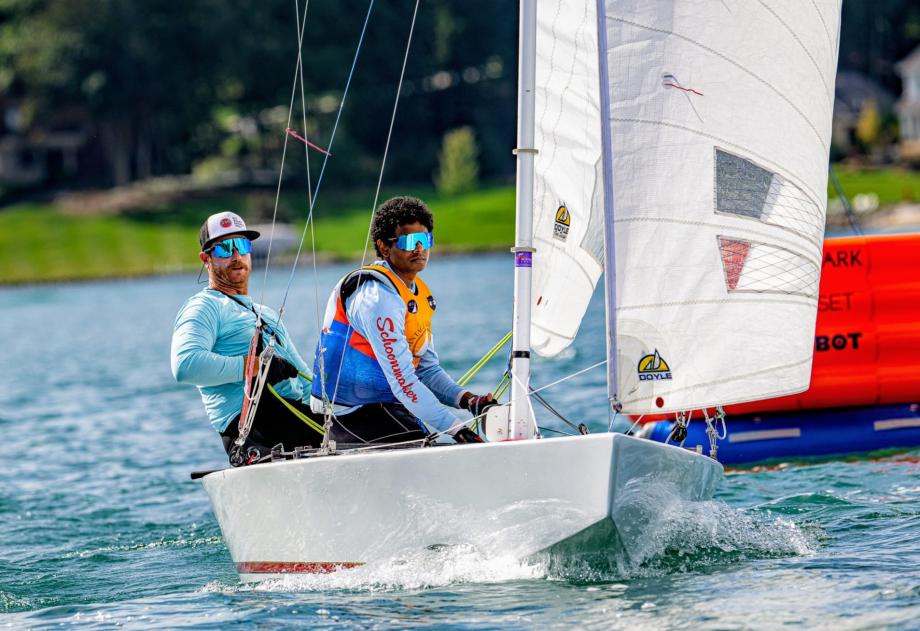
KALAMAZOO, Mich.—Saying the sky’s the limit for Mohammed Asif, a mechanical engineering doctoral student at Western Michigan University studying space propulsion, would be an understatement. He sees nothing but possibility as he charts his course for success—both in the lab and on the open water. A former Olympic-track sailor, Asif recently became a world class sailing champion at the 2025 Vintage Gold Cup, besting elite and Olympic sailors from around the globe.
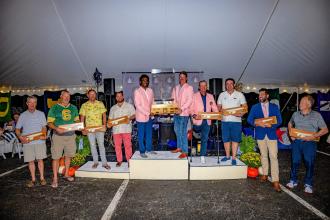
“I feel deeply honored to have won against some of the best sailors on the planet,” Asif says. “It brings me great joy and a sense of responsibility to those who are still pursuing their own dreams to show that perseverance and belief can take you anywhere.”
The event, held Oct. 1-4 at Gull Lake Yacht Club in Richland, comprised multiple races that challenged sailors to navigate vintage wooden Star Class boats into the wind, around a mark and then back to the finish line. Points were awarded cumulatively based on each race finish, with the goal of having the lowest total score.
“When I think about what made this sailing win possible, it wasn’t just skill — it was about making sure every little piece fit and worked together in harmony,” says Asif, who alongside sailing partner Luke Lawrence battled challenging conditions to edge out two-time Brazilian Olympic bronze medalist Lars Grael’s team to take the top spot overall.
“We checked every line on the boat to ensure nothing would fail under pressure, chose the optimal sails and gear, refined our strategy and learned to move in sync with one another. It was a constant process of adjustment and trust, of bringing all the details together to perform as one.”
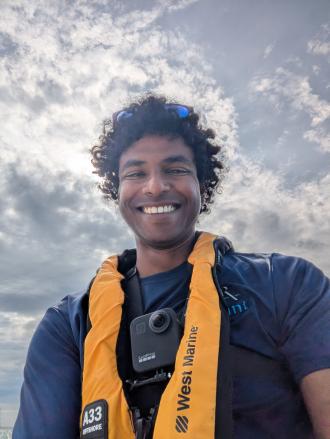
Not bad for someone who hadn’t even planned to participate in the race because he was focused on finishing his dissertation at Western on microwave-frequency ion thrusters for space vehicles.
“Luke called me about a week before the event and asked if I’d be around,” Asif recalls. “I thought he just needed a hand getting the boat ready, but then he said, ‘No, I need you to sail with me. The conditions are good for us to be competitive.’”
The duo only practiced a couple of times, but their long-standing friendship and history on the water proved a winning combination.
“To be the first Indian to do so at a major international championship—and the first active university student and Ph.D. candidate to achieve it—is both humbling and motivating,” says Asif, acknowledging the impact of his mother, who raised him by herself, on his journey. “None of it would have been possible without my mother’s strength and the values she instilled in me.”
Learning the ropes
A late bloomer in terms of sailing, Asif first fell in love with the sport as a teenager in his hometown of Chennai in southern India. A friend’s father offered to take him out on a ride, and he was hooked. Soon after, he joined the youth racing team at the Royal Madras Yacht Club.
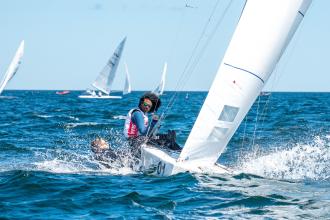
“India was working to break through to the Olympics in sailing, so we brought in an Olympic coach for the program,” Asif remembers. “I was part of the Olympic roster for a while, but once the campaign started, I had to make a choice: either graduate school or sailing. They’re equally competitive and highly demanding, and both are things I love doing.”
Unwilling to give up on his passion for rocket science and his vision for space exploration, Asif put his sailing career on pause to pursue his dream of advancing space propulsion technology. His search for the right opportunity took him across the world, and he built connections and collaborated with researchers in Italy, Germany, France, Japan, the United States and the Netherlands.
After earning a master’s degree in aerospace engineering from Penn State University, he connected with Dr. Kristina Lemmer, professor of mechanical and aerospace engineering at Western, to explore continuing his research in her Aerospace Laboratory for Plasma Experiments.
Asif arrived at WMU with a clear concept for his own doctoral research project—a vision that would take shape even more through the collaboration and mentorship he found on campus.
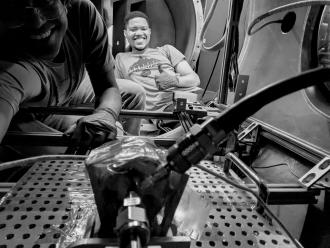
“WMU is where I’ve grown the most, not just as a researcher but as a person,” he says. “Professor Lemmer helped me begin my Ph.D. journey and gave me access to her lab to move my research forward. Professor [Muralidhar] Ghantasala helped me develop as a researcher and believed in my ability to finish what I started—in research, leadership and life.”
Over the last five years, Asif has worked on developing multiple miniature ion thrusters, and he is now focused on assessing their operational life as he prepares to complete his Ph.D. His research has involved collaboration with scientists and institutions around the world.
Finding balance
From designing and refining experiments in the lab to presenting his findings at international conferences, Asif has remained laser-focused on pushing the boundaries of his field from the moment he stepped onto campus. But he also realized early on that in order to thrive in his studies, he needed an outlet to stay grounded. After long hours in the lab, he found balance in the water.
“When you’re out on the water, you can’t afford to think about your Ph.D.” says Asif, who joined the WMU Club Sailing team in 2021. “I’m consistently having to look outside to see where the pressure is coming, what the clouds are doing, what my boat is doing, what other boats are doing, where the waves are, what the current is. All that focus goes into that, and I can completely let go of all my stresses outside.”
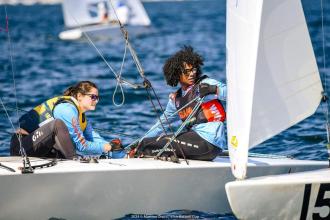
Being in the club also gave him an opportunity to mentor younger sailors and illuminated a passion for giving back and advocating for fellow students that led to a leadership role in the Graduate Student Association, where Asif became president. Through the organization, he worked closely with the WMU President’s Cabinet and sharpened his skills in management, collaboration and communication.
“It really helped me understand how the University works, how the student side works, how the management side works and what needs to happen to make this big entity function,” Asif says. “And that can translate into engineering design as well.”
Asif can identify another through line in his experience at WMU as well.
“I’ve had to learn how to learn, how to understand people, and how to bring together all the moving parts of research and life to reach the finish line,” he says. “The more I think about it, the more I realize that is the true heart of Western: all the little pieces and all the people that make this big engine of ideas and discovery work. That same idea carries through everything I do—whether in sailing, research or life.”
For more WMU news, arts and events, visit WMU News online.