
New geological repository expands essential geoscience research capabilities at WMU
KALAMAZOO, Mich.—From exploring carbon capture to identifying climate-related erosion risks to locating rare earth minerals, researchers are just scratching the surface of Michigan’s capacity for geological innovation. A new facility will position the Michigan Geological Survey (MGS) at Western Michigan University at the forefront.
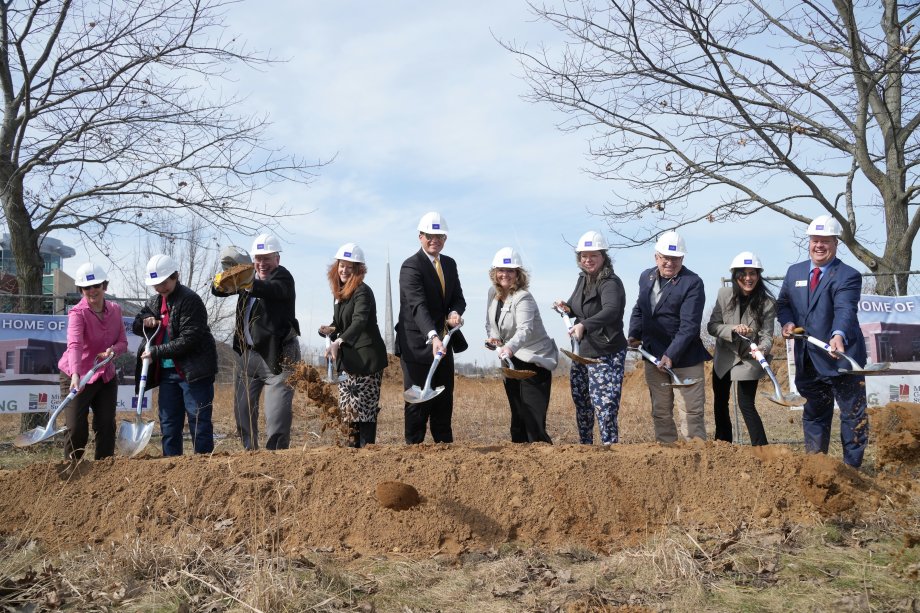
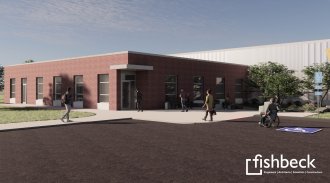
WMU and MGS today broke ground on a 20,000-square-foot building on the WMU Parkview Campus that will become the new home of the Michigan Geological Repository for Research and Education (MGRRE). The repository, currently in a leased building off campus, houses the largest collection of geological samples and data in the state—including approximately 600,000 linear feet of rock and mineral core.
“The facility is important because it preserves geologic materials collected over the past century from a wide range of projects and investigations, with examples ranging from oil and gas exploration to MDOT geotechnical work for road and bridge construction,” says Sara Pearson, director of the Michigan Geological Survey. “These materials can now be used to answer new questions about the subsurface and its resources without the added cost of redrilling, unlocking existing information in ways that advance research, resource management and economic development.”
“It feels incredible to see this project come to fruition!” adds Dr. Autumn Haagsma, MGRRE director. “MGRRE is far more than a data repository; it is a hub of geologic expertise. Our team provides essential knowledge across energy, critical minerals, water, natural resources, mapping and responsible management of the subsurface through the surface.”
Investing in innovation
The $8 million project is supported by $6 million in state funding: $3 million secured by state Sen. Sean McCann through the Higher Education and University budget and $3 million secured by former state Rep. Rachel Hood through the Michigan Department of Environment, Great Lakes and Energy budget.
“Western is thrilled to break ground on the new home for the Michigan Geological Repository for Research and Education, a state-of-the-art facility that will strengthen Michigan’s understanding and management of its natural resources, groundwater and geological risks,” says WMU President Russ Kavalhuna. “Thanks to the support and advocacy of multiple state agencies, this project places WMU at the forefront of delivering the science and research that can move Michigan forward.”
Expected to be completed by the end of the year, the facility will have ample storage space with a high-tech mobile racking system to expand storage capacity, a viewing room and dedicated lab space—something the current location lacks.
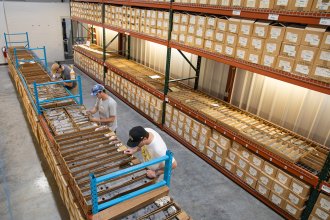
“We continually acquire new samples, and there are materials stored in other states that we hope to bring back to Michigan,” says Haagsma. “Additionally, the new laboratory spaces enable us to broaden our analytical capabilities, supporting a wide range of research applications across the geosciences.”
This new location also makes all of the resources of MGS more accessible to students and potential collaborators within WMU’s College of Engineering and Applied Sciences and Business Technology and Research Park.
Supporting Experience-Driven Learning
MGRRE is more than a learning resource for students; it’s a place where they can dig into important geological research and have a real impact in the field.
“MGRRE provides hands-on learning opportunities where students engage directly with Michigan’s rocks, samples and geologic data,” says Haagsma. “By working with real datasets and real geologic challenges, students gain the skills and confidence they need to excel in a wide range of geoscience careers—giving them a meaningful advantage as they enter the workforce.”
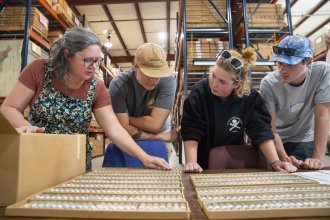
Students are currently working with Haagsma on a project involving carbon capture, utilization and storage (CCUS), with a focus on reducing risks by determining whether rock and mineral layers are able to seal carbon dioxide underground.
“Working with MGRRE has given me a lot of time and practice developing my skills as a geoscientist, team member and communicator,” says Moira Burns, B.S.’24, a geoscience master’s student who has presented CCUS research alongside fellow WMU students at national conferences.
Other projects involve locating critical minerals as well as responding to Gov. Gretchen Whitmer’s call to advance hydrogen power- related research in the state.
“People don’t realize how important geology is,” says Ashley Scott, a doctoral candidate in geology and senior geoscience specialist with MGS. “So many of the things we use in our everyday lives is mined. Your camera and phone have critical minerals in them. The car you drive uses petroleum gasoline. A geologist helped find the water that you use to make your coffee. All of the soil that our food is planted in—it all has some background in geology. It’s about so much more than just looking at rocks!”
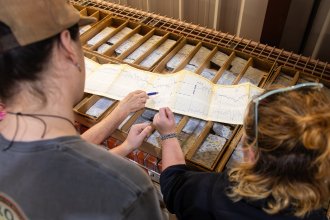
MGS regularly hosts courses for WMU and other universities, offers workshops and training sessions, supports student research and employment, and runs summer internship programs at MGRRE. The new facility could open the door to even more collaborations.
“This milestone would not be possible without decades of hard work by William and Linda Harrison, our former MGS Director John Yellich, and our dedicated industry partners,” Haagsma says. “MGRRE’s value as a statewide and national resource is built on the generous contributions of materials from industry, state agencies and private donors. Their support has made MGRRE what it is today.”
Burns says MGRRE has also made her the scientist she is today.
“It’s only because of MGRRE’s continuous support and opportunities that I’ve been able to continue my education and research,” she says. “I can’t thank MGRRE enough for what it’s done for me in my career.”
For more WMU news, arts and events, visit WMU News online.