Earth Day marks grand opening of new, dedicated space for WMU’s IDEAS Collaboratory
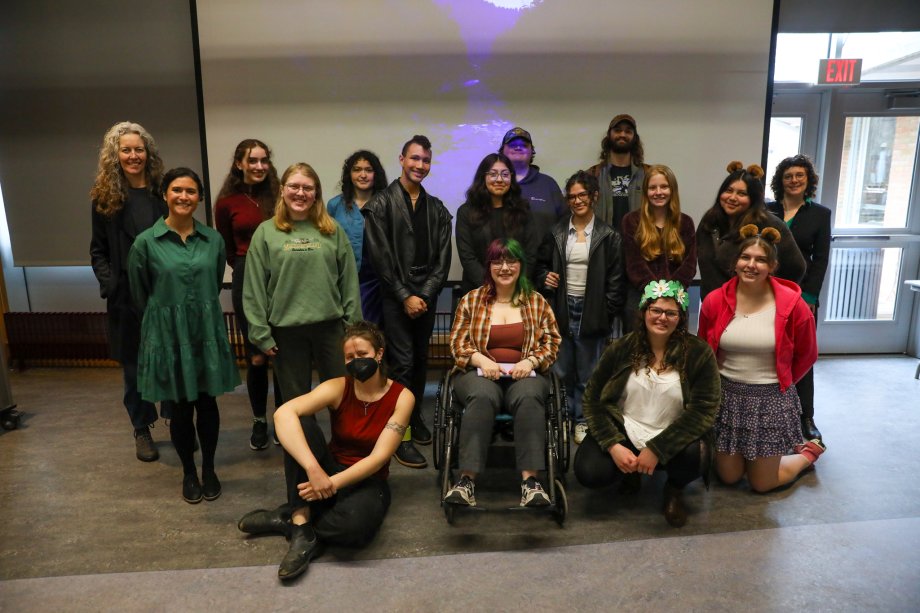
KALAMAZOO, Mich.—An interactive student art exhibition will officially mark the opening of a new space for collaborative work on Western Michigan University’s campus. The Interdisciplinary Experimentations in Art and Science Collaboration Laboratory (IDEAS Collaboratory) invites the public to its grand opening in 2402 Haenicke Hall on Wednesday, April 22, from 2 to 5 p.m.
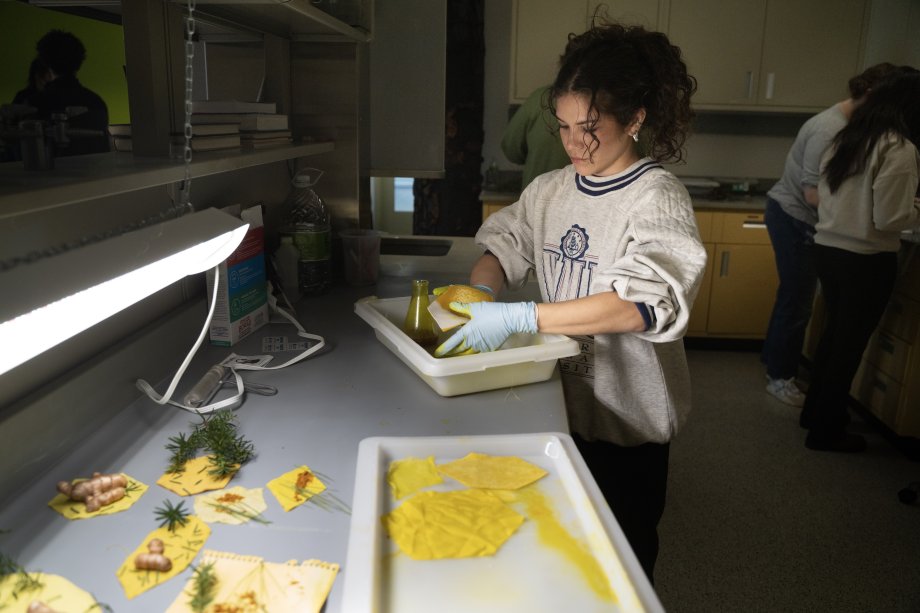
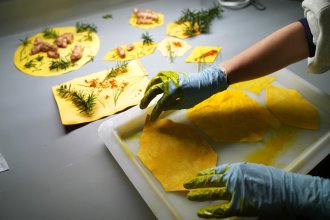
The exhibition, which coincides with Earth Day, focuses on the impact of plastics on the planet and is a collaborative project completed by the entire spring 2026 IDEAS Collaboratory cohort using various techniques they learned over the semester—from root casting and working with organic materials to performance.
“It will include some interactive installation and digital storytelling and calls to action,” says Jacklyn Brickman, assistant professor and co-area coordinator of kinetic imaging.
Antonia Kistler Ellis, who is a double major in exercise science and sculpture, hopes visitors will see the harm plastics have done to the environment and human bodies and be inspired to act.
“I hope they see the importance of individual change,” says Kistler Ellis. “I hope they are inspired to work together with their communities, to make a change, and not just wishing or hoping someone else will do it.”
Bridging the gap between art and science
Supported by two Experience-Driven Learning Venture Grants, the IDEAS Collaboratory was created in 2024 by Brickman and Dr. Sharon Gill, professor of biological sciences. They envisioned a course that would immerse students simultaneously in art and science to foster innovative thinking and professional growth.
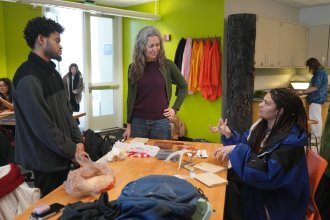
“Thinking about solutions to problems does not depend on only one of us or one type of us; it depends on all of us working together and being creative,” says Gill.
Work in the IDEAS Collaboratory is rooted in nature, drawing on environmental elements to bring science and art together. Students create ecological art based on the Anthropocene, the era of human impact on the planet’s species and ecosystems.
“Recognizing that we’re all answering and asking the same questions—What does it look like for climate change and biodiversity loss? How do we solve these things? We need to all come together to be able to do that,” says Gill. “Our class gives a framework.”
The first phase of the IDEAS Collaboratory unfolded in fall 2024 with 11 students in a shared classroom space on campus. Phase two, which included a cohort of 17 students and a teaching assistant in spring 2026, focused on expanding teaching opportunities through this new dedicated space, which includes a laboratory, a studio, a computer with animation software and more room to bring in guest speakers.
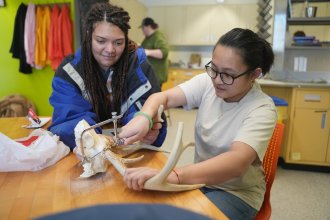
“We did a lot of growing in this space this semester,” says Brickman. “It’s really wonderful to see how it expands students’ experiences, and from my perspective, they’re thriving. It’s been very exciting.”
The venture grant also helped expand learning opportunities for students through field experiences at partner locations like the Kalamazoo Nature Center as well as trips to professional conferences.
Students appreciate the experiential nature of the class.
“I’m a kinesthetic learner all the way, so I thrive being able to learn with practice—it integrates knowledge and what I learn so much deeper than just reading,” says Kistler Ellis.
Encouraging holistic development
Students in the latest cohort comprise a wide range of majors, from biology and biomedical sciences to kinetic imaging and art. They completed a series of collaborative projects involving topics such as nuclear power, consumerism, invasive plants and accessibility.
Gill says the strength of the IDEAS Collaboratory is it encourages students to think differently and work with peers whom they may not have otherwise encountered in their own academic program.
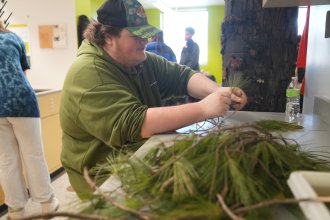
“Taking the risk and doing something that’s hard is where growth happens,” says Gill. “The important piece is that it feels risky, but we’re here to support students all the way through.”
“That’s the importance of practice,” adds Brickman, “because then when you do go out into the world and have to do something, you’re already comfortable with that and confident.”
Students who have taken the course say it has transformed how they think.
“It totally changed my career trajectory, because I’m exploring my scientific research and science concepts in art in a way that I never would have before,” says Lisa Trapp, a master’s student studying biological sciences, who was part of the inaugural IDEAS Collaboratory cohort and is now the teaching assistant for the second cohort.
Trapp came to Western to study with Gill after managing a nature center for several years.
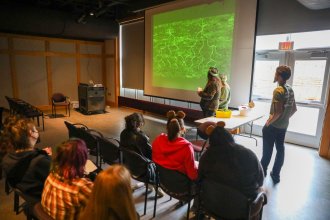
“One of the things that I really wanted to keep exploring was ways to bring the arts into that space,” she says. “After taking this class, I really learned how to speak the language of art and connect with people in the industry. And it also really changed how I approach my research and how comfortable I feel thinking holistically about ecological concepts.”
Riley O’Rourke, a biology major, says the course taught her the importance of collaboration—something she’ll draw on as she prepares for a career in conservation biology.
“It’s impacted my future plans in a good way,” she says. “It’s opened my mind back up to creative practices and helped me grow into someone who includes creativity rather than shutting it down in the name of being scientific.”
“I think what we don’t talk about enough is the bridge between subjects that are traditionally thought of separately,” Kistler Ellis adds. “I think it’s really important always, but especially nowadays, that we have more communication with each other and more connection with each other in order to change our pathway.”
For more WMU news, arts and events, visit WMU News online.