

All systems go: Aerospace engineering student launches work into space
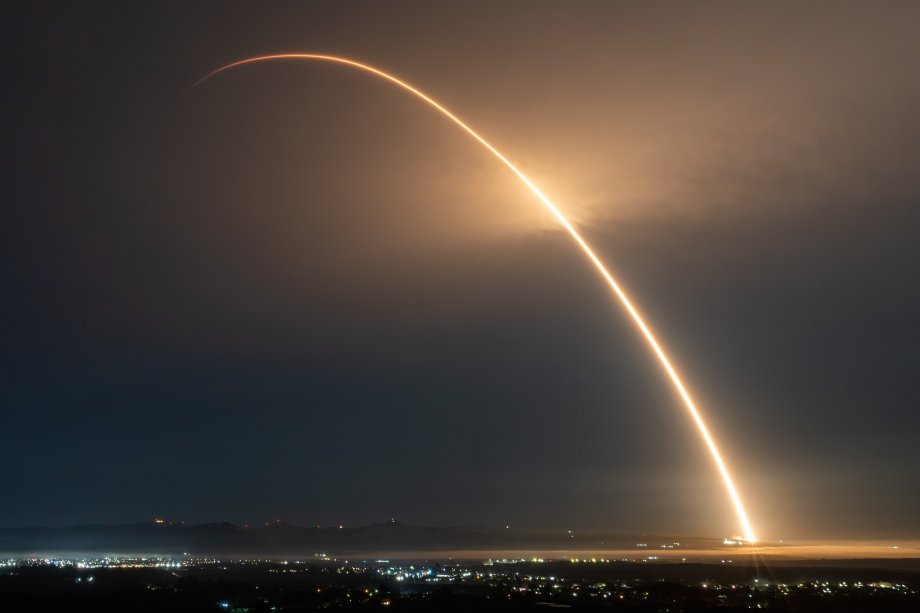
KALAMAZOO, Mich.—As a bright streak of light split the early morning sky over Vandenberg Space Force Base in California, Tom Scott, B.S.E.’25, M.S.’26, watched his graduate studies literally flash before his eyes.
“It was almost surreal. It was pitch black and then all of a sudden, like a flash of lightning, everything lit up,” he says.
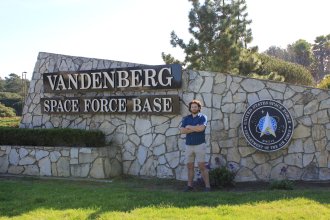
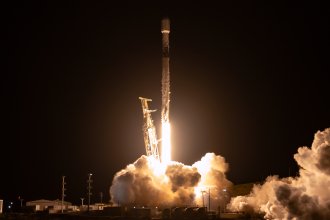
The aerospace engineering master’s student followed the glowing arch of the SpaceX Falcon 9 rocket on March 30 as it carried Transporter-16—with his payload, the Western Aerospace Thin-Sat, on board—into the ionosphere. Scott’s research now rests in low Earth orbit, where no Bronco satellite has gone before.
“This is the first Western satellite in space,” says Dr. Kristina Lemmer, professor of mechanical and aerospace engineering. “I’m really excited and proud of the students who worked on this, and especially Tom for going the extra mile and seeing it through to fruition. To have something of ours actually in space is so exciting!”
For Scott, the launch was a childhood dream become reality.
“Experiencing the launch alongside other engineers seeing their work go to space for the first time was unforgettable,” he says. “Growing up, I always read about planets and solar systems and astrophysics and things like that. I think all of that led me here.”
The mission
The launch was nearly two years in the making for Scott and other students from the Western Aerospace Launch Initiative (WALI) who helped him along the way.
In 2024, Western was among six universities selected to participate in NearSpace Education’s Dream Big Mission, supported by NearSpace Launch, NASA and Firefly. The program charged students with designing a Thin-Sat payload to hitch a ride on a SpaceX rocket.
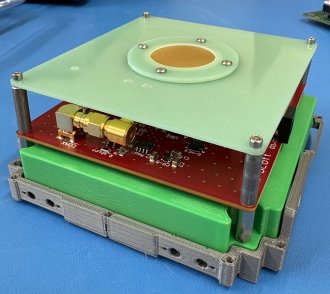
Lemmer approached members of WALI with the opportunity, and Scott, who was in his final semester as an undergraduate and the structures lead for WALI at the time, jumped at the chance to make it his senior design project. Alongside three other students, he got to work designing instrumentation to test viability of electrospray propulsion in space.
“When they’re operating in space, spacecraft can charge to different voltages because of the plasma, which can damage onboard electronics,” Lemmer explains.
The probe the students developed measures both spacecraft charge and plasma density in the ionosphere. They tested its viability with high-altitude balloon launches that sent the technology nearly 100,000 feet into the air.
By the time the students graduated, they’d made progress on the project, but it was still far from finished. Because Scott chose to stay at Western and pursue an accelerated master’s degree in aerospace engineering, he was able to continue with the project, recruiting students such as Brian Packard, a computer science major, to teach him computer programming and other skills he’d need in order to complete the work.
“I had never used Python, the programming language, but I had to figure out how to program the payload to collect the information we needed,” says Scott. “Without Brian’s help, I’m not sure that ever would have happened.”
The experience was a win-win: It bolstered the WALI research and reinforced Scott’s resume.
“This project required so many different skill sets and gave me a greater understanding of how systems come together,” he says. “I designed a printed circuit board and learned new software. And I grew as a professional by presenting at conferences and networking.”
Scott graduated with a master’s in aerospace engineering on May 2, so it will now be up to other students to carry on his work. With the payload now operational in space, they can collect data and measure it over time.
“This project will keep excitement going for the students as we look toward the next opportunity to send payloads to space,” Lemmer says.
Meanwhile, Scott is leaving Western on a high note, excited to help take the University’s aerospace program to the next frontier.
“It’s a great feeling to see something I worked on for so long and spent so many hours with actually go into space,” he says. “There were several roadblocks along the way, but I’m just so proud it finally happened.”
For more WMU news, arts and events, visit WMU News online.