Job outlook
98%
of College of Health and Human Services graduates working full time have a job related to their degree
98%
of College of Health and Human Services undergraduate students had instructors who made them excited about learning
95%
of College of Health and Human Services graduates participated in experience-driven learning
Pursue a B.S. in Health Administration
The Bachelor of Science in Health Administration at Western Michigan University prepares students to lead and manage healthcare organizations through coursework in health systems, policy, finance and operations. Students build skills in problem-solving, communication and ethical decision-making, with a focus on improving quality, efficiency and patient outcomes. The program includes applied learning opportunities, such as internships and project-based experiences with healthcare partners. Graduates are prepared to analyze organizational challenges, support teams and improve processes across a range of healthcare settings. With this degree, students are ready for entry-level roles in hospitals, clinics, public health agencies and nonprofit organizations, or for continued graduate study.
What you'll learn
Students in the Bachelor of Science in Health Administration at Western Michigan University engage in applied coursework that includes a supervised internship. These opportunities allow students to work with healthcare organizations and apply classroom knowledge to real operational challenges. Throughout the program, students develop skills in data analysis, healthcare operations, leadership, communication and regulatory compliance. Graduates leave with practical experience and a strong understanding of how to improve organizational effectiveness and patient-centered care.
Block Quote
One of the most valuable connections I made between my coursework and my internship was through my biostatistics class. Being able to interpret patterns, identify gaps, and translate numbers into meaningful insights helped me see how data-driven approaches can directly impact patient engagement and healthcare outcomes.
Where you'll be after graduation
A bachelor's degree in health administration opens doors to many career opportunities in hospitals, medical practices and community health programs. Graduates help support the day-to-day operations that keep healthcare organizations running smoothly. This degree provides a strong foundation for those interested in contributing to the business and administrative side of healthcare.
Recent graduates from the health administration program have these titles:
- Office coordinator
- Healthcare administrator
- Hospital department manager
- Clinic operations assistant
- Administrative assistant
What others have achieved
What others have achieved
Every student in our health administration program completes a real-world internship in a healthcare setting. After building a strong foundation through hands-on coursework, you'll step into your internship ready to put your knowledge to work in hospitals, clinics and health organizations. It's the kind of experience that boosts your confidence, sharpens your skills and helps you stand out as you launch your career.
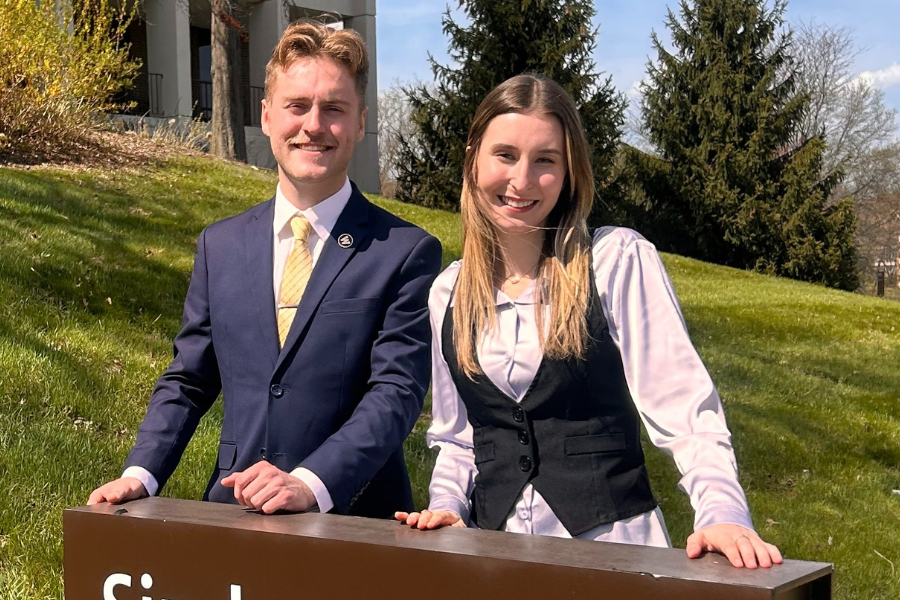
Clay Linson and Olivia Naas
Clay Linson and Olivia Naas, both graduates of health administration program in the College of Health and Human Services at Western Michigan University, completed their internships at WMU’s Sindecuse Health Center.
Making the most of your learning experience

What scholarships are available for the Bachelor of Science in Health Administration?
Additional admission requirements
Admission to the program occurs when students who have previously been admitted to WMU, have a minimum of a 2.00 GPA and are not on academic probation select Health Administration as their major. Students must raise their GPAs to 2.50 or higher before taking the required internship course.
Students must obtain at least a “C” in all HA core major courses. In accordance with University policy, students may repeat courses to obtain the required grade of “C”.
Students must have a minimum of a 2.50 cumulative GPA when applying for the required internship course. Those who do not have a 2.50 cumulative GPA in the semester before their internship course may take one additional semester to raise their cumulative GPA to a 2.50 or higher. If after this additional semester they do not meet the 2.50 cumulative GPA requirement, they will be dismissed from the program.