Pride Points
100%
of civil and construction engineering graduates working full time are satisfied with their job
$70K to $80K
median starting salary for recent College of Engineering and Applied Sciences graduates working full time
100%
of civil and construction engineering graduates are working or continuing their education
Pursue a bachelor's degree in construction engineering
The construction engineering program is committed to preparing you to contribute to the global civil and construction engineering community. You'll be prepared for construction planning, management or development with technical, business and human relations knowledge and skills industry leaders seek.
Your skills will develop in the classroom and on residential and commercial construction job sites as part of coursework or internships, culminating in a Senior Engineering Design project where you'll team up with peers and industry to address a real-world project.
If you are thinking about graduate school, you can save time and money with our accelerated master's program.
By graduation, you'll be ready to take on the evolving challenges in the such industries as water resources and environment, transportation, construction, urban development and energy.
Working through the construction engineering program with my peers has been the best experience. We all help each other move toward graduation.
What you'll learn
As a construction engineering major, you'll study soil mechanics, fluid mechanics, engineering materials, construction codes, specifications, planning and contracts, structural analysis and design, planning and scheduling, and estimating, bidding and cost control.
Core courses
- Dynamics
- Civil Engineering Measurements
- Soil Mechanics
- Fluid Mechanics
- Ethics in Engineering and Technology
- Transportation Engineering
- Construction Codes, Specifications and Contracts
- Structural Analysis
- Traffic Design
Where you'll be after graduation
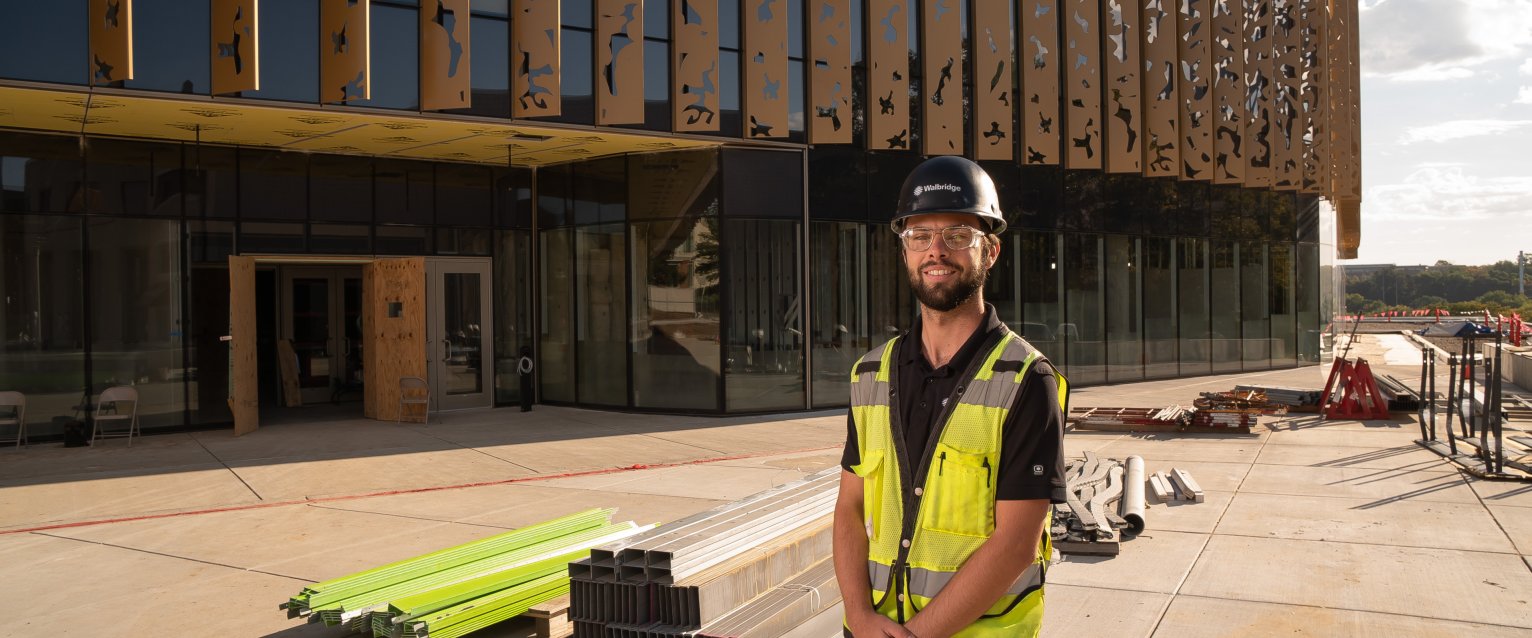
When you graduate from the construction engineering program, you'll be ready to take on a range of responsibilities as a construction engineer, project manager, project executive or structural engineer. Recent WMU graduates with degrees in construction engineering are working for companies including AECOM, CSM Group, Prein & Newhof, Siemens Logistics & Assembly Systems and Walbridge.
What others have achieved


Making the most of your learning
Professors and advisors will support your participation in real-world experiences that will set you apart when you launch your professional career. You'll make lifelong friends and apply your skills by joining student organizations such as Bronco Wind Team and Concrete Canoe Team. Internships and co-ops will all boost the knowledge you build in your coursework. Your time at Western culminates in a Senior Engineering Design project, where you will team you up with peers and industry to apply your knowledge to a real world project.
What scholarships are available to construction engineering students?
A number of scholarships are available for students enrolled in the construction engineering program at Western. We encourage you to apply for all scholarships that match your interests, career goals and financial or academic needs.