

From a ‘shot in the dark’ to a national honor: Inside one Bronco’s summer at SmithGroup

KALAMAZOO, Mich.—Abby Naugle almost didn’t apply.
The scholarship was national, the firm was one she had studied in class, and graduate students were in the same applicant pool competing for five spots in the entire country.
“I kind of thought it was a shot in the dark because it is so competitive,” says the interior architecture and design major of the SmithGroup scholarship and internship. “Just looking at the firm, I really have loved their work. I thought it was kind of aspirational to try it out.”
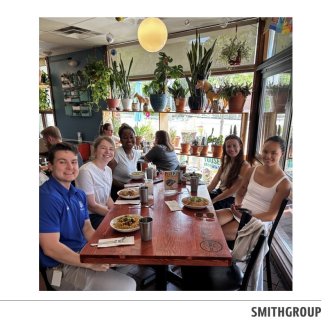
She applied anyway. Twelve weeks later, the Western Michigan University senior had worked on projects for Yale University, Google and the Arizona Cardinals, and had been named to Interior Design magazine’s 30/30 Class of 2026, an honor that goes to fewer than half a percent of the roughly 130,000 practicing interior designers in the United States. She is still an undergraduate.
Ready on day 1
Naugle, a senior in the interior architecture and design program in the Richmond Institute for Design and Innovation, arrived at SmithGroup’s Detroit office in May expecting to spend her first weeks catching up. She didn’t have to.
“I felt pretty prepared,” she says. “I think Western does a really good job of software comprehension. I’ve learned Revit on my own earlier, but being able to hit that in class and have the option to work in it has been really nice, because it’s just such a big standard.”
Revit is indeed the industry standard, and it is what SmithGroup builds its drawings in. Not everyone arrived knowing it.
“A couple of the other people from other schools had never learned it,” Naugle says.
The vocabulary was familiar, too, and so was the process. What was new was everything a classroom can’t simulate: firm drawing standards, real budgets and a client waiting on the other end of the work.
Four varied projects in one summer
Naugle came to SmithGroup through the firm’s Design a Better Future Scholarship, which pairs a $6,000 tuition award with a paid summer internship for five students nationally. She was the first interior design student the Detroit office had hosted through the program, which meant her summer was never confined to a single team.
She worked with the Detroit office, with Boston on Brigham and Women’s Hospital, and with Phoenix on the Arizona Cardinals facility while also contributing to a workplace design for Google in Huron, Michigan, and Yale’s master plan to convert hospital space into laboratories and offices.
The Yale project was broad. The team handed her a building and a question.
“We had basically been given the shell—just the center core of the building and the exterior walls—and then [we] played around with how many things we could fit in there and different layouts,” Naugle says.
She tested three ways to organize a workplace: a conventional corridor packed with private offices, a flexible plan built around shared enclaves and an open layout with almost no private offices at all.
The Cardinals training facility took most of her summer. SmithGroup had picked the project up from another firm midstream, so Naugle worked from an inherited plan, selected furniture and fixtures, built prototype office and classroom layouts, and produced interior render studies that went to the client and came back marked up. She also modeled the media building and designed a custom reception desk and millwork for the space.
A nomination she didn’t see coming

The firm was paying closer attention to her work than Naugle realized.
She was helping run a Bring Your Child to Work Day event when a colleague pulled her aside to tell her she had been nominated for Interior Design magazine’s 30/30 program, which recognizes designers under 30 who have already made a mark on the field.
Firms put forward two or three candidates, and Interior Design and SANDOW Design Group select each city’s class from that pool. Naugle made it.
SmithGroup hosted the Detroit 30/30 event in July. The class spent the afternoon in working sessions on mentorship, on presenting to clients, and on where design ideas actually come from. That last one resonated with Naugle.
“All of my ideas have come from dreams, weirdly,” she says. “I thought that was a super interesting thing that I learned a lot of other designers have as well.”
Looking forward to graduation
Naugle went into the internship thinking she knew her path. Healthcare was what she had done before, at a Kalamazoo firm, and she assumed it was where she would land. The summer told her otherwise, and workplace, hospitality and higher education are where she is headed now.
“I think a lot of people go into it feeling like it’s interior decorating, especially in the first year,” she says. “Understanding that we are able to do a lot more than just pick out materiality has been really important.”
She is spending her senior year on a thesis about how people move through space and why, and pursuing LEED Green Associate certification after seeing how many firms look for it.
“It’s a lot of work, but if you like it, it’s really rewarding,” she says. “I can sit myself at the computer for hours and stare at Revit or Photoshop and tweak deliverables. If it’s something you really enjoy, it’s definitely worth it to stick with.”
She has good things to say about the people the field attracts as well, at SmithGroup and at Western.
“Interior design draws certain types of people, and they’ve been very nice and open,” she says.
Learn about interior architecture and design at WMU.
For more WMU news, arts and events, visit WMU News online.