Job outlook
98%
of College of Health and Human Services graduates working full time have a job related to their degree
98%
of College of Health and Human Services undergraduate students had instructors who made them excited about learning
95%
of College of Health and Human Services graduates participated in experience-driven learning
Pursue a B.S. in Healthcare Services and Rehabilitation Sciences
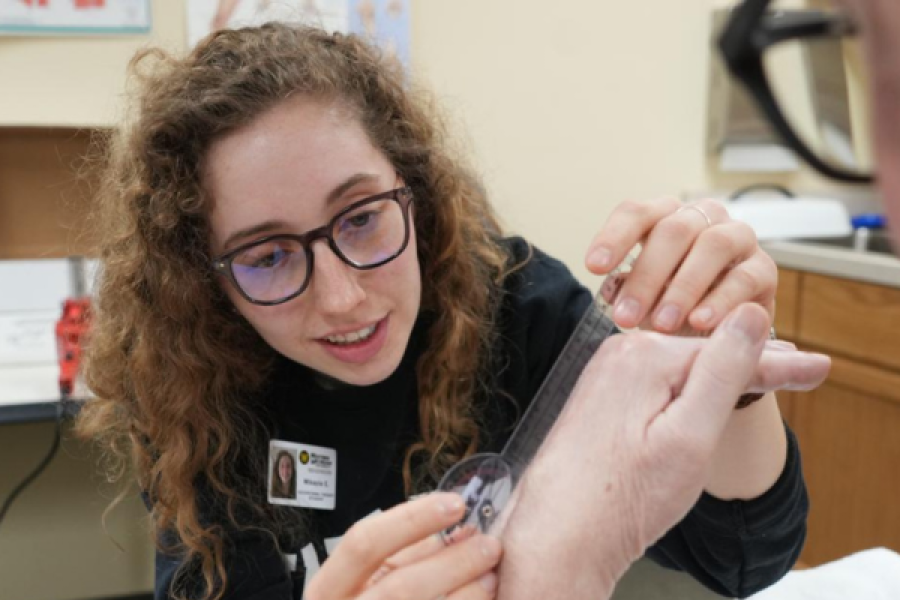
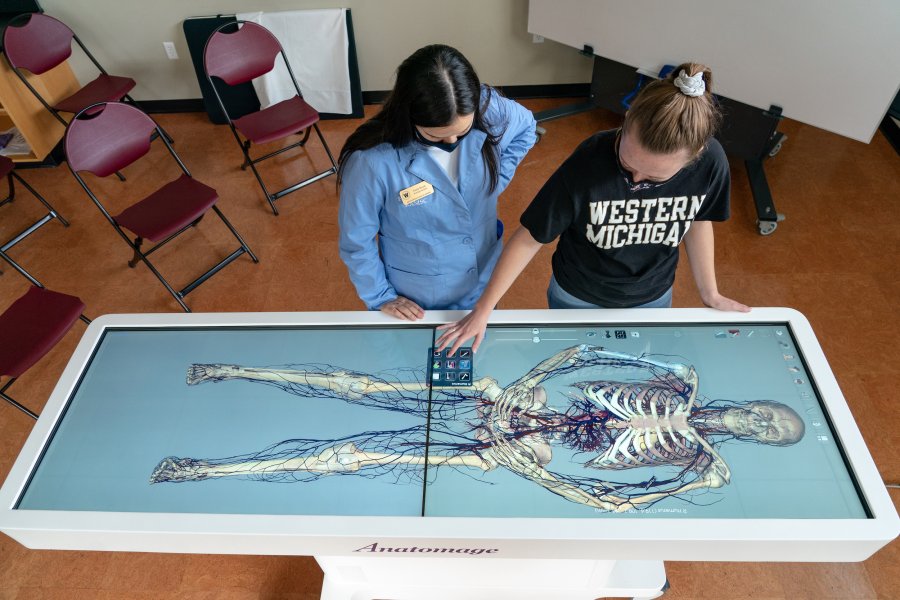
The Healthcare Services and Rehabilitation Sciences program is designed for students who plan to pursue graduate education in rehabilitation sciences and related healthcare fields. You'll complete coursework in anatomy, medical terminology, healthcare systems, health policy and research while developing critical thinking and communication skills. The curriculum provides flexibility to align your studies with your career goals and the prerequisites required by your preferred graduate program. Through classroom learning and applied experiences, you'll gain a deeper understanding of patient care, healthcare systems and evidence-based practice.
Occupational Therapy or Physical Therapy
Our curriculum provides a strong foundation to continue to graduate-level OT or PT programs to ultimately become a licensed therapist. In addition, this program offers you practical experience through an experience-driven learning internship, allowing you to apply your knowledge in real-world settings.
Blindness and Low Vision Studies
This course of study prepares you to apply to two of WMU's Blindness and Low Vision Studies accelerated graduate programs. Some of our courses can be accepted for credit in these graduate programs, reducing the number of graduate credit hours needed.
We’ll prepare you with the necessary biomedical background, plus we’ll help instill professionalism, communication skills, skills in using research to make decisions, and we’ll help you understand our rapidly changing health care systems and policies.
What you'll learn
You'll build a strong foundation in biomedical sciences, healthcare systems and rehabilitation-focused studies. Coursework explores healthcare management, health policy, diversity and inclusion, health literacy, legal issues and psychosocial aspects of health and healthcare. You'll also strengthen your ability to use research to guide decision-making, communicate effectively with diverse populations and understand the changing healthcare landscape. Elective coursework allows you to tailor your academic experience to support future graduate study and career goals.
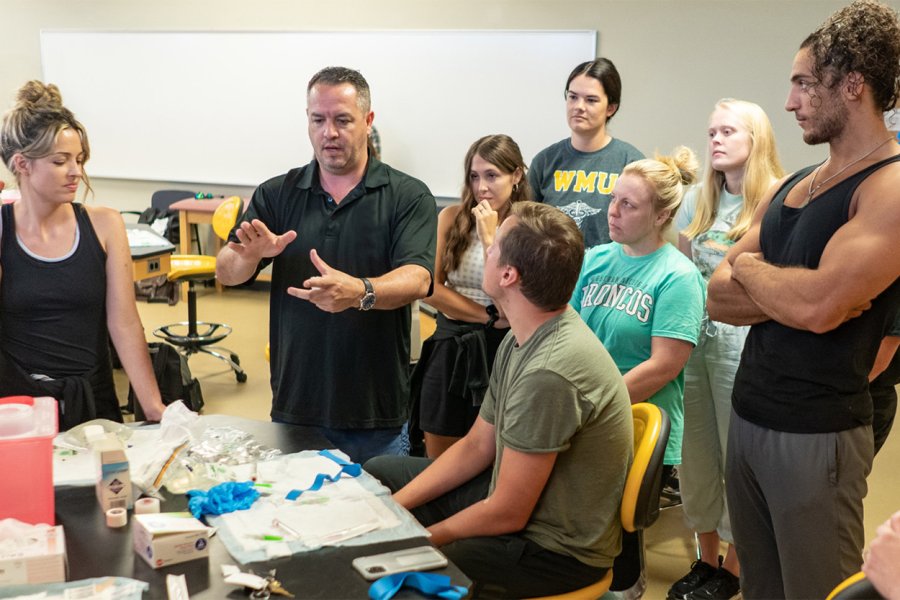
Test your skills while you're still learning through a capstone experience. You'll complete an internship, professional project or research project that you can add to your resume.
The professors and instructors I’ve had at CHHS have been the best and my favorites. They try to get to know you as both a student and a person, which is something I value. The instructors here have a “learning through doing” approach to their classes which I appreciate a lot.
Where you'll be after graduation
Many students continue into graduate programs in rehabilitation sciences and related healthcare professions. The program provides preparation for occupational therapy, physical therapy, blindness and low vision studies and other graduate healthcare programs. Graduates enter advanced study with a strong understanding of healthcare systems, research, professionalism and patient-centered care.
Career pathways
- Occupational Therapy (graduate education required)
- Physical Therapy (graduate education required)
- Blindness and Low Vision Studies
- Rehabilitation Services
- Community Health Programs
- Healthcare Support and Coordination
What others have achieved
What others have achieved
Making the most of your learning experience
Your learning extends beyond the classroom through a required capstone experience. You'll complete an internship, research project or professional project that allows you to apply your knowledge in real-world settings. These experiences help you build professional skills, strengthen your network and gain practical experience before graduate school or employment. Faculty advisors work closely with students to identify coursework and experiences that support individual career goals.
What scholarships are available for the Healthcare Services and Rehabilitation Sciences degree?
Western Michigan University offers a range of institutional scholarships and grants to help make a high-quality education affordable, including merit-based awards, need-based grants and departmental scholarships. Many students receive financial support—99% of full-time undergraduates with financial need receive aid—and scholarships and grants do not need to be repaid. The University’s financial aid team works closely with students and families to navigate options, from admissions scholarships like the Medallion program to funding identified through Scholarship Universe, WMU’s scholarship-matching tool. With personalized support, financial resources and a commitment to access, WMU helps students identify funding opportunities and manage the cost of their education.
Additional admission requirements
Students complete three required elements:
1) core courses;
2) specialized knowledge (electives); and
3) a capstone experience (internship) where students gain knowledge and experience to take their place as effective team members in today’s health services systems.
The HSRS major offers a special opportunity for students interested in blindness and low vision studies as it prepares students to apply to two of WMU’s Blindness and Low Vision Studies accelerated graduate programs. These are Orientation and Mobility for Adults and Vision Rehabilitation. The Healthcare Services and Rehabilitation Sciences major includes required prerequisites for the graduate program. Once accepted into the graduate program, some courses are utilized for both a BS-HSRS degree and a graduate degree. Interested students should consult WMU’s Graduate Catalog and, in their sophomore or early junior year, contact the department for details.
- The HSRS Core is comprised of the two sets of courses: the HSRS Core Major requirements and the HSS Core Cognate requirements. These courses provide an introduction of core competencies that are needed across health services disciplines including delivering patient and family centered care, working in interdisciplinary teams, evidence-based practice, health literacy practices, quality improvement, informatics, and ethical decision making. In addition, the HSS Core provides a more in-depth study of the organization and delivery of health services, safety practices, health disparities, diversity in delivering services, and health policy.
- Specialized knowledge obtained through completion of at least 15 hours of electives chosen with an advisor to prepare for application to graduate programs in rehabilitation sciences.
- A capstone experience (usually an internship) that pulls together skills obtained throughout the program and applies them to an internship placement, a professional project, or a research project. Please see more information at “Capstone Experience”.
Admission
Admission to the Healthcare Services and Rehabilitation Sciences major occurs when students, who have previously been admitted to WMU, select this as their major as long as the student has a 2.0 GPA and is not on academic probation. However, all students must raise their GPAs to 2.5 before taking the required capstone course.
Continuance and graduation policy
Students must obtain at least a “C” in all HSRS required core courses with the Health Services (HSV) designation. Students may repeat courses to obtain the required grade of “C”. Only two repeated HSV courses will count toward degree requirements. These two repeated courses may be the same course repeated twice or two separate courses repeated once each.
Students must have a 2.5 cumulative GPA when applying for the required capstone course. Those who do not have a 2.5 cumulative GPA in the semester before their capstone course may take one additional semester to raise their cumulative GPA to a 2.5 or better. If after this additional semester they do not meet the 2.5 cumulative GPA requirement they will be dismissed from the program.
Capstone Project (HSV 4895)
The capstone project provides students an opportunity to design and complete a project in health services. Only students who have completed at least one year of employment at a healthcare or health-related organization and have successfully applied for this option may select it. Students must complete a capstone experience application following the date guidelines for all capstone experiences. Students complete the project over one semester, typically the student’s final semester of his/her undergraduate career.
The capstone project requires students to conceive, plan, and implement a special project in an area within the scope of healthcare services and sciences. This is generally at their place of employment, but not always. Capstone projects may take many different forms. Some examples are: patient satisfaction surveys in an applied setting, a written health literacy project, analysis of a health informatics system, clinical review of a therapeutic intervention, implementation of a quality improvement project, development of a patient manual or an educational program.
Students will work under the supervision of a capstone project instructor. Enrollment in the capstone project course requires departmental approval from the internship coordinator. If you have at least one year of healthcare experience and desire to take the capstone project course, contact the internship coordinator for more information.
Students must have the minimum of a 2.5 GPA to enroll in HSV 4895 to complete a capstone project. If a student misses the minimum GPA the student will be given one semester to achieve the 2.5 GPA before taking the course. If the student is unable to achieve the 2.5 GPA in one semester the student will be dismissed from the program barring hardship circumstances. If hardship circumstances are present, the Program Director and the Director of the School of Interdisciplinary Health Programs will review the case.