Pride Points
100%
of electrical and computer engineering graduates working full time have a job related to their degree
$70K-$80K
median starting salary for recent College of Engineering and Applied Sciences graduates working full time
98%
of College of Engineering and Applied Sciences undergraduates participated in Experience-Driven Learning
Pursue your bachelor's degree in electrical engineering
Electrical engineers design, develop, test, operate and apply a wide range of electrical and electronic system components and concepts to real-world applications. In this program, you'll learn about electric power, circuits, digital logic, digital signal processing, electromagnetics, electronic components and devices, energy conversion, computers and microcomputers, communications, instrumentation and control systems.
When you graduate, you will readily find internships and full-time employment throughout the world—in fact 9 out 10 Broncos are employed quickly, working in their fields in jobs they like.
You will participate in hands-on projects with local industry and engage in research. With professors who are leaders in their fields and academic advisors who guide your progress, your time at WMU culminates in a Senior Engineering Design project where you will be part of a team completing a project for industry.
And if graduate school is in your future, you can save time and money with our accelerated master's in electrical engineering program.
The electrical engineering program has challenged me to think critically and solve problems in practical ways. The professors have been supportive, always willing to explain concepts, offer guidance, and share advice.
What you'll learn
As an electrical engineering student, you learn to design, develop, test, operate and apply a wide range of electrical and electronic system components and concepts to real-world applications. Your courses will stress hands-on experiences for solving complex problems and providing practical solutions.
You will have the opportunity to qualify for departmental scholarships and become a member of one of the College of Engineering and Applied Sciences student organizations. WMU's student branch of the Institute of Electrical and Electronics Engineers (IEEE) features guest speakers, technical films, industry trips and social gatherings.
Core courses
- Digital Logic
- Intro to Microprocessors
- Circuit Analysis
- Network Analysis
- Electromagnetic Fields
- Linear Systems
- Probabilistic Methods
- Electrical Machinery
- Senior Capstone Project
- Technical Communication
Where you'll be after graduation
Electrical engineers work in aerospace, automotive components, communication systems, defense systems, electric vehicles, healthcare, research and development and more.
Recent WMU graduates with degrees in electrical engineering are working in roles such as electrical engineer, programmer analyst, infotainment test engineer and product development engineer. They work in local and global companies including Black and Veatch, Eaton, Stryker, General Motors, Denso and Ford Motor Company.
What others have achieved


Making the most of your learning experience
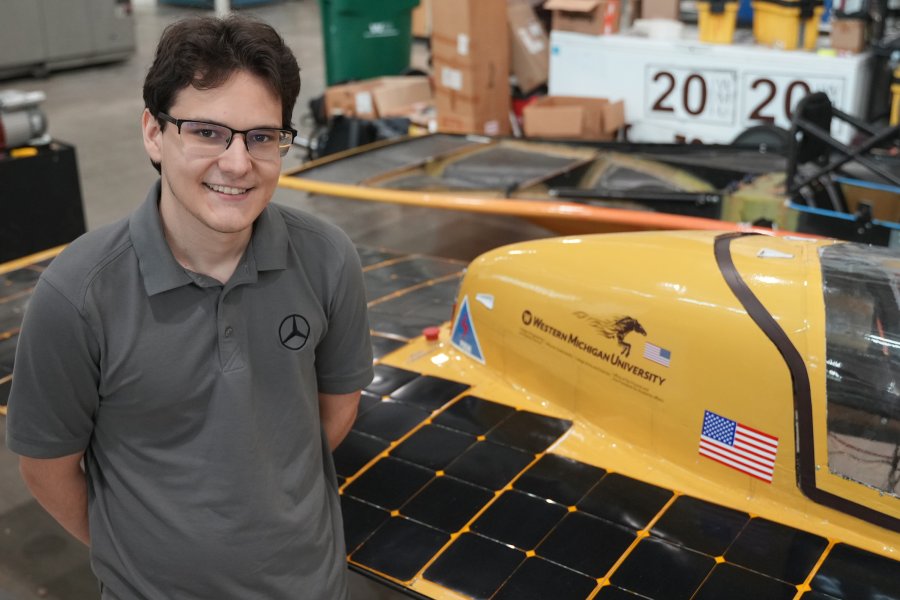
Professors and advisors will support your participation in real-world experiences that will set you apart when you launch your professional career. You'll make lifelong friends and apply your skills by joining student organizations such as Institute of Electrical and Electronics Engineers, Eta Kappa Nu electrical and computer engineering honor society, and Sunseeker. Internships and co-ops will all boost the knowledge you build in your coursework. Your time at Western culminates in a Senior Engineering Design project, where you will team you up with peers and industry to apply your knowledge to a real world project.

What scholarships are available to electrical engineering students
A number of scholarships are available for students enrolled in the electrical engineering program at Western. We encourage you to apply for all scholarships that match your interests, career goals and financial or academic needs.