

Well-being Wheel
At Western, we care about health and wellness and how it helps students thrive. We are here to support each student to find their unique pathway on their life-long well-being journey.
Well-being is:
Developing my identity and living as my authentic self.
Making lifelong healthy choices.
Learning and applying skills to meet my own physical, social, spiritual, intellectual, occupational, financial, emotional, and environmental needs.
Demonstrating resilient behavior, including the ability to become strong, healthy, or successful when faced with obstacles and challenging situations; including the ability to adapt and be flexible when responding to change.
Addressing external factors within communities, systems, and organizations that impact health/wellness.
The WMU Well-being Wheel is one of the ways that we can assess our own overall well-being. There are many factors that can impact a person's well-being, and the wheel helps us examine each area.
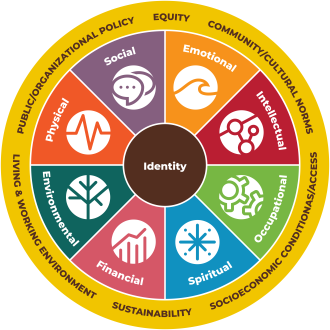
Individual Level (Middle Sections surrounding Identity)
- Enhance holistic student success
- Support balance between multiple determinants of well-being
- Encourage healthy behaviors and build skills for navigating life
- Identify needs for support and intervene early to connect people to resources and services
University and Community Level (Outer Gold Ring)
- Ensure policies and institutional practices support health for all
- Change the environment and culture to be more conducive to comprehensive well-being
WMU Well-Being Wheel Definitions
At WMU, we define well-being as making lifelong healthy choices; learning and applying skills to meet one’s own physical, social, spiritual, intellectual, occupational, financial, emotional and environmental needs; demonstrating resilient behavior including the ability to become strong, healthy, or successful when faced with obstacles and challenging situations; includes the ability to adapt and be flexible when responding to change.
Individual factors:
Identity
The center of this wheel represents a person’s intersectionality of identities, including but not limited to gender; race; ethnicity; sexual orientation; age; generation; first language; national origin; physical, emotional, developmental ability; political affiliation; religion/spirituality; socioeconomic status; and education level. Identity development and living as one’s authentic self is a core part of well-being.
The colorful pieces of this wheel represent eight interconnected dimensions of an individual person’s wellness. The well-being journey involves maintaining balance between these dimensions. It also involves identifying, utilizing, and advocating for access to resources, programs and services that support well-being.
Social Wellness
Developing a sense of connection, belonging and support with others. Maintaining healthy relationships and awareness of how one’s self is valuable to others.
Emotional Wellness
Thriving while experiencing a diverse range of emotions, experiences, and vulnerabilities. Coping effectively with life. Managing and expressing feelings effectively.
Intellectual Wellness
Exploring creative abilities and expanding knowledge and skills. Pursuing learning, professional development, problem-solving, cultural activities, interests and hobbies.
Occupational Wellness
Finding personal satisfaction and enrichment in one’s work. Discovering individual strengths and seeking opportunities to utilize unique talents.
Spiritual Wellness
Discovering a sense of purpose and meaning in life. Developing ethics, values, and a world view. Aligning actions to be consistent with one’s beliefs and values.
Financial Wellness
Developing financial literacy and skills to effectively manage financial resources and overcome financial challenges.
Environmental Wellness
Occupying and improving safe, healthy, accessible and sustainable environments. Contributing to environments that are inclusive and free from harassment and discrimination.
Physical Wellness
Practicing healthy behaviors regarding physical activity, nutrition, sleep, substance use, sex, preventive exams, etc. Learning when to seek medical attention and managing chronic conditions.
External factors
The outer ring of this wheel represents determinants of well-being that go beyond individual factors and are often outside of an individual’s control. When these ecological, socioeconomic, cultural, environmental, and global factors are identified and addressed, individual well-being is enhanced.
Reference List:
1. Dahlgren, G., Whitehead, M. (2006). European strategies for tackling social inequities in health- levelling up part 2. World Health Organization Europe, p. 20.
2. Hettler, B. (1976). Six Dimensions of Wellness Model. National Wellness Institute, Inc. nationalwellness.org/page/Six_Dimensions
3. Krugg, et al. (2007). The Social-Ecological Model: A Framework for Prevention. Centers for Disease Control.
atsdr.cdc.gov/communityengagement/pce_models.html
4. National Wellness Institute. (2019). Multicultural Wellness Wheel. nationalwellness.org/page/mcc
5. Network for Improvement & Innovation in College Health. (2020). Healthy Campus 2020 Framework.
https://collegehealthqi.nyu.edu/20x30/frameworks/healthycampus2020/
6. University of Michigan (2020). What is Well-being? wellbeing.studentlife.umich.edu/what-well-being