


Research Laboratories
The fatigue and fracture laboratory is a facility for academic and industrial collaboration and interaction in applied mechanics.
Research interests
- Computer-aided testing of metals and composites.
- Cyclic behavior, fatigue and fracture testing and modeling.
- Damage characterization under low- and high-cycle fatigue.
- Life prediction and durability enhancement.
- Stress-strain analysis of notched components.
MTS biaxial (axial-torsion) universal testing machine
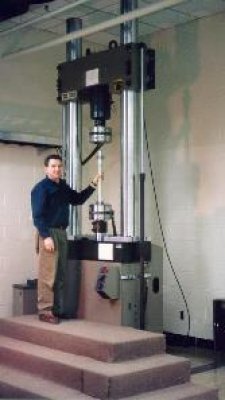
The MTS biaxial universal testing machine in the AMT&E Laboratory is one of a handful of such systems in Michigan. It is a hydraulically operated, computer-controlled facility capable of forces of up to 100,000 pounds and torques up to 55,000 inch-pound at frequency up to 17 Hz. This facility may perform test functions for which companies have only an occasional need. Purchase of such item by a single company would mean a large capital outlay for facility that would not be used to capacity.
MTS 810 uniaxial system with TestStar digital controller
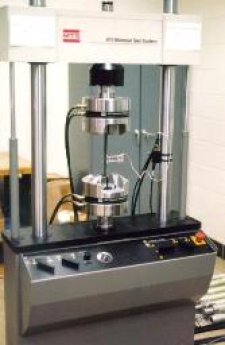
The MTS 810 TestStar Material Testing System is the-state-of-the-art facility which can be used to meet most of testing needs for both monotonic and dynamic tests. The system is capable of forces of up to 22,000 pounds. The TestStar IIs software allowed for digital control and computer automation with provision to generate the standard or custom's design command signals. The hydraulically actuated grips (in both machines) ensure even specimen clamping due to symmetrical housing design and minimize any bending.
Additional equipment and capacity
- Environmental chambers.
- Mechanical testing of materials, parts, and structures.
Director: Dr. Daniel Kujawski, professor of mechanical and aerospace engineering
The Aerospace Laboratory for Plasma Experiments (ALPE) investigates plasma for space propulsion, enhanced combustion, and environmental concerns.
Lab director: Dr. Kristina Lemmer, professor of mechanical and aerospace engineering
The alternative fuel research laboratory is focused on the performance evaluation of internal combustion engines using alternative gaseous fuels and associated mixtures. The effect of various operating parameters, such as fuel compositions, pressure, temperature, spark timing, on performance, efficiency and operational limits is investigated through experimental and analytical modeling and simulation techniques. Another area of interest is the investigation on the knock phenomena and cyclic variation while using alternatives fuels and their mixtures and modeling these phenomena using high-end software and detailed chemical kinetics.
The laboratory is also an integral part of undergraduate laboratory experiment for the courses such as ME 4680 Engine Design and ME 3670 Internal Combustion Engine.
The following experiments are conducted in this laboratory to enhance the undergraduate teaching:
- Fuel combustion rate analysis using in-cylinder trace diagrams.
- Effect of various operating parameters in the fuel burning rate.
- Investigation of fuel composition effects.
Ongoing graduate and undergraduate research in the laboratory include the following:
- Landfill gas combustion in internal combustion engines.
- Biogas combustion in internal combustion engines.
- Knocking and its suppression.
- Chemical kinetic modeling and simulation.
- Natural gas combustion in internal combustion engines.
- Hydrogen combustion as an additive or fuel for internal combustion engines.
Director: Dr. Bade Shrestha, professor of mechanical and aerospace engineering, ASME Fellow and U.S. Fulbright Scholar
The laboratory houses the Advanced Design Wind Tunnel, the Small Wind Tunnel (SWT), and the GM Wind Tunnel (to be set up) and a small turbine engine test cell. The Applied Aerodynamics Laboratory conducts research in measurement techniques and experimental and applied aerodynamics.
Lab director: Dr. Tianshu Liu, professor of mechanical and aerospace engineering.
WMU’s Automotive Laboratory is a central research and training facility supporting the College of Engineering and Applied Sciences' mission of “increasing knowledge through collaborative discovery, teaching and application.”
The Automotive Laboratory supports academic and research activities through student engagement, faculty involvement, and active collaboration with industry. The primary technical objective of this laboratory is to advance the transportation industry by supporting current and upcoming technologies through experimental research, testing and validation.
Director: Dr. Claudia Fajardo, professor of mechanical and aerospace engineering
The Center for Advanced Vehicle Design and Simulation (CAViDS) provides complete, multi-disciplinary solutions to challenging engineering problems with the extensive resources of WMU's College of Engineering and Applied Sciences.
Director: Dr. Caludia Fajardo, professor of mechanical and aerospace engineering
The Combustion and Flow Research Laboratory (CFRL) focuses on turbulence, thermodynamics, and combustion research with emphasis on energy conversion systems. The research team conducts government and industry-sponsored projects in the following areas:
- Turbulence and combustion
- Energy conversion systems
- Development, evaluation and application of non-intrusive diagnostic techniques
Hardware and software
- Single-cylinder optical research engine
- High-repetition rate Nd: YAG laser
- High-speed digital cameras
- Optical tables and opto-mechanical hardware
- Commercial and in-house developed software for system simulation and image processing
Director: Dr. Claudia Fajardo, professor of mechanical and aerospace engineering.
The Computational Engineering Physics Laboratory at Western Michigan University (WMU) engages in computational research in multidisciplinary engineering physics.
Director: Dr. William Liou, professor of mechanical and aerospace engineering
Learn more from the Computational Engineering Physics Lab website.
Western Michigan University's Energy Efficient and Autonomous Vehicles Lab actively pursues a realization of sustainable and safe automotive transportation through research and development.
Director: Dr. Zach Asher, associate professor of mechanical and aerospace engineering
Learn more from the Energy Efficient and Autonomous Vehicles Lab website.
The Fluid Mechanics lab is located in Floyd Hall G-106 and G-107 on WMU's Parkview Campus.
- Facilities
- Research
- Turbulence
- Laser doppler velocimetry
- Particle image velocimetry
Laboratory Director: Dr. Parviz Merati, professor of mechanical and aerospace engineering
The fuel cell evaluation and research center researches in the following areas:
- Performance and efficiency evaluation of various PEM and alkaline fuel cells—The effect of various operating parameters such as pressure, temperature, humidity, load, atmospheric impurities and composition are investigated.
- Transient performance and control strategies are also the area of investigation both experimentally and analytically through simulation and modeling.
- Electrochemical phenomena of the electrode materials, catalysts (noble or non-noble metals), process of loading of catalyst and assembly methodology of membrane-electrolyte-assembly.
- Research and development of enhanced bipolar, mono-polar and simulation model development using CFD.
The center is used both in teaching and research for undergraduate and graduate students.
Major equipment
- Fuel Cell Test Station
- Hydrogen Generating System
- Test PEM and Alkaline Fuel Cells
- Impedance Meter
- Gas chronography
Fuel cell test station
- Up to 3 KW capacity testing
- Two mass flow meters in each side
- DPH humidifying system
- Cooling system
- Temperature control
- Automated data acquisition system
Ongoing research areas
- Optimization, modeling and simulation of PEM and AFC
- New electrode development using nanotechnology architecture
- Development of micro fuel cell technology
- Alternative Electrolyte Member Research
- FC micro-channel modeling and experiment research
Lab director: Dr. Bade Shrestha, professor of mechanical and aerospace engineering
The Micro and Nano Manufacturing facility team conducts research into
- Torque sensors for automotive applications
- Nanoparticle drug delivery systems and applications – Lab-on-chip Devices
- CNT/graphene based sensors for different applications
- Fuel Cell catalyst layers – Graphene oxide based materials
The facility includes the following equipment: spinner, hot plates, convection oven, optical microscope, electroplating, wet etching and microbalance and ma 45 Mask Aligner.
The micro- and nano-manufacturing facility also includes a thin films laboratory which houses:
- Dual Magnetron Sputtering with DC/RF sputter sources
- Thermal Evaporation system
- RF Plasma CVD system
- MW Plasma CVD system
- Etching facilities (Reactive Ion Etching), and
- Excimer laser micromachining (for patterning, etching, and/or polymer microfluidics channel fabrication)
- 3-D Printing (Poly Lactic Acid-PLA or ABS)
Lab director: Dr. Muralidhar Ghantasala, professor of mechanical and aerospace engineering
The Parker-Hannifin Motion and Control Laboratory at Western Michigan University trains undergraduate and graduate engineers in hydraulic, pneumatic and electromechanical systems engineering. The lab is focused on hydraulic system engineering experiences and student exposure to pneumatic and electromechanical systems.
Lab director: Dr Rick Meyer, associate professor of mechanical and aerospace engineering
Learn more from the Parker-Hannifin Motion and Control Lab website.

With funding from National Science Foundation and Hewlett Packard, current research in the Smart and Advanced Materials lab includes the following:
- Nano-crystalline titania as a photocatalyst
- Magnetic shape memory (MSM) alloys
- High-temperature coatings
- Metal matrix nano-composites
Facilities
- Scanning electron microscope (and EDS)--currently unavailable
- X-ray diffractometers (powder, polycrystalline and residual stresses)
- Optical microscopes
- Hardness and micro-hardness testers
- Arc-melting furnace
- Tube vacuum and protective environment heat treating furnace
- Heat treatment furnaces
- Table PC’s
Rates for use of x-ray diffraction, electron microscope and other materials facilities
| User | Daytime Rate | Night and Weekend | Operator Assisted | Facility Service |
|---|---|---|---|---|
| WMU users | $40/hour | $30/hour | $30/hour | $84/hour |
| Other University users | $50/hour | $50/hour | $40/hour | $110/hour |
| Industrial users | $161/hour | $161/hour | $55/hour | $110/hour |
Lab director: Dr. Pnina Ari-Gur, professor mechanical and aerospace engineering
The virtual materials science lab is a unique set of fully interactive 3D virtual laboratory experiments for broad use. The laboratory modules can run on a simple desktop or laptop. The following modules are provided free of charge on request:
- Introduction/safety/metallography
- X-ray diffraction
- Scanning electron microscopy
- Concrete
- Asphalt
- Tensile testing
- Brass
- Steel
- Microstructure
Lab director: Dr. Pnina Ari-Gur, professor of mechanical and aerospace engineering