
WMU professor collaborates on breakthrough technology featured in Science
KALAMAZOO, Mich.—An advancement co-developed by an international research team, including a Western Michigan University professor, is gaining international attention for its potential to transform waste into clean energy.
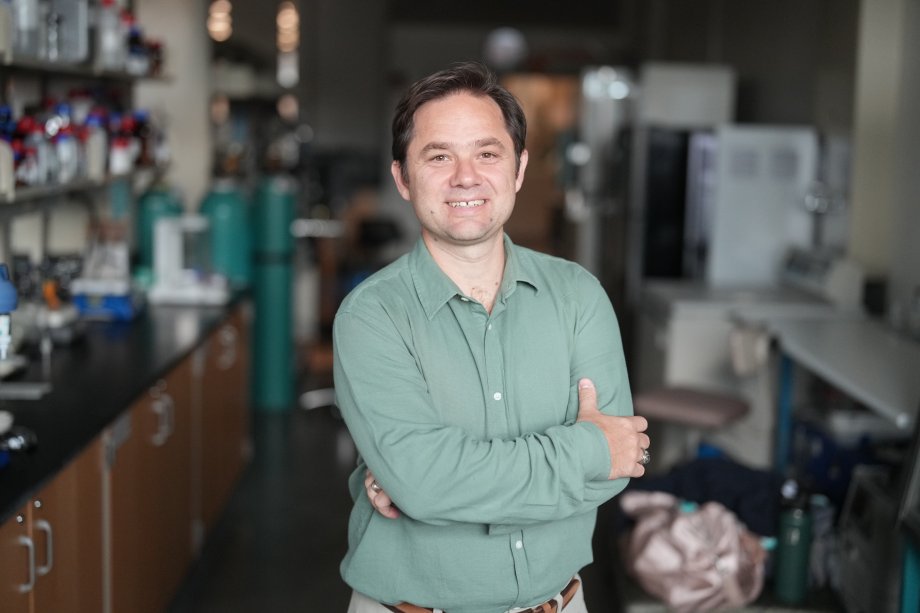
Research published in Science, one of the world’s leading scientific journals, highlights a new industrial catalyst developed by an international team of researchers, including Dr. Mert Atilhan, professor of chemical and paper engineering at WMU. The promising new catalyst converts emissions into a renewable energy source used to manufacture fuels, fertilizers, plastics and chemicals.
“The ultimate goal is to create a sustainable, circular carbon economy on a massive, gigaton scale,” says Atilhan. “This means constantly upcycling greenhouse gases and municipal waste directly into zero-carbon fuels and essential chemicals, effectively reducing global emissions without having to completely overhaul the world’s existing fuel infrastructure.”
Working with researchers at King Abdullah University of Science and Technology (KAUST), Atilhan and the team developed the durable catalyst called NiMoCat (nickel and molybdenum on magnesium oxide) that turns waste such as plastics, coffee grounds, natural gas and CO2 into syngas, a building block for fuels and chemicals. The effort received support from the world’s leading oil producer, Aramco.
One of the catalyst’s most promising features is its ability to work with real-world waste materials rather than carefully sorted materials.
“It can take messy, everyday waste—everything from plastic bottles to leftover coffee beans—and efficiently turn it into clean fuel while actively consuming carbon dioxide,” explains Atilhan.
Unlike previous catalysts, NiMoCat resists clogging and breakdown, stays active for hundreds of hours, and was successfully scaled up to industrial quantities.
The next step for the team is to focus on integrating this technology seamlessly into current commercial infrastructures and optimizing heat integration. A significant milestone involves using this process to produce low-carbon diesel substitutes at a highly competitive cost.
The new process roughly cuts carbon dioxide emissions in half while remaining cost-competitive, offering a practical way to recycle both trash and greenhouse gas into fuel.
The article, titled “Industrial-scale nanocrystalline Ni–Mo–MgO catalysts for hybrid reforming of waste to fuels,” was published in the June 25, 2026, issue of Science. Science is published by the American Association for the Advancement of Science (AAAS) and features highly cited, influential research from all scientific disciplines alongside science policy and news.
Learn about WMU’s Department of Chemical and Paper Engineering.