


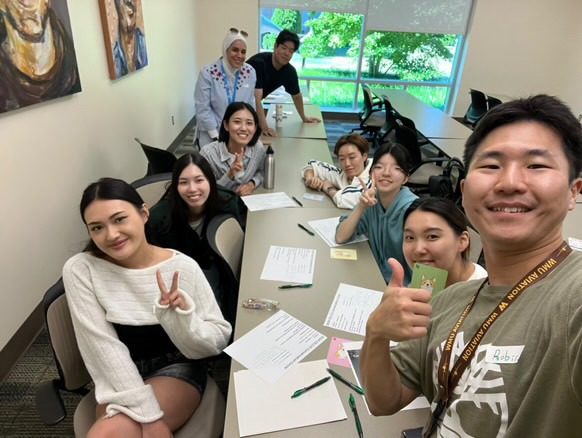
To be successful in the Western Michigan University Center for English Language and Culture for International Students (CELCIS) program, it is important that students understand the policies and expectations of the program. CELCIS policies are outlined on this page and in the CELCIS student handbook. If a student is not sure about the meaning of these rules, he or she should ask a CELCIS instructor or staff member for more information.
Admission to WMU
All prospective students who wish to apply to an undergraduate or graduate program at WMU may do so by submitting an online application.
The WMU (Dual Enrollment) Pathway Program enables international students to take English as a second language courses while also taking academic courses that count toward an academic degree program. The Pathway Program includes an International Student Success seminar that provides assistance in cultural adjustment, an extended orientation to the University and general academic support.
When applying for admission, international students must provide proof of language proficiency. Students may demonstrate English proficiency by successful completion of a WMU Pathway II or the Advanced level in the Center for English Language and Culture for International Students (CELCIS).
For questions and advising, visit International Student and Scholar Services (I3S). Their office is located on the 3rd floor of the Faunce Student Services building.
Academic Honesty and Rules
The Center for English Language and Culture for International Students wants to help students understand the standards for academic honesty that are used in most American institutes of higher education including Western Michigan University. There are six types of behavior that are not acceptable in CELCIS classes and in WMU classes.
- Look at another student's paper during a test.
- Write information to help you on a test on small pieces of paper, on your body, or on tissues.
- Text another person for answers to an activity, quiz, or test.
- Use non-verbal signals from other classmates to answer the questions.
- Copying ideas or words from books, magazines, or websites.
- Not showing that the information came from that source.
- Do homework for another student.
- Allow another student to copy your work.
- Text answers to another student during an activity or a test.
- Non-verbally signal answers to classmates.
- Fabrication means inventing information that is used for an academic assignment. This means it is not acceptable to make up ideas that are used for a class assignment when the assignment requires that you collect information from sources. For example, if the student is asked to interview others about a topic, he or she may not invent the answers to those interview questions.
- Falsification means changing a grade or score. That means that it is not acceptable to erase a grade or score and write a different one on an academic paper.
- Forgery is imitating another person's signature. That means that it is not acceptable to write a teacher's name or a doctor's name on a report or a letter that they did not sign.
- If a student wrote a paper for one class and received a grade, it is not acceptable for him/her to hand in the same paper or use parts of it for a different class.
- If a student prepared a presentation for one class and received a grade, it is not acceptable for him/her to hand in the same presentation or parts of it for a different class.
- Write a paper in his or her native language and use translation programs to translate the paper into English.
- Use alternative forms of content for an assignment which the teacher told the students to complete in a particular way. For example, to complete a listening assignment, a student may not use transcribing software that would allow him/her to read the text instead of listening to it unless the teacher approves such an alternative format.
Attendance
CELCIS attendance requirements, leave requests, participation policy, and course withdrawal procedures.
All CELCIS students must attend classes and make normal progress in learning English. You are responsible for knowing this policy. Keep in mind that CELCIS classes are participatory, and your success in each class will depend on your attendance and participation. If you do not understand, you must ask your instructors, the CELCIS Chair, or the Assistant Manager to explain it to you. If you do not understand the immigration effect of this policy, you must ask your immigration advisor.
- Absences are counted in class hours
- CELCIS requires at least 90% attendance over the course of a semester.
- All absences will be recorded, including those caused by medical, legal, or emergency reasons.
- Your instructors’ record of attendance is the official attendance record.
- Missing class time will have a negative effect on your final grade.
- If you miss more than 10% of your classes, you will receive an email notification from the CELCIS office and may be required to meet with the CELCIS chair or assistant manager.
If you reach 15 or more unexcused absences (class hours) in a class during fall, spring, summer I, or summer II, you will be considered in violation of the CELCIS Attendance Policy:
- You will receive an INITIAL violation notice from the CELCIS office. You must contact the assistant manager within 5 business days. If you believe the records are incorrect, you may appeal within the 5 business days.
- After confirming that the attendance record is accurate, a FINAL violation notice will be sent to you. At this time, students with F-1 or J-1 visas will be referred to the CELCIS immigration advisor.
- A violation of the CELCIS Attendance Policy may result in dismissal from the CELCIS program.
For students on F-1 and J-1 visas, with 15 or more unexcused absences (class hours) in a class, you may be deemed in violation of your immigration status.
- Your SEVIS record may be terminated and the U.S. Department of Homeland Security may be notified of your failure to attend class.
- You must immediately make an appointment with the CELCIS immigration advisor to request a reinstatement.
- You must go to classes while U.S. Citizenship and Immigration Services make a decision on your application.
- Your reinstatement might be approved or might be denied. If the application for reinstatement is denied, the student must leave the U.S. immediately.
- If you do not file for reinstatement, U.S. Immigration will require you to leave the U.S. immediately.
Classes begin on the hour (9 a.m., 10 a.m., and 11 a.m.) If you arrive late, you may miss in-class assignments, and your grade may be affected. If you arrive more than 10 minutes late to class or if you miss more than 10 minutes of class at any other time, you may be marked absent for that class hour.
All students (new and returning) who are unable to arrive on time should understand the following:
- You must notify the CELCIS Chair and receive permission to arrive late.
- Any arrival after the start date reflected on your I-20 or DS-2019 may result in being denied entry at the U.S. port of entry. It is advised for initial students to obtain a new initial I-20 from I3S reflecting a deferred start date to arrive late.
- Late arrival for any reason may have a negative effect on your progress during that semester.
- All students who begin classes after the start of the semester, for any reason, will be counted absent for the classes they have missed. This may affect grades.
- Instructors are not required to re-teach any material that is covered while you are absent, and instructors do not have to provide make-up tests or accept late assignments, etc. for the period that you are absent.
- Students who choose to leave before the end of the semester will be counted absent.
- Instructors are not required to pre-teach or re-teach any material that is covered while a student is absent, and instructors do not have to provide make-up tests or accept early or late assignments, etc. for the period that a student is absent.
- If a final assessment is given, students who are not in class during the final week of classes may not be allowed to take the assessment. Students cannot take the assessment early. This will affect class participation points and affect grades.
- Before you leave WMU, you must:
- Make an appointment with the CELCIS immigration advisor and submit a Notification of Departure.
- Be sure to take care of any financial obligations to the University, drop classes in the CELCIS office, and cancel health insurance.
A student will be allowed up to five (5) consecutive absences (class hours) if there is a death in their immediate family (spouse, parent, child, grandparent, sibling, spouse’s parent, spouse’s grandparent, spouse’s sibling). The student should provide the CELCIS office with a copy of a death certification or obituary and contact their teachers about their class work.
If you have a serious illness or medical condition, you may be eligible for medical leave. You must provide the CELCIS Chair or Assistant Manager with documentation from a licensed medical doctor or clinical psychologist. The doctor’s note should specify dates and indicate the reason why you are unable to attend classes. Medical documentation should be submitted as soon as possible and will not be accepted after the last day of classes.
- If a student cannot maintain full-time enrollment due to an illness or medical condition, they should contact the International Student and Scholar Services office about submitting a Reduced Course Load request.
- Students on medical leave must complete all missed work according to the teachers’ policies.
- Students may be allowed up to a maximum of 14 consecutive class hours or 14 total class hours of approved leave for the semester (per class).
- In the case of pregnancy, women are eligible for medical leave with a doctor’s note at the time of birth or if complications occur. Fathers are eligible for up to 3 class hours of paternity medical leave at the time of birth.
NOTE: Medical leave is for serious illnesses or medical conditions, not for scheduled appointments. To avoid absences, students should try to schedule medical appointments outside of class time.
It is University policy to permit students to fulfill obligations set aside by their faith. Students must let their instructors know that they will be missing class in advance. Students are responsible for completing all missed work according to the teachers’ policies and within a reasonable time frame.
Students will be marked absent if they are not in class. To avoid grade penalties, students should try to schedule appointments outside of class time. This includes personal appointments, court appearances, driver's license exams, etc.
You are responsible for contacting your teachers when you are absent. You are also responsible for doing all homework, quizzes, tests, and assessment according to the teachers' policies. No work can be submitted after the last day of classes for the semester for Speaking/Listening, Grammar/Communication, and Reading/Writing 2. No work may be submitted after mid-term for Reading/Writing 1.
Tuition Refund Policy (excludes application fee)
If you need to withdraw from CELCIS during the first few days of class, tuition will be refunded. The refund amount will be determined by the date the CELCIS office receives the refund request
CELCIS at Western Michigan University is authorized under Federal law to enroll nonimmigrant students. As an SEVP approved school, all CELCIS students who have F-1 or J-1 visas are required to enroll full-time during fall and spring semesters. Fall and Spring are mandatory semesters.
Summer Sessions
Summer I/summer II sessions are considered University break period for student enrollment. Students are not required to take CELCIS classes during the summer sessions. (This does not apply for new students whose first term of enrollment is summer).
However, CELCIS offers optional summer I/summer II classes. If you are receiving a financial scholarship by a sponsor, please follow their enrollment requirements for funding purposes. The CELCIS department recommends that students take summer semester classes. Taking long breaks may cause students to forget the English that they have learned.
All students who study during the Summer I session will be required to also study in the Summer II session.
If a new student receives a Summer I I-20, then by federal regulations, both summer sessions are mandatory enrollment periods. The student will not be eligible for vacation until the summer session the following year.
New students have the option to begin in the Summer II term only if they have a Summer II I-20. Students who begin in Summer II will not be eligible for a vacation period until the summer session the following year. Returning students will not be allowed to register for only summer II classes.
Basic Rules
Students enrolled in CELCIS and in Western Michigan University agree to follow the basic rules and meet the expectations listed below:
- Students are expected to be in class every day. If students miss class: Student will be marked absent. Student will miss the placement tests (beginning of semester). Student may miss important tests and assignments (beginning and end of semester). Student's grade may go down (if they don’t finish and hand in tests and assignments). In extreme cases, a student may be dismissed from the program. Students should always talk to their teachers when they are absent from class to find out what they missed and what they need to do to complete all assignments.
- Students are expected to complete all assignments, tests, and assessments during the semester.
- Class work ends on the last day of class. No work can be submitted after the last day of class.
- Students cannot choose their teachers at CELCIS. “I want a different teacher because I don’t like X’s teaching style” or because “X is a difficult teacher” are not good reasons to change classes. All CELCIS teachers work hard to help students learn.
- Students cannot choose their classrooms.
- Students are not allowed to cheat during tests or quizzes, or on research papers. For example, during tests students are not allowed to look at their phones, look at a classmate’s answers, or look at a paper that has the answers written on it. Students are not allowed to copy from another source on research papers. Students caught cheating will receive low grades and will be reported to the WMU Office of Student Conduct.
- All students are expected to show respect to their teachers, classmates, and the CELCIS office staff. Students are never allowed to shout at teachers or use violent words or actions in the classroom or CELCIS office. Students who behave like this will face disciplinary action and may be dismissed from the program. Disruptive behavior of any kind is not tolerated in the classroom. If a student disturbs other students by refusing to participate, talking loudly and out of turn, or in any other inappropriate way, the student will be reported to the WMU Office of Student Conduct.
- The CELCIS chair and assistant manager cannot and will not change students’ grades. Students get the grades they earn, and CELCIS teachers decides what grade each student has earned. CELCIS office staff cannot change grades. Students who have a question about their grade/s need to talk to the teacher who gave them the grade.
WMU Student Code of Conduct
The University may hold a conduct hearing if a student breaks the Student Code of Conduct to ask questions and investigate what happened. After the meeting, the University will decide if the student failed to follow rules and policies of the Student Code of Conduct. Sanctions (consequences) will imposed on students who fail to follow the rules and policies of the Code, per earlier list.
Enrollment
Signing up for classes and dual enrollment.
New students will take a placement test to determine their English language level. After taking the placement test, attending International Student Orientation and confirming their consent to be registered, new students will be registered for CELCIS courses by the Assistant Manager.
Returning Student registration is scheduled mid-way through the previous semester. Students will be asked to complete an online Intent Form. This form lets CELCIS know student’s plans for the upcoming semester.
Students must resolve all holds. Students will not be registered for classes until their holds have been cleared.
Students who wish to study in the Western Michigan University CELCIS program on an F-2 visa (dependent) are permitted to study as a part-time enrolled student. This means that an F-2 student is only permitted to take up to three class hours per day. Four class hours is considered full-time enrollment. A student who begins CELCIS as a part-time enrolled student, returns to his/her home country to apply for an F-1 visa, and resumes his/her studies on an F-1 visa (student), will be required to take the placement test the next semester before starting classes.
A CELCIS student will be allowed to re-take a CELCIS class that the student has already passed ONLY IF by not taking the class, the student will be under-enrolled and consequently go out of status. Approval from the CELCIS chair and the CELCIS immigration advisor is required. In addition, the student will bear the cost of retaking the already-passed class.
CELCIS at Western Michigan University is authorized under Federal law to enroll nonimmigrant students. As an SEVP approved school, all CELCIS students who have F-1 or J-1 status are required to enroll full-time during fall and spring semesters.
Summer I and Summer II sessions are considered a University break period for student enrollment. Students are not required to take CELCIS classes during the summer sessions. (This does not apply for new students whose first term of enrollment is in summer).
If you are receiving a financial scholarship by a sponsor, please follow their enrollment requirements for funding purposes. The CELCIS department recommends that students take summer semester classes. Taking long breaks may cause students to forget the English that they have learned.
All students who study during the Summer I session will be required to also study in the Summer II session. If a new student receives a Summer I I-20, then by federal regulations, both summer sessions are mandatory enrollment periods and the student will not be eligible for vacation until the summer session the following year.
New students have the option to begin in the Summer II term if they have a Summer II I-20. Students who begin in Summer II will not be eligible for a vacation period until the summer session the following year. Returning students and Pathway students will not be allowed to register for only summer II classes.
Grading
The class grade will be assigned by the instructor according to the class syllabus.
The final grade will determine whether or not you pass a class. Students must have a minimum grade of "C" or 75 percent in order to pass a class.
Students who are not in class during the final week of classes may not be allowed to take tests or assessments scheduled by the instructor. Students cannot complete the tests or assessments early.
CELCIS students receive reports on their progress from their instructors via eLearning. These progress reports notify the students of the quality of their classroom performance in meeting the curricular goals. Students are rated on their overall performance, attendance, attitude and effort, and progress toward meeting the goals of the courses.
| 95-100 percent | A |
| 90-94 percent | BA |
| 85-89 percent | B |
| 80-84 percent | CB |
| 75-79 percent | C |
| 70-74 percent | DC |
| 65-69 percent | D |
| 0-64 percent | E |
At the end of each semester, all students who have earned a final grade of BA or higher (90%) in every class will be placed on the CELCIS Honor Roll. The Honor Roll is posted on the wall in the main hallway of the CELCIS office in the garden level of Ellsworth Hall.
- If a student fails all of their classes, the student gets placed on Probation 1 for the next semester.
- If that student then fails more classes in the following semester, the student gets placed on Probation 2, and is automatically given a contract which must be signed at a meeting with the CELCIS Assistant Manager or the CELCIS chair.
- If a student on Probation 2 fails a majority of classes the next semester, the student may be dismissed from the program. The CELCIS chair reserves the right to dismiss any student with excessive absences or inappropriate behavior.
- If a student on Probation 1 or 2 passes all of his/her classes for the semester, then the probation status will be removed.
- Students on Probation 2 will not be able to receive a travel signature on their I-20 form until the final grade report becomes available on the last day of the semester. This is not the same as the last day of classes. Be sure to confirm the last day of the semester.
- With the permission of the chair, students who have been dismissed from CELCIS may be eligible to return after taking a minimum of one academic semester off. If students are given permission to return, they will not be on probation when they restart their classes. Probation status does not carry over for students who have been dismissed.
- Students who have been dismissed twice are not eligible to return to CELCIS.
Placement
Students will be enrolled in CELCIS classes based on the results of their placement test. Students will be informed of their level and class schedule before the first day of classes.
CELCIS instructors will administer pre-tests to all enrolled students during the first week of classes to evaluate skills in listening comprehension, speaking, grammar, reading comprehension, and writing. After reviewing the results of the pre-tests, instructors may notify the CELCIS Chair if they believe a student is placed at the wrong level.
- Oral evaluation—instructors interview student for three to five minutes.
- Writing test—timed writing sample on a given topic. Lasts approximately 25 minutes.
- Placement test—listening comprehension, grammar, vocabulary, reading comprehension. Lasts approximately 65 minutes.
You will be assigned to classes according to the results of your placement tests.
- Speaking/Listening class pretest—listening comprehension, speaking.
- Grammar/Communication class pretest—grammar, grammar test.
- Reading/Writing Class pretest—Reading comprehension, writing.
Instructors will determine if any students have demonstrated English proficiency ABOVE the level they are currently in. If it is decided that a student should be moved to a different level, the student will be notified by email to come to the office to pick up a new schedule.
Instructors and the CELCIS Chair will determine if any students have demonstrated they have been placed at a proficiency level above or below their current placement. If it is decided that a student should be moved to a different level, the student will be notified by email and sent a new class schedule.
If a student wants to request a change to their placement, they should follow these steps:
- Talk to your teachers, the CELCIS Chair, or the CELCIS Assistant Manager about changing your level.
- Fill out the “CELCIS Level Change Form” by printing it from this webpage or by picking one up in the CELCIS office. The form should be submitted within the first 3 days of the semester.
- Submit the form to the CELCIS Chair or Assistant Manager.
- Your placement test results and the pre-tests you took during the first week of classes will be reviewed and your instructors will be consulted about your skills.
- A final decision will be made by the Chair before the “Last Day to Add/Drop” date on the Academic Calendar
- You will be sent an email with the final decision and a new class schedule if applicable.
If you do not attend the first 3 days of class, you are not eligible to request a level change
Changing sections (within the same level) is not permitted except in special circumstances:
- If a student fails a class and is then placed in the same class with the same teacher the following semester, that student may request a section change.
- If a student has a physical disability that requires a specific classroom building, that student may request a section change. However, the student needs to have a documented disability through the Disability Services for Students Office. The CELCIS office must receive these documents before any change will be considered.
While CELCIS makes an effort to accommodate student requests, it is not always possible or desirable to do so. To request a level change, please complete the Level Change Form.
Promotion and Program Completion
Requirements to advance levels and complete the Intensive English Program.
- Students who pass a class will be promoted to the next level of that class.
- Students who fail (having a final grade of DC or less, or an average grade of less than 75%) must repeat the course.
- There are no promotions in the middle of the semester or session.
- Students who earn an A for their final grade in Speaking/Listening, Grammar, Reading/Writing 1 and Reading/Writing 2 will receive permission to retake the CELCIS placement exam at a designated time at the beginning of the following semester.
- If the resulting test scores are high enough, the student may be allowed to advance one level at CELCIS.
- Promotion in the summer semester is based on a weighted average of the Summer I and Summer II courses, with equal weight given to both classes. Review the promotion table for details.
- New students beginning in the Summer II session may be required to retake courses or take a placement test to advance to the next level.
To complete the CELCIS program, students must receive a passing grade (C or higher) in Speaking/Listening, Grammar/Communication, Reading/Writing 1 and Reading/Writing 2 at the Advanced level. Students must pass all 4 courses to complete the Intensive English Program.
Class grade | A | BA | B | CB | C | DC | D | E | ||
| 4 | 3.5 | 3 | 2.5 | 2 | 1.5 | 1 | 0 | |||
| A | 4 | 4.0 | 3.8 | 3.5 | 3.3 | 3.0 | 2.8 | 2.5 | 2.0 | |
| BA | 3.5 | 3.8 | 3.5 | 3.3 | 3.0 | 2.8 | 2.5 | 2.3 | 1.8 | |
| B | 3 | 3.5 | 3.3 | 3.0 | 2.8 | 2.5 | 2.3 | 2.0 | 1.5 | |
| CB | 2.5 | 3.3 | 3.0 | 2.8 | 2.5 | 2.3 | 2.0 | 1.8 | 1.3 | |
| C | 2 | 3.0 | 2.8 | 2.5 | 2.3 | 2.0 | 1.8 | 1.5 | 1.0 | |
| DC | 1.5 | 2.8 | 2.5 | 2.3 | 2.0 | 1.8 | 1.5 | 1.3 | 0.8 | |
| D | 1 | 2.5 | 2.3 | 2.0 | 1.8 | 1.5 | 1.3 | 1.0 | 0.5 | |
| E | 0 | 2.0 | 1.8 | 1.5 | 1.3 | 1.0 | 0.8 | 0.5 | 0.0 |