

Collaborative robots offer unique hands-on experiences for students
KALAMAZOO, Mich.—Imagine seeing them scanning inventory in grocery stores, holding tools in small workshops, and even operating tools in manufacturing plants.
A new generation of collaboration is on the rise in form of “Cobots”—collaborative robots that interact and work side by side with humans in many industrial settings. One of the fastest growing segments of the industry, devices not only complete tasks, but also interact with humans, working side-by-side in many settings.
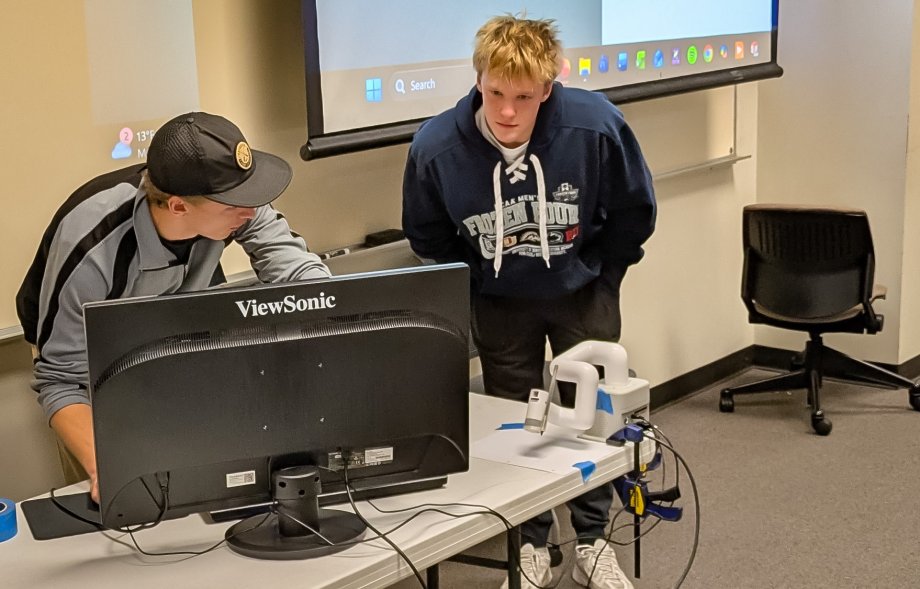
This is the future of automation explored in Western Michigan University’s mechanism analysis course, where students built and controlled their own robotic mechanisms using Python programming language; ROS 2, a robot operating system; RViz 2, a 3-D visualizer; and MoveIt 2 for controlling robotic movements.
And it is these skills that are essential for meeting the demands of internships and professional positions in many industries.
“It’s the kind of hands-on, forward-leaning work that prepares students for where automation is actually headed, not where it used to be,” says Dr. Zachary Asher, associate professor of mechanical and aerospace engineering, who teaches the course. "Cobots are a newer technology that have the potential to work alongside humans to further automate dangerous or repetitive tasks. It is anticipated that they could be a major part of manufacturing during our student's careers."

In the course, mechanical engineering student Torrey Cookman successfully built a device—a physical Cobot that can write with a pen.
“This was unlike any project I have taken on in the past,” says Cookman. “Learning the code and how to troubleshoot issues or come up with a different way to approach the same problem was very satisfying.”
Cookman struggled with some of the computer updates and glitches.
“Even working with Linux had its own learning curve,” says Cookman. “Although I was working with a physical robot, I was still able to collaborate and brainstorm with my classmates who ran into similar issues.”
Demonstrating that the Cobot could perform a real welding pattern, Osman Omer, an aerospace engineering student, and a team, programmed a tack welding motion that directed the cobot in repeating small, controlled movements then returning to the starting position before making the next movement.

“The most challenging part was getting the code to behave the way we wanted,” explains Omer. “There were a lot of small issues that slowed us down, but looking back, that is realistic to what happens in real engineering projects, so it ended up being a good learning experience.”
The experience-driven project is designed to practice programming skills and deepen students’ understanding of the vital role of Cobots in industry.
“At WMU, we’re proud to offer these kinds of experiences, and I’m excited to see what these students go on to achieve,” says Asher. “Across the board, teams show impressive engineering judgment designing digital twins, solving kinematics, planning trajectories, and debugging real software and hardware under pressure.”
“I think the future of Cobots is going to focus on teamwork between humans and machines,” says Omer. “In class, we taught the robot each step, the same way you teach a person a new skill. In the future Cobots will be better at adapting, avoiding obstacles, and learning from corrections, which will make them easier and safer to work with.”
As technology continues to advance in industrial settings, WMU students will continue to prepare for the future—a future where Bronco engineers will be leading projects and working to enhance and improve the robot-human connection.
For more WMU news, arts and events visit WMU News online.