
From safer helmets to heated gloves: students unveil capstone projects
KALAMAZOO, Mich.—A big part of graduating from Western Michigan University’s College of Engineering and Applied Sciences is completing and presenting a project at the Senior Engineering Design Conference, held every fall and spring semester. Students put their experience-driven learning education to work tackling real-world and industry problems.
Join us for this semester’s Senior Engineering Design Conference on Tuesday, April 21, at Floyd Hall, home to WMU’s College of Engineering and Applied Sciences. Presentations are open to the public and will be held from 8:30 a.m. to 4:30 p.m. Continue reading to learn about some of the projects that these Broncos have been working tirelessly on.
Smart Industrial Heated Glove
Electrical and Computer Engineering
10 to 10:25 a.m., Room D-204, Floyd Hall
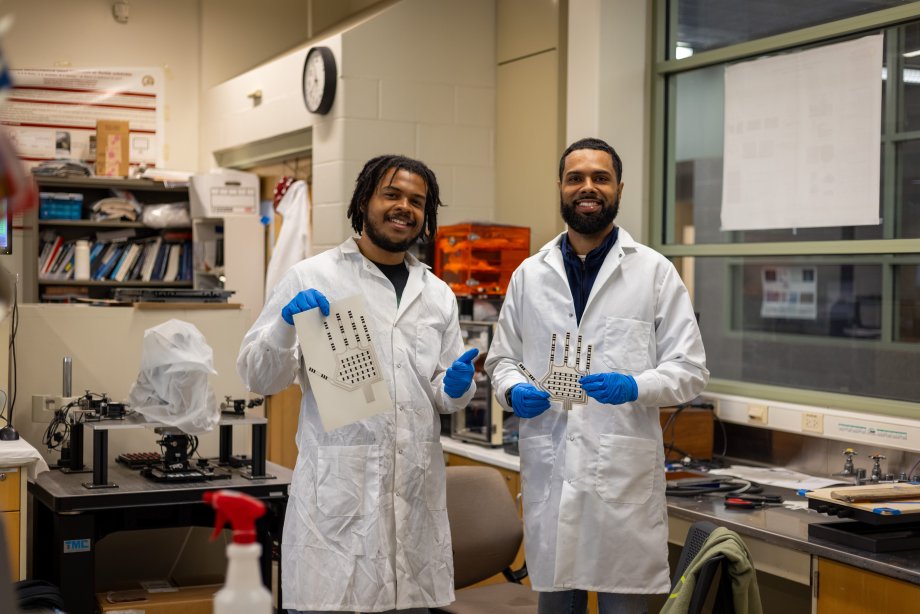
Soon-to-be graduates from the Department of Electrical and Computer Engineering, Allen Morton, Cameron Johnson and Mohammed Afnan designed and developed a product to benefits electricians and construction workers in frigid climates recognizable to Michigan residents. The industrial heated glove utilizes advanced multi-layer screen printing to maintain warmth in temperatures as low as negative 40 degrees Fahrenheit.
For Morton, a major perk of focusing on this project was applying classroom skills to a tangible, self-produced product.
“I learned the capabilities of positive temperature coefficient circuits and how this emerging technology can optimize current designs, as well as open the door for new ideas to be executed,” says Morton.
Part of the team’s mission was to utilize technology that could realistically fit into the glove and also serve its heating function. It was this mission that served to be a challenge for the team, which they ultimately overcame with their final product.
“The biggest challenge we faced while working on this project was optimizing the circuit for ideal thermal generation while also remaining realistic within the confines of acceptable power consumption, current range and voltage source limitations,” says Morton.
The team wishes to acknowledge financial support from the Center for Advanced Smart Sensors and Structures (CASSS).
Energy Absorbing 3D-Printed Football Helmet for Safer Play
Mechanical and Aerospace Engineering
10:30 to 10:55 a.m., Room D-210, Floyd Hall
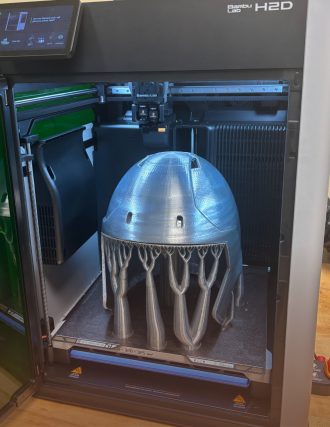
Mechanical engineering students Molly Blanchard, Evan Swank and Mason Thomas decided to create a project connected to their personal interests: they decided to design, build and test a 3D-printed football helmet, intended to absorb contact energy to promote safer play.
The helmet was created using super-elastic materials that were integrated into 3D-printed polycarbonate helmet structures to better absorb and dissipate impact energy. The team conducted controlled drop tests to compare different designs and evaluate their ability to reduce acceleration during impacts.
“The project also pushed us to think across different areas like design, materials, manufacturing, and data analysis, instead of treating them separately,” says Blanchard. “The biggest challenge was successfully integrating the energy-absorbing materials into a 3D printed helmet in a way that was both manufacturable and effective during testing. Balancing design complexity with the limitations of 3D printing and material behavior required multiple iterations.”
The team wishes to acknowledge the financial support they received from Intertek and mechanical and aerospace engineering alumni Alex Porter, B.S.E.’89, M.S.’92, Shubram Subramanyam, B.S.E.’14, M.S.’19, and David Brock, B.S.E.’94, M.S.’98.
For more WMU news, arts and events, visit WMU News online.