
Western set to compete with top U.S. universities in the EcoCAR Innovation Challenge
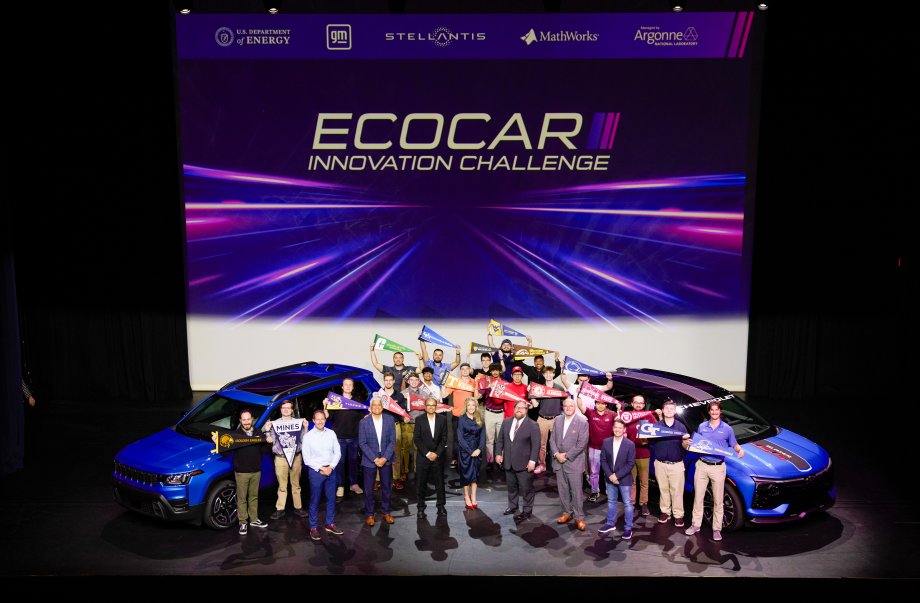
KALAMAZOO, Mich.—Western Michigan University is taking the wheel as one of only 20 universities nationwide selected for the highly competitive EcoCAR Innovation Challenge. Hosted by the U.S. Department of Energy and Argonne National Laboratory, this multiyear competition tasks students with engineering the next generation of automated electric vehicles.
“This project allows students to get hands-on experience building modern commercial vehicles, which unlocks incredible job opportunities after graduation,” says Dr. Zachary Asher, principal investigator for the project, director of WMU’s Automated Driving Assurance Lab, and associate professor of mechanical and aerospace engineering. “This competition also provides dedicated one-on-one learning and engagement with automotive industry professionals through training, building, testing and presentations.”
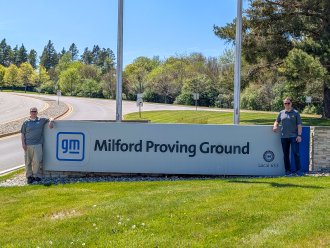
To ensure WMU hits the ground running, Asher, alongside Dr. Rick Meyer, co-principal investigator and associate professor of mechanical and aerospace engineering, and Dr. Pete Gustafson, chair of the Department of Mechanical and Aerospace Engineering, recently attended the final competition of the current EcoCAR cycle at the General Motors (GM) Milford Proving Ground to prepare. This forward-looking preparation is backed by a top-tier student leadership team. Four specialized graduate student leads have been hired to manage project operations, autonomy, artificial intelligence (AI) and vehicle integration. These graduate leaders include Jacob Russell, Jonathan Girier-Dufournier, Menuka Ghalan and Charles Rodgers.
Partnering with GM and Stellantis, the EcoCAR Innovation Challenge pushes student teams to the cutting edge of automotive engineering. WMU will compete in the GM track, where the team will reengineer a 2026 Chevrolet Blazer SS into a high-performance, fully automated electric vehicle. Students will develop advanced automated driving features and vehicle-to-everything connectivity, as well as optimize the propulsion system.
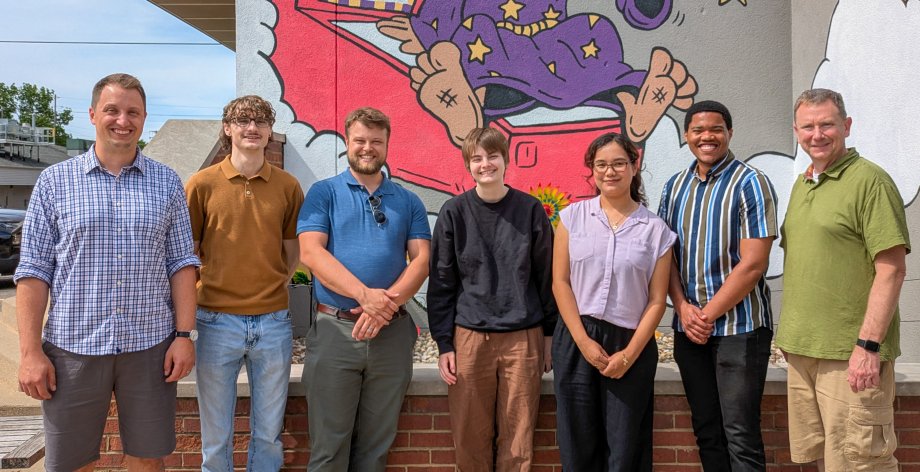
“We are moving beyond theory to deploy next-generation autonomous AI on actual asphalt,” says Charles Rodgers, the autonomy lead for the project who is pursuing a master’s degree in computer science from WMU.
Beyond the competition, this project feeds directly into Western’s cutting-edge automotive safety research and commercialization. The team is working to mathematically prove that autonomous vehicles can drive safely, even in blind spots or unpredictable weather, rather than relying only on standard computer simulations. By building strict, ironclad safety metrics into the vehicle’s AI, Western is helping to establish the trust and mathematical certainty needed to get self-driving cars safely onto public roads.
The competition officially kicks off in fall 2026 and runs through spring 2030. At the conclusion, teams will present their final vehicles, technical reports and commercialization strategies to industry executives, engineering experts and organizers from the U.S. Department of Energy, Argonne National Laboratory, General Motors and Stellantis.
Evidence from previous competitions shows that students with experience in the EcoCAR Innovation Challenge have higher starting salaries than their peers, earning $4,000 to $15,000 more on average.
“This challenge places our students at the forefront of the global mobility revolution,” says Dr. Steve Butt, dean of WMU’s College of Engineering and Applied Sciences. “We encourage students from all disciplines and at every academic level to get involved and take advantage of this exceptional opportunity.”
In addition to Asher and Meyer, Western faculty members involved with this project include:
- Dr. Guan Yue Hong, AI mentor and associate professor of computer science
- Dr. Sandun Kuruppu, electric vehicle mentor and associate professor of electrical and computer engineering
- Mike Konkel, manufacturing and safety mentor and master faculty specialist of engineering design and manufacturing
- Dr. Claudia Fajardo, vehicle testing mentor and professor of mechanical and aerospace engineering
“We are evolving academic research into hands-on projects, market-ready technology and real-world startups,” says Asher. “We can’t wait to get started and see what this impressive team of students, industry and faculty members contributes to this ever-evolving and rapidly expanding sector.”
Learn more about the EcoCAR Innovation Challenge and WMU’s Department of Mechanical and Aerospace Engineering.