

WMU Sunseeker Solar Car Project speeds through a successful summer
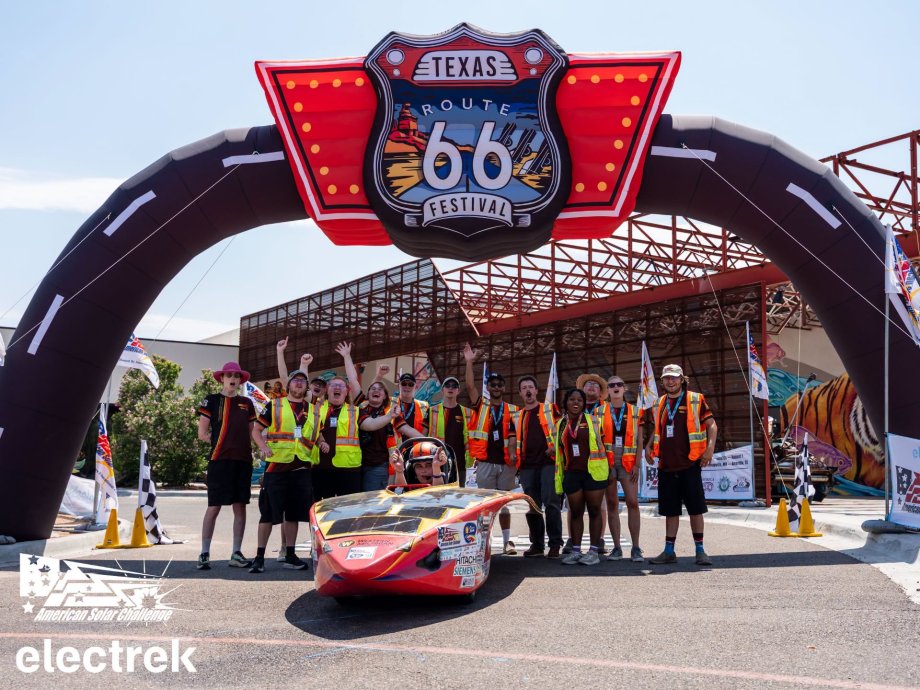
KALAMAZOO, Mich.—Students in a Western Michigan University registered student organization (RSO), Sunseeker Solar Car Project, returned to campus this fall semester with a spring in their step and success on their mind. Members of the organization spent the summer traveling cross-country in their student designed and built solar car. They qualified for the 2026 American Solar Challenge (ASC) by successfully completing testing and a required number of laps at the 2026 Formula Sun Grand Prix. The team and their solar car were very pleased with their performance as they performed better than they have in recent years.
Sunseeker 23, the 11th generation of solar car at Western and the current iteration of the project, is heavily focused on efficiency. As the car is fully solar powered, it is also fully electric. Sunseeker is also fully road legal with a license plate, a back-up camera and all necessary lights. The team’s goal is to prove that it is possible to have fully solar powered vehicles on the road and demonstrate that a greener future is possible.
July 2026 first took the Sunseeker Solar Car Project to Brainerd International Raceway in Brainerd, Minnesota for FSGP. FSGP involves four days of scrutineering—the process of proving your car is safe to be driven for FSGP and ASC, and that it follows the regulations— then three days of on-track racing.
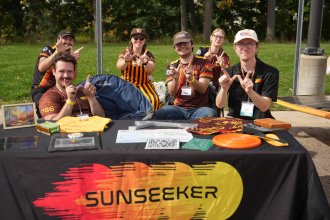
Student Lila Sparks, who serves as the organization’s director of media, explained how scrutineering is judged.
“Each team has to acquire green dots in every category before they are allowed on the track,” says Sparks. “Categories include safety, driver registration, driver ops, lights & vision, body & sizing, electrical, battery protection, mechanical, dynamics, array testing and ASC support.”
Sunseeker finished scrutineering third out of the 39 teams participating in FSGP.
“This meant that when racing started, we were third through the starting line on July 21,” says Sparks.
Over the three days of racing at FSGP, Sunseeker completed 165 laps and came in 8th place. Their fastest lap was 6 minutes and 6 seconds long. The team didn’t have any deductions from their score.
The team’s performance at the FSGP qualified them for the ASC, which happens every other year and is multi-day event where teams drive their solar cars along a set path through several states.
“In 2026, we drove from Minneapolis, Minnesota following the Great River Road to the southern tip of Illinois,” says Sparks. “From Edwardsville, Illinois we celebrated the 100th anniversary of Route 66 and drove to Amarillo, Texas, sightseeing the whole way there.”
2026 was monumental for Sunseeker, as it was the first time the team had finished an ASC in ten years.
“It has been an incredible motivator for the team as a whole,” says Sparks. “We had our fair share of hardships on the race when our motor controller and motor broke, but we were able to switch out both parts in under two hours getting us back out onto the road very swiftly.”
Sunseeker placed 11th of the original 39 teams in ASC.
“The experience for the team along the route was fantastic,” says Sparks. “We were so happy to see the excitement for solar racing from all of the people we saw along the route.”
Sparks noted how the experience made an impact on her. She most enjoyed meeting fellow solar car enthusiasts from across the world, including Europe and Canada, and across the United States.
“The culture differences going from one region to the next have always been something that I have wanted to experience more of,” says Sparks. “I also loved being able to explain what we were doing and sharing the joy of solar cars with people from all over.”
This next year, the Sunseeker Solar Car Project is focused on creating their next version of their vehicle. While the team is awaiting some updates to Innovators Educational Foundation regulations, the design process is wrapping up. With the current regulations, the team will be able to extend the solar array by two square meters (from four square meters to six). The extended array will allow the car to take in more sunlight, thus increasing the possibilities for the vehicle to break even at higher speeds.
“Our biggest goal is to continue giving students the chance to apply the skills that they’re taught in class and to continue having a positive presence, creating an inviting space for all sorts of different students,” says Sparks. “Oh, and to race a super cool car.”
For more WMU news, arts and events, visit WMU News online.