

High schoolers prepare for college through WMU business simulation course
KALAMAZOO, Mich.—At Van Buren Tech, students in the Applying Business Fundamentals course are building real-world skills while preparing for their future careers. The dual enrollment class is taught on site by Dr. Decker Hains, chair and master faculty specialist of management at Western Michigan University. Its focus? Teaching students the fundamentals of business through hands-on experience.
This isn’t your typical high school business class. It’s the same foundational class WMU first-year students take, adapted to fit a different schedule while maintaining college-level rigor.
Van Buren Tech is a career and technical institution affiliated with the Van Buren Intermediate School District. They work closely with business and industry professionals to prepare students for a variety of postsecondary options. Their model of hands-on learning pairs perfectly with WMU’s Experience-Driven Learning, making this partnership a win-win for all parties.
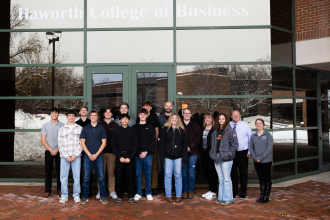
Using a simulation program called ScrimmageSIMTM, students work in groups and oversee operations at a fictional small business for one virtual year. During the semester, groups navigate every aspect of business operations including production schedules, sales strategies, inventory management and the ever-present challenge of keeping revenue above expenses.
“We wanted to provide the students the most realistic college experience possible,” Hains explains. “The course is very engaging, and the simulations require a fair amount of effort, making it a great way to experience the expectations of a business class and also gain some hands-on business lessons.”
For Joseph Roethlisberger, a second-year engineering design student and Mattawan senior, that authenticity paid off. “Getting my first real experience with a college course helped me feel more confident about starting college. I know what to expect now and how I can succeed.”
Surprising lessons
During the semester, students learned many important business lessons, including how to use Microsoft Excel, how to keep track of income and expenses and how to give an effective presentation. But they didn’t anticipate one crucial takeaway: the power of teamwork and communication in business.
“I was surprised how much effective communication can shape how a business functions,” says Daniel Northrup, a second-year architectural design student and Decatur senior. “Understanding this helped me see the impact of clear communication on the bottom line.”
That discovery—that success isn’t just about numbers but also about how teams talk, listen and problem solve together—became one of the course’s most valuable insights. When team members missed deadlines or misunderstood assignments, the simulation didn’t just give them a lower grade. It showed them how those breakdowns affected every part of the process.
From classroom to conference room
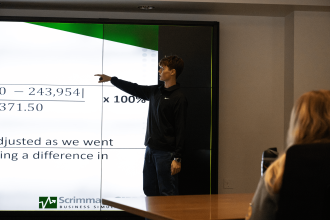
The semester culminated with group presentations at the Haworth College of Business. Students summarized their “year” of business and talked about lessons learned. Presenting in a conference room on Western’s campus was a perfect way for the students to experience a real-life college scenario at WMU Haworth—and turned out to be a highlight.
“My favorite part of the course was presenting at WMU Haworth,” Northrup says. “It gave me a feel for what a college presentation is like, giving me an advantage when I start college since I have some experience with meeting college-level expectations.”
Hains sees the course extending even further than getting ready for college. “I want students to view their personal lives with a business lens,” he says. “Making a good income and spending responsibly are lessons that will serve them well. In your personal life, just like in the simulation, you must make sure your income is greater than your expenses!”
This class is just one example of Experience-Driven Learning in action at WMU Haworth.
Learn more about the Haworth College of Business.
For more WMU news, arts and events, visit WMU News online.