

WMU students claim top spots at DECA competition

Alexis Ehlebracht and Tatum Kral display their first-place "DECA glass" in the lobby of Schneider Hall. The duo won first place in the sports marketing competition.

Lyndsey Sootsman and Mac Graham teamed up for the business ethics competition where they took second place.
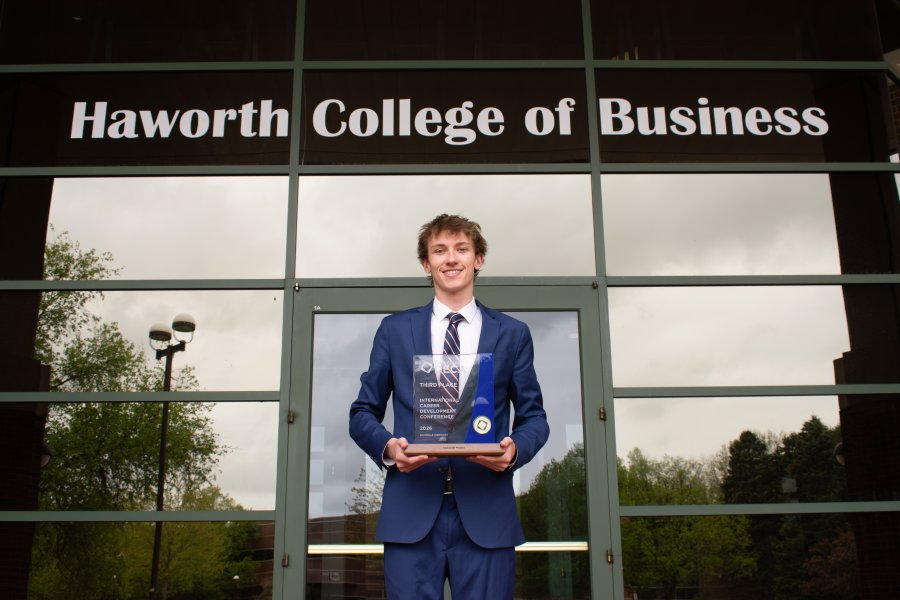
Liam Zoli found success in the corporate finance competition where he built a recommendation for an orthopedic implant manufacturer and placed third.
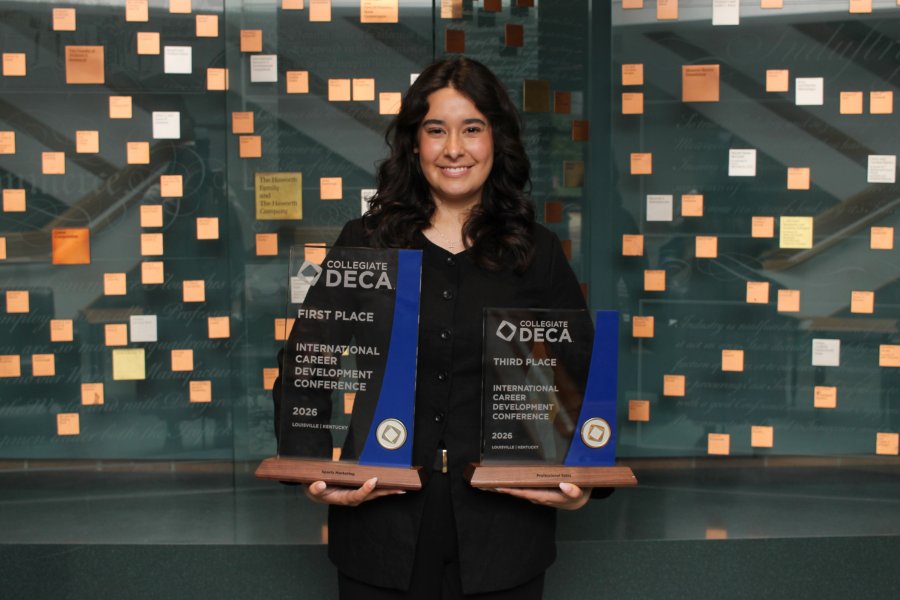
Double threat Alexis Ehlebracht placed first in sports marketing and third in professional sales. A founding member of DECA at WMU, she helped build the organization's engaging and supportive culture.
KALAMAZOO, Mich.— Western Michigan University business students once again distinguished themselves as top finishers at the Collegiate DECA International Career Development Conference, which included 1,200 competitors from across the world. At the competition in Louisville, Kentucky, WMU Haworth students tested their skills in a variety of competition categories—both prepared and extemporaneous. Five students placed in the top three in the international competition.
- Alexis Ehlebracht of Marcellus, Michigan, and Tatum Kral of Glen Ellyn, Illinois, placed first in sports marketing where they were asked to oversee the merger between two companies, interpreting a detailed case study and then creating a presentation within an hour.
- Lyndsey Sootsman of Kalamazoo, Michigan, and Mac Graham of Northville, Michigan, took second place in business ethics where they explored two cases. The first case focused on keeping children safe on online social gaming platforms while also considering the needs of all users. The second case dealt with an HR issue, specifically advanced HR metrics, and whether it’s ethical to make compensation and promotion decisions without clearly informing employees about changes to the way performance is being measured.
- Liam Zoli of Canton, Michigan, placed third in corporate finance where his work centered on capital investment analysis and strategic decision making. Given a case study for a publicly traded orthopedic implant manufacturer, he had 30 minutes to read the case and build a full presentation. He compared two mutually exclusive capital investment options, evaluating two financing structures and building his ultimate recommendation.
- Alexis Ehlebracht came in third in professional sales, an event that sets the task for competitors months in advance. Ehlebracht sold Tile Bluetooth Tracker to a consumer; in this case, the judge for the competition. Her approach involved getting to know the judge’s lifestyle and adjusting her sales pitch in real time so the interaction became a natural and relatable conversation, exemplifying “Selling the Western Way.”
“Seeing our students compete on an international stage is one of the best parts of my job,” says Madison Nichols, career development specialist and co-advisor of DECA at WMU. “At the Haworth College of Business, faculty and staff help business students develop career readiness skills like communication, leadership and critical thinking. Through the Collegiate DECA International Career Development Conference, our students apply those skills at the highest level. It’s amazing to be there to support them and witness their success. I know that it's only the beginning of their promising careers. "
Business is a team sport
Collaborating, embracing strengths and complementing each other—these are the hallmarks of DECA team competitions.
“Working with each other on the sports marketing presentation allowed us to combine our different skill sets and divide responsibilities, which helped us work more effectively than either of us could have alone,” says Tatum Kral. “Alexis and I were thrilled to make it to the finals as the only two-woman team. Earning first place was very meaningful, especially in a male-dominated event like sports marketing.”
For Ehlebracht, it was a full-circle moment. “Achieving a first-place finish as a senior means so much to me, especially as a founding member of DECA at WMU. When we started the organization, it was a small group with two weeks to prepare for our first competition, so to end my collegiate DECA career at the top with my best friend and freshman-year roommate really feels special.”
Approaching business issues from multiple perspectives is a strength of the team competitions. “DECA has sharpened my skills in several areas, but I think the strongest pieces that I will carry into my professional career are collaboration, research and strong communication,” says Graham. “Working closely with a partner under the pressure of time limits during extemporaneous competition forced us to divide responsibilities, look at each other for feedback and rely upon each other.”
Sootsman walked away from the first round of competition feeling that their team performance was strong, and she was pleased to learn that they qualified for the final round of competition, where they could test their skills against the best teams.
“DECA helps you take what you have learned in class and through limited professional experience and dials the pressure all the way up,” she says. “In a role-play, you are not acting as an entry-level employee who is still being trained. You are stepping into the role of a senior-level executive who is expected to understand the field, the company, and the issue at hand very quickly. That is what makes DECA so valuable. It pushes you to think, communicate and make decisions with a level of confidence that you may not fully have yet, but that you are working toward.”
Field experience
Zoli has participated in the Collegiate DECA International Career Development Conference multiple times, and each time he’s taken away something valuable from the experience of competing in his field of study.
“Professionally, this opportunity has given me real exposure to financial concepts, such as capital budgeting, cost of capital, and mergers and acquisitions due diligence. I've had to understand concepts deeply enough to explain them out loud, not just provide an answer on a test,” he says.
On a personal level, DECA has built Zoli’s confidence in high-stakes situations. “Every competition has made me better at organizing my thinking quickly, owning a recommendation even when I'm uncertain, and handling pushback from judges gracefully. Placing third internationally this year was validation of that growth. The process of preparing, building the analysis, stress-testing the numbers, and anticipating questions is where most of the development happens.”
Ehlebracht echoes this sentiment.
“Placing top three in a competition that directly aligns with my major is such a rewarding feeling,” she says. “This is my second time placing internationally in professional sales, and it really reinforces that I chose the right path. It’s one thing to learn sales in the classroom but being able to apply it in a competitive setting and succeed builds a whole different level of confidence. I’ve learned how powerful it is to connect a product to a person. The ability to quickly build rapport, ask the right questions and truly understand someone’s needs is what makes sales so interesting to me. Every conversation is different and that challenge is what I enjoy most.”
Ehlebracht credits much of her growth and success to WMU’s sales and business marketing program. “The program has given me the foundation to step into situations like this and perform at a high level while continuing to learn something new every time.”
Learn more about DECA at WMU and additional business student organizations.
For more WMU news, arts and events, visit WMU News online.