

WMU researchers identify the bot loop, reshaping how food brands reach the next generation of shoppers
KALAMAZOO, Mich.—In a major win for food marketers who want to make their brands stand out, researchers in Western Michigan University’s Haworth College of Business have successfully mapped out how artificial intelligence impacts which brands make the cut—and which ones don’t.
In their white paper “Breaking the Bot Loop,” Drs. Anezka Viskova-Robertson, Marcel Zondag and Russell Zwanka argue that food brands are increasingly chosen or bypassed in AI-curated environments long before consumers reach a shelf or a search bar.
The conceptual framework provides industry with a measurable view of AI-mediated shopping.
This “bot loop” is a repetitive system in which AI assistants, retail apps, social feeds and shopping agents filter, rank and personalize what shoppers see and then learn from how those shoppers respond. The result is a self-reinforcing loop that trains both the algorithm and the consumer on which brands do and don’t belong in the consideration set.
Winning the loop
To test their framework, the team ran a three-condition experiment with 295 Gen Z participants, comparing identical product information delivered by an AI assistant, a social media influencer and a traditional ad.
What were the results?
Data collected from experiment participants confirmed the framework's dual-track prediction: Younger shoppers trust the system and also reserve the right to override it simultaneously.
According to the research team, this seemingly contradictory finding is exactly what makes the research actionable for companies.
"Trust and agency are not opposites in this generation—they coexist,” says Dr. Anezka Viskova-Robertson, assistant professor of supply chain management at WMU Haworth. “Brands that design for both win the loop."
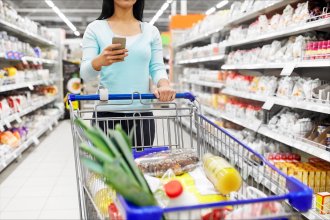
To do that, marketers need to think way beyond product presentation, especially as the next generation of shoppers joins the queue.
"The market starts before the shelf," says Dr. Russell Zwanka, director of the food marketing program at Western. "Gen Alpha is the first cohort raised with algorithmic curation as the baseline. If a brand is not optimized for the recommendation systems, it is slowly written out of the category, even if shelf execution is flawless."
A hiccup anywhere in the supply chain can affect a brand’s chances of reaching consumers, adds Zondag, director of WMU’s supply chain management program.
"This is not just a marketing story," he says. "Every out-of-stock teaches the algorithm a substitute. Fulfillment reliability, freshness and on-shelf availability now feed directly into how AI systems rank brands. A weak supply chain can train the algorithm to forget the brand.”
Putting the research into action: A pilot for industry partners
Based on this research, WMU Haworth is running a four-to-six-week confidential pilot program to help food and consumer packaged goods companies understand how artificial intelligence impacts brand visibility; how the addition of transparency and user controls affects shoppers’ reliance on algorithmic choices; and how AI marketing, influencers and traditional advertising work differently for the same products and audiences.
The pilot will focus on the following food and CPG categories: Snacks, frozen pizza, beverages, meal kits, cereal, dairy alternatives, school lunch items, convenience meals, private-label comparisons, retail-substitution scenarios and auto-replenishment simulations.
The pilot's focus will be on four measurable indices for any food or consumer packaged goods category:
Algorithmic preference index: The probability AI assistants and answer engines surface a brand versus the competitive set.
Override-resistance score: A segment-level read on which shoppers are entrenched in algorithmic choices versus persuadable.
Trust-control elasticity: How quickly override loosens when transparency and user controls are added to the experience.
Stimulus-source comparison: A head-to-head readout of machine-mediated, influencer and traditional advertising for the same SKU and audience.
To request the white paper or be considered for the pilot, email Dr. Marcel Zondag.
For more WMU news, arts and events, visit WMU News online.