
Good for the community. Good for business.
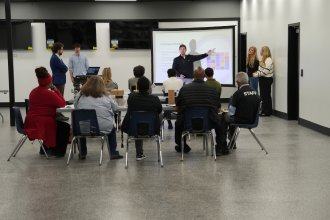
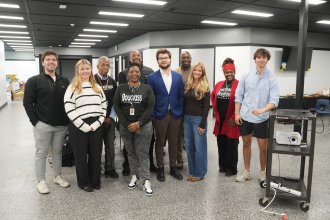
KALAMAZOO, Mich.—Most business courses end with an exam. This one ended with 41 teams of Western Michigan University students standing in front of the Kalamazoo organizations that had been counting on them all semester. These community partners had brought real problems, waited through a full semester and were about to find out what 204 students had built for them.
This spring, students enrolled in WMU Haworth’s Business Ethics and Sustainability course picked from 19 projects brought to the course by 11 organizations across the city. Working in small teams called “purpose pods,” they tackled challenges ranging from neighborhood economic development to city sustainability operations to housing insecurity. Each partner came with something specific they needed to be done.
The course runs on a direct premise: Ethics and sustainability aren’t moral arguments, they’re operational realities with direct implications for supply chains, workforce decisions, financial planning, product design and brand positioning. The question isn’t whether a business should care. It’s how to manage the trade-offs when it does. Students didn’t just write papers about what responsible business looks like. They built the plans, ran the numbers and designed the campaigns for organizations waiting on the work.
“An exam tells me what a student can recall under pressure,” says Teresa Greenlees, faculty specialist II of marketing at WMU Haworth, who led the spring section this semester and piloted a new project-based consulting component. “This project tells me what they can actually do with real organizations, real timelines and real people waiting on the other side.”
“This project tells me what they can actually do with real organizations, real timelines and real people waiting on the other side.”
Each purpose pod was four or five students, deliberately cross-functional: a marketing student, a supply chain student and an accountancy student all looking at the same problem from different angles. Students chose their projects based on interests, skills and the kind of impact they wanted to have. When the work got hard—and it did—they had access to Greenlees, the WMU Office of Service Learning and a 24/7 artificial intelligence coaching tool built specifically for the course.
“Teammates who go quiet, partners who are slow to respond, scope that keeps shifting—those aren’t obstacles,” Greenlees notes. “They’re previews of exactly what these students will face in their careers.”
Aubrie Hicks, a digital marketing major from Lansing, Michigan, came in as a marketing student. She left with a portfolio piece. Working with Housing Resources Inc., she built a digital marketing campaign from scratch using Meta Ads, identifying a target audience, writing ad messaging and structuring the campaign around a real budget and performance goals. “The most impactful part was realizing how marketing can directly support real community issues,” she says. “Creating messaging around housing insecurity made the project feel more meaningful, and it showed me the importance of reaching the right audience in the right way.”
The range of projects stretched across nearly every functional area of business. Justin Gish, sustainability planner for the city of Kalamazoo, asked students to investigate the feasibility of switching city landscaping operations from gas-powered to electric equipment, including surveying community members and landscaping professionals about the idea. “Having the students focus on this issue helped quite a bit,” Gish says. “I’m not quite sure when I would have gotten around to this work.” He plans to use their findings to justify the purchase of electric lawn equipment.
“Creating messaging around housing insecurity made the project feel more meaningful, and it showed me the importance of reaching the right audience in the right way.”
Other pods tackled transportation barriers for students in the Kalamazoo Innovative Learning Program, a mini-grant and microloan program for entrepreneurs in the Edison Neighborhood, cooperative housing feasibility for adults experiencing homelessness and operational expansion planning for Housing Resources Inc.
Lucy Whitney, campus education manager at Switch4Good, brought two projects: an Earth Day event and an environmental action campaign. Her organization advocates for plant-based diets as a climate solution, and she wanted students, the exact demographic Switch4Good is trying to reach, to develop the messaging. “These student projects injected the perspective of individual college students,” she notes. “We would have had to rely on aggregated market research data.” The Earth Day pods went further, doing in-person outreach to WMU students Switch4Good wouldn’t have reached.
At Communities In Schools of Kalamazoo, Kelly Leversee, volunteer services coordinator, brought students a problem her organization had been sitting on: the barriers marginalized youth face in accessing driver education and obtaining licenses. The students dug in. They researched costs, identified additional obstacles and developed solutions her team hadn’t considered. “They provided us with time, focus, research, new energy and ideas,” Leversee says. “Their energy and enthusiasm is contagious, and when challenged, they step up.” She has since shared their findings with The Kalamazoo Promise team, which is now in meetings with the Douglass Community Association to explore implementing a driver education program for Kalamazoo Public Schools students.
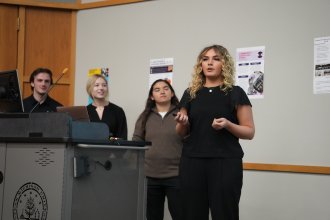
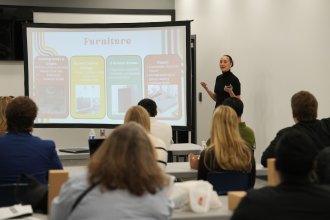
At the end of spring semester, students presented their work in a gallery-style format in the Schneider Hall auditorium, moving between displays and fielding questions from classmates, faculty and visitors. Two days later, teams presented to a judges’ panel for prizes. Final presentations followed at partner sites and on campus at WMU, where the audience included Kalamazoo Mayor David Anderson. One of the winning teams had worked with his office on a feasibility study and business plan for an affordable housing development he is currently seeking funding for. Anderson called the course one of the most meaningful examples of partnership between WMU and the city of Kalamazoo and said he hopes to see it continue.
The Business Ethics and Sustainability course is one of WMU Haworth’s most direct expressions of Experience-Driven Learning, the practice of students applying their skills to problems that matter beyond the classroom.
A graduation requirement for all WMU Haworth undergraduates, the course runs across multiple sections each semester and was built on a service-learning tradition established by Dr. Tim Palmer. This semester, Greenlees piloted the Impact Consulting Projects in her spring section as part of Project Impact, a dean’s office initiative examining how WMU Haworth should integrate societal impact into its programs and curriculum. The pilot was designed to test whether societal impact could be delivered through Experience-Driven Learning at mega-class scale. WMU Haworth holds AACSB accreditation, and community engagement is central to how the college measures the value of that education in action.
“Good intentions alone don’t create change. You need strategy behind them. If you can’t show how something creates value or reduces risk, it usually stays an idea.”
Kenan Tungkoye, a supply chain management major from Jakarta, Indonesia, walked into the course thinking sustainability was about caring. He walked out knowing it’s about making the case. “Good intentions alone don’t create change. You need strategy behind them,” he says. “If you can’t show how something creates value or reduces risk, it usually stays an idea.” Tungkoye eventually wants to go to Papua to build supply chain systems that serve local communities, a goal he came to WMU specifically to pursue. This course, he says, showed him what that actually requires. “I need more than a good heart. I need to embrace stakeholder thinking, understand trade-offs and make the business case so people will actually fund the project.”
That’s what a semester in Business Ethics and Sustainability produces: A body of work with real deliverables for real organizations. The course will continue next year across multiple Haworth sections. Greenlees plans to run the Impact Consulting Projects pilot again in her spring section, with a new cohort of students and a new set of community partners.
Learn more about the Haworth College of Business.
For more WMU news, arts and events, visit WMU News online.