

New engineering and applied sciences faculty usher in a bright future
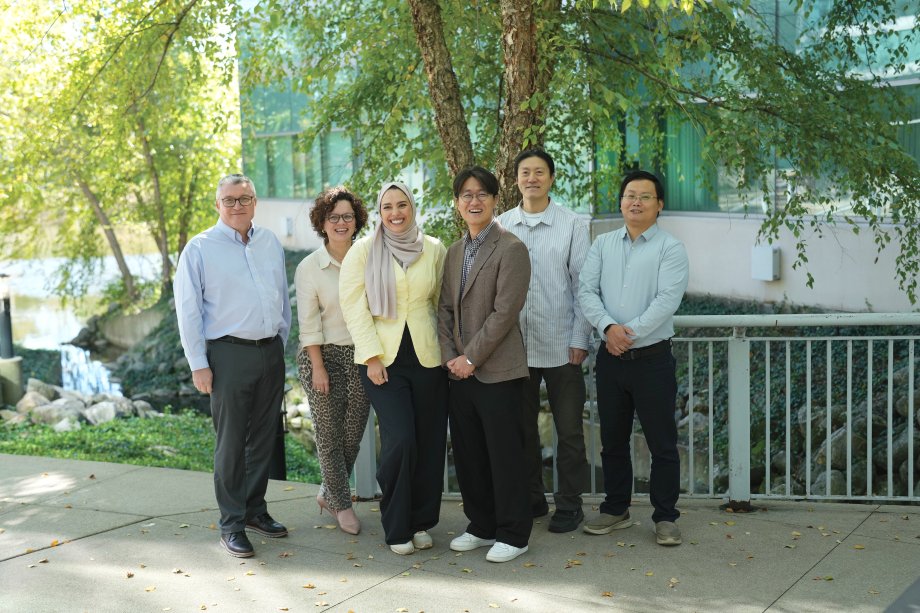
KALAMAZOO, Mich.—The hallways and labs of WMU’s College of Engineering and Applied Sciences are buzzing with the excitement of new faculty, who are developing impressive research projects, collaborating with innovative internal and external partners, seeking funding and leading a powerful new generation into the workforce.
Seven of these newcomers share their research and the ways in which their projects are developing at WMU.
New ideas and new collaborations
“My role is to identify interdisciplinary projects where our faculty can team–up,
and where their expertise is utilized in larger system-wide projects to advance the engineering knowledge for the benefit of the society.” – Dr. Radu Babiceanu.
With extensive administrative and research experience spanning more than 20 years, Babiceanu came to Western with a focus on workforce education and research accomplishments as society delegates more activities and decisions to machines.
“Workforce education is at the forefront of what we do. The most in-demand graduates will be those trained in many areas led by our department such as artificial intelligence, digital technology, smart hardware and software systems, electric power, battery technology,” says Babiceanu. “As chair, my research philosophy involves building collaborations within the department, college and across the university; identifying opportunities that align with our research; and forming productive teams that can compete for federal, state and industry funding.”
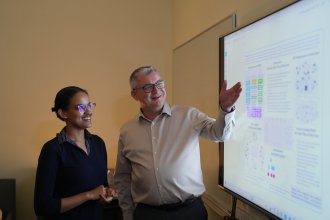
Babiceanu also remains current in his own research area, which has evolved toward design, analysis and operations of resilient systems from both the safety-critical design as well as cybersecurity protection characteristics.
“The importance of this cannot be overestimated,” says Babiceanu. “For example, in the aviation and aerospace domain, both safety and security design are foundational for the trust placed in flight operations. These systems must provide their required safe functionality even when facing unexpected disturbances.”
Babiceanu earned his Ph.D. in industrial and systems engineering from Virginia Tech.
Advancing a circular economy—where resources are shared, reused, repaired, refurbished and recycled—is at the forefront of Li’s research, which seeks to establish the relationship between renewable resources and the development of sustainable materials for
diverse applications.
develop their interests and achieve their future goals.” – Dr. Jinghao Li
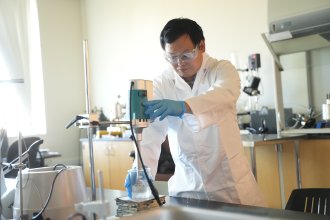
With federal, state and industry support, Li is turning byproducts from the pulp and paper industry, mushroom farms, and agricultural and forest residues into additives for use in sustainable pavement. This process produces byproducts such as polysaccharides that then can be turned into sustainable biofuel and bioproducts. The system provides a closed-loop solution that tackles multiple environmental challenges, promoting resource valorization, sustainable transportation, active agricultural and forest management, and wildfire risk reduction.
Beyond this, Li’s research spans biodegradable polymers and plastics, sustainable construction materials, energy efficient technologies, environmental remediation solutions, innovative fire suppression materials and related fields.
Li earned his Ph.D. in material science from the University
of Wisconsin-Madison.
“I have developed innovative technologies that leverage low-cost resources to create new types of functional materials. I hope to collaborate with relevant industries to apply these technologies in protecting people and property from wildfires and to deliver their benefits to society.” –Dr. Jinghao Li
With a unique background in understanding how high pressure affects polymer physics and chemistry, Park has been developing specialized scientific instruments to study these effects—an area pursued by only a few researchers due to its complexity. He also pursues research in medical adhesives and sustainability.
For one project, Biomedical Sealants from Biomass, Park is chemically modifying materials to mimic the adhesive properties of mussel feet, which can stick to surfaces even in wet environments. Park hopes to commercialize the resulting sealant for use as a liquid bandage or as a suture alternative.
“The ultimate goal is to develop commercially viable formulations, particularly for sealing lung punctures, a challenging medical issue with high demand for effective solutions,” says Park.
He also is developing ways to convert nonrecyclable plastic waste into usable, recyclable products and exploring repurposing coal waste. Each project uses alternatives for coal waste, particularly from steel manufacturing.
Park earned a Ph.D. in chemical engineering from McGill University, Canada.
"Understanding how pressure affects polymer physics and chemistry is critically important, as many chemical and mechanical processes occur under high-pressure conditions. Understanding material behavior under such conditions can lead to significant advancements in materials science and engineering.” – Dr. Heon Park
In the increasingly complex efforts to protect personal data, Lachtar is designing system-level defenses to prevent modern malware threats, with an emphasis on ransomware and cryptojacking, which aim at making financial profit. She is pursuing collaboration with students, research institutions and industry due to the complexity of her research, seeking to strengthen the technical foundation of her work.
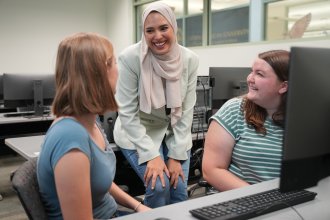
Along the way, Lachtar developed RansomShield, a lightweight detection system that uses deep learning to protect data. She is also researching ways to address cryptojacking that works on both the hardware and operating systems rather than other methods that focus on web-based attacks. Lachtar explores emerging malware trends and research at the intersection of quantum computing and cybersecurity.
Lachtar earned her Ph.D. in computer and information sciences from the University of Michigan-Dearborn.
“My goal is to build practical, efficient, and scalable security solutions that work in real-world environments. I focus on bridging the gap between research and application by developing tools that benefit both users and the academic community.” – Dr. Nada Lachtar.
Working with WMU Public Safety to ensure security on campus, Acar’s research efforts focus on developing on-campus patrolling using drones. The goal is to improve safety in campus-like settings by expanding surveillance coverage, with an emphasis on events such as graduation, homecoming and other large gatherings. Using drones will help Public Safety monitor these hard-to-reach areas more effectively and create a safer environment overall. The project uses various mathematical models for surveillance with plans to integrate computer vision to analyze drone video footage.
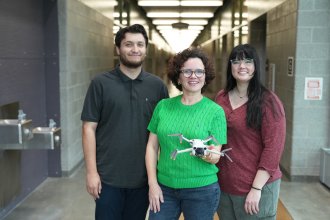
As WMU’s director of the Optimization, Data, and Decision Science Lab, Acar and her team are also developing post-disaster optimization using machine learning and drone-based mapping for humanitarian logistics. Additionally, one of the team’s doctoral students is investigating the applicability of the quantum optimization approach in solving drone routing problems.
Acar earned her Ph.D. in industrial engineering from Western Michigan University.
“Due to the nature of optimization, all problems in the real world can be solved. However, these projects cannot be completed by one person; they require teamwork. Thus, we are pursuing interdisciplinary teams to put effort into our projects.” – Dr. Ilgin Acar.
Lower back pain continues to pose challenges across many industries. Kang’s research aims to better understand and prevent low back pain in occupational environments by seeking to provide quantitative and qualitative evidence on ergonomic interventions, contributing to improved human-centered design.
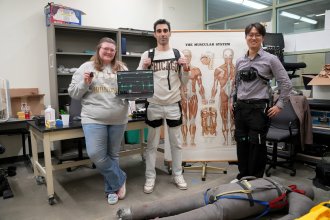
Kang’s team is using an artificial intelligence and machine-learning approach to predict lower back muscle fatigue and evaluating the effectiveness of wearable support systems in reducing lumbar tissue stress. Future efforts will focus on integrating wearable technologies with AI-driven analytics to provide real-time, individualized feedback. He plans to expand into human-robot interaction, neuroimaging and the application of immersive technologies to enhance training, rehabilitation, and remote collaboration in ergonomics and human performance research.
Kang earned his Ph.D. in industrial manufacturing and systems engineering from Iowa State University.
“I envision the convergence of ergonomics and biomechanics with emerging areas such as human-robot interaction (especially humanoid robot), aging workforce considerations, cloudbased data integration, and personalized training/modeling. My research will advance through the development of adaptive, intelligent systems designed to enhance physical performance and ensure safety in both aging and industrial populations.” – Dr. Sang Hyeon Kang.
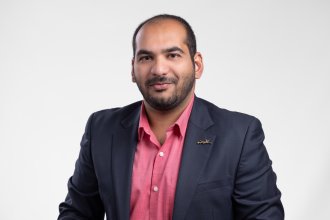
Inspired by nature, Pillay is focused on creating autonomous, intelligent swarms of satellites that can self-optimize for their mission without direct input from ground control. By applying artificial intelligence (AI) and machine learning (ML) techniques, Pillay seeks practical ways to intelligently control these cheaper-to-operate satellite swarms that could adapt to unforeseen circumstances such as collisions or failure. These satellite swarms could be used to capture space debris from damaged satellites or to survey the Earth and its atmosphere. Pillay also researches ways to enhance emergency medical services responses in urban areas using drones and seeks to develop machine-learning-based algorithms for generating efficient airfoil designs by emulating natural evolution.
Pillay earned his Ph.D. in electrical engineering from Wichita State University.
“My current goal is to determine which types of AI and ML schemes are most suitable for advancing the satellite swarm technology, and I hope to develop simulations that can validate my findings.” – Dr. Yrithu Pillay.
For more WMU news, arts and events, visit WMU News online.