

WMU experts in medicine, engineering and communication earn national recognition for efforts to reduce medication dosing errors for children
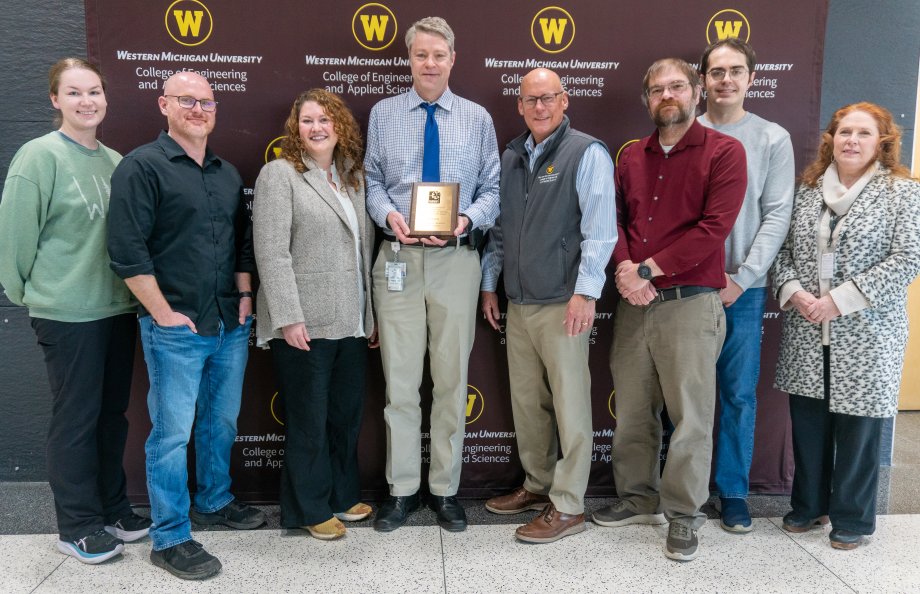
KALAMAZOO, Mich.—Breaking through long-standing norms, a team of interdisciplinary researchers from Western Michigan University and the WMU Homer Stryker M.D. School of Medicine (WMed) received national attention when they challenged conventions to engineer a solution that delivers meaningful change.
The team was recognized by the National Association of EMS Physicians (NAEMSP) for developing an innovative solution that resulted in a significant decrease in prehospital pediatric dosing errors. The project, “Augmenting the On-Scene Medic (ATOM): Development of a head-mounted display application to reduce prehospital medication errors,” earned the Best Pediatric Research Presentation Award at the 2026 NAEMSP Annual Meeting.
The award comes at the culmination of their three-year study, which showed the application the team developed reduced pediatric dosing errors from 52% to 6% in a large randomized controlled trial involving seven EMS agencies in Michigan and Indiana. The project was funded by a $1.37 million from the U.S Department of Health and Human Services Agency for Healthcare Research and Quality.
The study had an important objective—to reduce medication-dosing errors that occur when children are treated by emergency medical services. While EMS calls involving critically ill children are relatively rare, making up just 1 to 3% of all emergency encounters for paramedics, the incidents are intense and studies have shown that there is a 31% error rate across all drugs administered to children by EMS. Medications such as midazolam and fentanyl have higher error rates at 61% and 35%, respectively. The team completed extensive field research and developed an application for the Microsoft HoloLens, a popular wearable augmented-reality technology, to help paramedics more accurately deliver medications to young patients.
Medicine, engineering and communication come together
The power of bringing together experts in medicine, engineering and communication proved to be what the team calls the “secret sauce” and helped their diverse team view the pediatric dosing challenge through fresh perspectives.
“In this room [with the project team], everyone thinks differently. Bringing all these different perspectives together … it was 2 to the power of 10. We wouldn’t have gotten here without it,” says Dr. John Hoyle, MD, principal investigator on the grant, professor and chair of the Department of Emergency Medicine and associate dean for simulation at WMed.
The team also included:
- Dr. Tycho Fredericks, professor and chair of the Department of Industrial and Entrepreneurial Engineering and Engineering Management at WMU
- Dr. Bryan Harmer, a critical care paramedic and assistant professor of nursing at Creighton University and adjunct clinical assistant professor in the Department of Emergency Medicine at WMed
- Dr. Lee Wells, associate professor in the Department of Industrial and Entrepreneurial Engineering and Engineering Management at WMU
- Dr. Autumn Edwards, professor in the School of Communication at WMU
- Dr. William Rantz, professor in the Department of Aviation Sciences at WMU
- Kathryn (KC) Christopher, Ph.D. student in industrial engineering at WMU and affiliate faculty at Grand Valley State University
- Adam Lecznar, Ph.D. student in industrial engineering at WMU
- Sue Dunwoody, ATOM research project coordinator at WMed
“A good engineer can solve most problems given to them. A great engineer knows what problems to solve,” says Fredericks. “Our group from WMU’s College of Engineering and Applied Sciences on the ATOM project brought in expertise in design thinking, problem solving, data analytics, programming and usability.”
Edwards, a researcher in human-machine communication, looked at aspects like how bringing in this new technology could impact the EMS team and how they function with each other, and worked on the user experience for the application developed.
“I don’t think anyone in medicine has done a similar process—including design thinking and simulation—to approach a challenge like this,” says Hoyle.
The team ran 308 simulations, interviewed and interacted with 122 paramedics and EMTs, and developed 43 versions of their application throughout the project.
“It wasn’t a magic thing—it was hard work. The technology has shown great promise, and we are excited about the future,” says Fredericks.
“Our next steps are to seek out funding so we can build out the remaining clinical indications for the application and then get it out to paramedics for use in the field and for training,” says Hoyle. “This is not only a great clinical tool, but our EMS partners have said they would really like to have the ATOM software for their pediatric training as well.”
For more WMU news, arts and events, visit WMU News online.