
Opening text and CTAs
Pride Points
100%
of electrical and computer engineering graduates working full time have a job related to their degree
$70K-$80K
median starting salary for recent College of Engineering and Applied Sciences graduates working full time
98%
of College of Engineering and Applied Sciences undergraduates participated in Experience-Driven Learning
Pursue a bachelor's degree in computer engineering
Computer engineering deals with the research, development, design, operation and application of all forms of electronic digital components, smart systems, embedded computers, IOT, personal electronic devices and larger computers and systems.
In this program, you’ll get to study concepts and then learn by doing. You’ll work hands-on in labs to understand how digital devices and circuits work, explore things like digital signals, and see how computer hardware is built—from small embedded systems all the way up to supercomputers. You’ll also learn the programming skills that make computers and digital systems run.
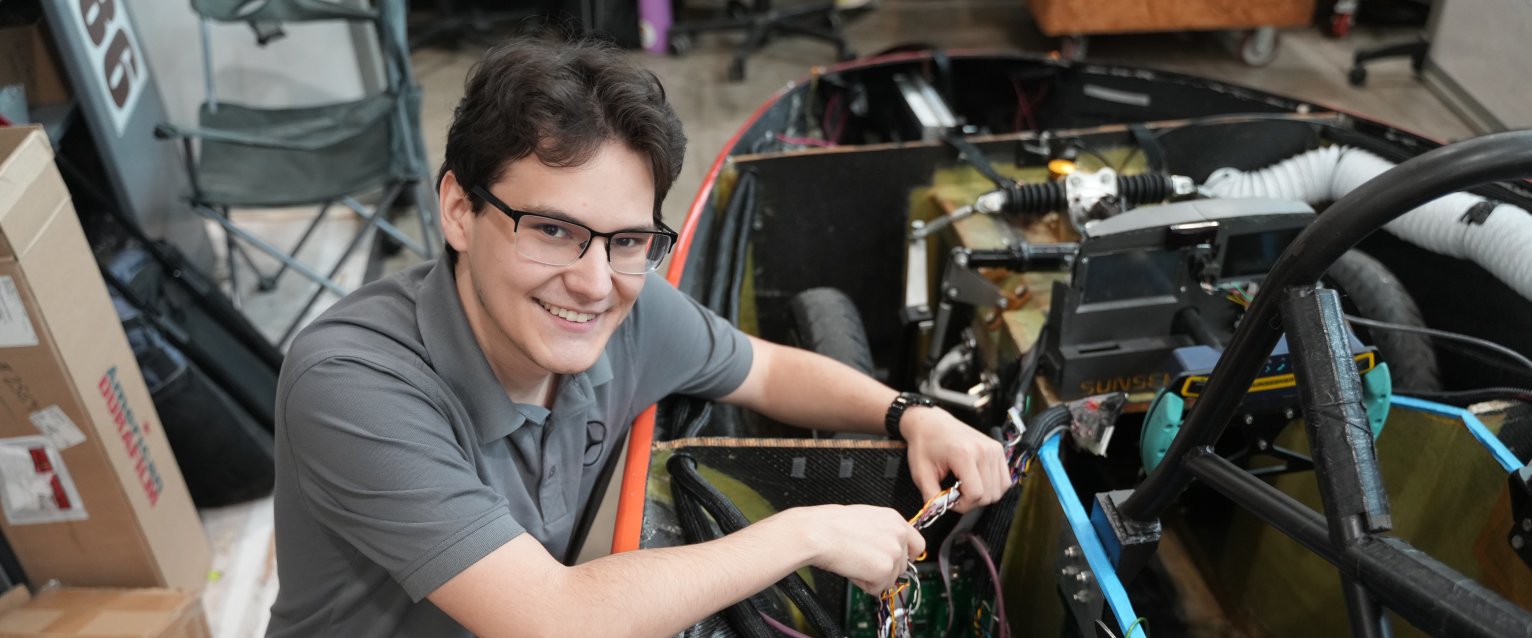
You will participate in hands-on projects with local industry and engage in research. With professors who are leaders in their fields and academic advisors who guide your progress, your time at WMU culminates in a Senior Engineering Design project where you will be part of a team completing a project for industry.
And if graduate school is in your future, you can save time and money with our accelerated master's in computer engineering program.
Project-based learning was probably the most important thing I did at Western. The classes, the clubs, the internships—all of them gave me hands-on experience that was invaluable.
What you'll learn
As a computer engineering student, you will learn to research, design and implement the operation and application of electronic digital computer systems. You will study the architecture and physical construction of digital computers as well as important programming aspects.
Because all engineers must consider non-technical as well as technical factors in the design process, you will also take courses in the humanities, social sciences and communication.
Design courses in your senior year cap off your studies and give you a practical, integrated experience in engineering design.
Core courses
- Circuit Analysis
- Computer Architecture
- Network Analysis
- Data and File Structures
- Digital Design
- Signal and System Analysis
- Microcontroller Applications
- Electrical Design
- Electronics
- Digital Logic
Camryn Ruiz, B.S.E’24
Where you'll be after graduation
Recent graduates of our program are working in roles such as automation engineer, embedded software engineer, software developer, project engineer and firmware engineer. They in diverse industries at companies such as Ford Motor Company, Intel, DENSO, FEMA Corporation, Stryker, Gentext, Control System Integrators and more.
What others have achieved


Making the most of your learning experience
Professors and advisors will support your participation in real-world experiences that will set you apart when you launch your professional career. You'll make lifelong friends and apply your skills by joining student organizations such as WMU Computer Club and Bronco Cybersecurity Club. Internships and co-ops will all boost the knowledge you build in your coursework. Your time at Western culminates in a Senior Engineering Design project, where you will team you up with peers and industry to apply your knowledge to a real world project.
What scholarships are available for computer engineering students
A number of scholarships are available for students enrolled in the computer engineering program at Western. We encourage you to apply for all scholarships that match your interests, career goals and financial or academic needs.