Bachelor of Science in Nutrition and Dietetics

Summary

Dietetics is an allied health field that builds on the foundation of life and social sciences. The nutrition and dietetics program provides the graduates with the food and nutrition knowledge needed to promote good health and prevent chronic diseases. The undergraduate program in nutrition and dietetics at Western Michigan University leads to a Bachelor of Science degree and is accredited by Accreditation Council for Education in Nutrition and Dietetics of the Academy of Nutrition and Dietetics as a didactic program in dietetics.

Program Stats

97%

of College of Education and Human Development graduates working full time have a job related to their degree

——2024-25 Career Outcomes Report

98%

of College of Education and Human Development graduates participated in Experience-Driven Learning

——2024-25 Career Outcomes Report

95%

of College of Education and Human Development graduates working are satisfied with their job

——2024-25 Career Outcomes Report

Pursue a Bachelor of Science in Nutrition and Dietetics

Do you want to make a difference in the community? Do you want to educate and empower people to make healthy choices? Then the Bachelor of Science in Nutrition and Dietetics is right for you.

Through the Department of Family and Consumer Sciences, you will receive a well-rounded education alongside a robust grounding in nutrition, dietetics, and related sciences. The program emphasizes the integration of theory, research, and practical application within the profession. Its curriculum fulfills the didactic requirements of the Academy of Nutrition and Dietetics, positioning you to apply for accredited internships after graduation.

In addition to completing the nutrition and dietetics program, students must complete a dietetic internship and pass the registration examination for dietitians in order to qualify for certification as a registered dietitian nutritionist. Students apply for admission to internships during the last semester of their senior year or after graduation.

What you’ll learn

This program provides a strong scientific foundation in food and its impact on health, covering topics from biochemistry to medical nutrition therapy. You'll also learn essential communication and assessment skills, often serving as the first step towards becoming a registered dietitian nutritionist.

Student quote

Western provided an atmosphere for learning and growth, laying a foundation for me to become a well-rounded student.
— Anja Grommons (B.S.'15), RDN

Where you’ll be after graduation

Upon completion of this Bachelor of Science degree, you will be equipped with the skills needed for the graduate internship program and Master's degree at Western Michigan University, both necessary to become a registered dietitian nutritionist (RDN). Alternatively, you are able to pursue a career as a nutrition coach, dietary aide, food service associate and more. 

For 95% of College of Education and Human Development grads, they got that job or got into that graduate school program after graduation. That is because your journey of self-discovery begins the moment you step on campus. At WMU's Career and Student Employment Services, career specialists help you align your passions and abilities with future careers and advanced degrees. They will connect you to practical experiences like internships, job shadowing, research projects and professional mentors.


What others have achieved

Learn about the successful journeys of recent program graduates and the advice they have to share for prospective WMU students.
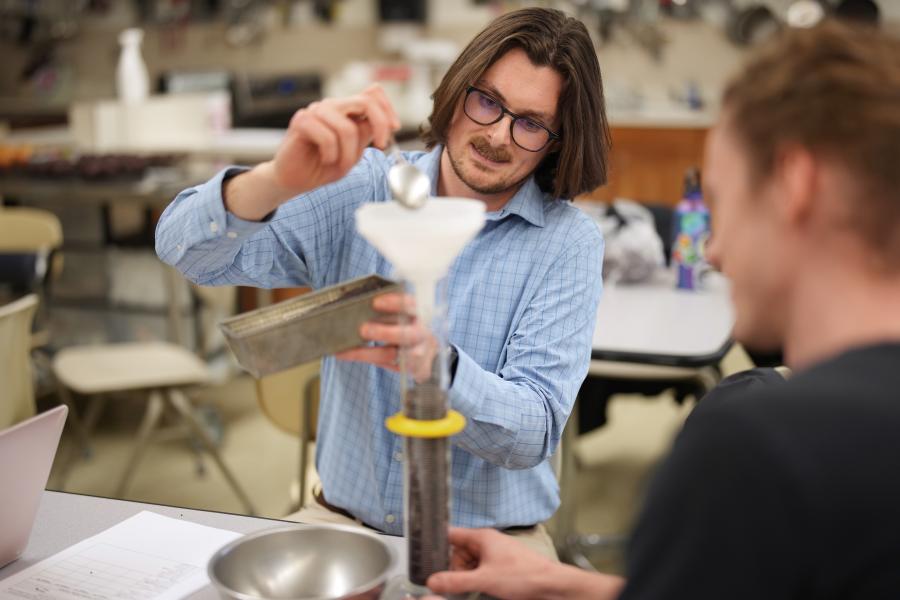
Derek Fischer measures ingredients for a recipe.

Meet Derek

Derek went from fixing steering systems in military helicopters to helping steer patients toward healthy nutritional choices—and he couldn't be happier.

Meet Anja

Discovering her passion for nutrition at WMU, Anja is now a pediatric clinical dietitian and designs interventions for patients to meet their specific needs and health goals.

Making the most of your learning experience

In the College of Education and Human Development, you'll embark on an incredible journey of experiential learning that goes beyond textbooks. Collaborating closely with faculty members, you'll dive into cutting-edge research, fieldwork and professional pursuits. Pushing the boundaries of the traditional classroom, you'll gain practical skills and make a tangible impact.

As a nutrition and dietetics major, you will receive strong support from current professionals in the Greater Kalamazoo and Southwest Michigan area. Local RDNs provide opportunities for externships, mentor students, and work closely with the Student Dietetic Association. This robust network ensures that you'll gain invaluable practical experience and build vital professional relationships even before graduation.

Banner Image

table with food and nutritionist items

Are scholarships available?

Yes! You've put in the hard work—now it's time to see your reward.

Scholarships are an excellent way to help the reduce the costs of higher education. Whether you are entering college for the first time, transferring to WMU from another institution or returning from a gap in your education, be sure to check out our scholarship options. Students earn scholarships for financial need, academic success and promoting multicultural awareness. Most are offered on a competitive basis.

Additional admissions requirements

All students are initially admitted to the pre-nutrition and dietetics program when they apply and are accepted to WMU. After successful completion of the required pre-dietetics courses, they apply for admission to the nutrition and dietetics professional program. Applications are due by Sep. 28 of the semester prior to entry into the three-semester professional program. The admission criteria and application procedures are described below:
  • Completion of the following pre-nutrition and dietetics courses with a grade of "C" or better
    • ENGL 1050: Thought and Writing
    • BIOS 1120: Principles of Biology
    • BIOS 2400: Human Physiology
    • BIOS 2320: Microbiology of Infectious Diseases
    • CHEM 1100/1110: General Chemistry I w/ Lab
    • CHEM 1120/1130: General Chemistry II w/ Lab
    • CHEM 3700/3710: Introduction to Organic Chemistry w/ Lab
    • FCS 2600: Nutrition
  • Achievement of a cumulative grade point average of 3.0 or better
  • Completion of the majority (70%) of WMU's general education requirements is strongly recommended prior to applying to the Nutrition and Dietetics program.
  • Completion and submission of a formal application to the Department of Family and Consumer Sciences where the nutrition and dietetics program is housed
    • A non-refundable application fee of $30 (paid electronically immediately following application submission)

Students will not be allowed to enroll in professional nutrition and dietetics courses at the 3000-level or above until they have been admitted to their professional program.

Additional information

In addition to completing the nutrition and dietetics program, students must complete a dietetic internship and pass the registration examination for dietitians in order to qualify for certification as a registered dietitian nutritionist (RDN). Students apply for admission to internships during the last semester of their senior year or after graduation. Appointment to internships is competitive. Students are selected on the basis of a variety of criteria including grade point average, work and volunteer experience, and recommendation letters. Most dietetic internships require that applicants have a GPA of at least 3.0. Beginning in January 1, 2024 the entry-level registration eligibility education requirements for the Registered Dietitian Nutritionist credentialing exam will change from a bachelor’s degree to a master's degree. Program graduates that decide not to pursue a dietetic internship or not to pursue one immediately after graduation are eligible to sit for the Nutrition and Dietetic Technician Registered (NDTR) credentialing exam.

Graduates of the Didactic Program in Nutrition and Dietetics who earn their Nutrition and Dietetic Technician Registered credential or go on to earn their Registered Dietitian Nutritionist credential and want to practice as Dietitians/Nutritionists may need to apply for licensure before they are eligible to do so. Licensing statutes include an explicitly defined scope of practice, and professional practice is illegal without first obtaining a license. A list of the states that require licensure is available on the Commission on Dietetic Registration website

Licensure is not currently required for practice as a dietitian or a dietetic technician in the state of Michigan.

Additional information about the program’s curriculum, policies and procedures, the process of applying to post-graduate internships and career opportunities in dietetics are included in the Didactic Program in Nutrition and Dietetics Student Handbook.

The mission of the Didactic Program in Nutrition and Dietetics is to provide graduates with foundational knowledge in dietetics and related disciplines, and the opportunity to develop professional skills and attitudes that will prepare them for post-graduate internships, advanced degree programs, and entry-level employment in dietetics related fields. The program prepares graduates who can address the food and nutrition needs of diverse individuals, families and communities.

Program Goals:

Goal 1—The program will prepare graduates who are competent for entry into dietetic internship programs and first professional employment in dietetics related fields.

Objectives and expected outcomes for goal 1:

  • At least 80% of students complete program requirements within 3 years of admission (150% of the program length).
  • Mean overall GPA of graduates will be 3.0 or higher.
  • At least 60% of graduates apply for admission to supervised practice programs prior to or within twelve months of graduation. 
  • At least 70% of program graduates who apply to supervised practice programs are admitted within twelve months of graduation will be accepted.
  • The program's one-year pass rate (graduates who pass the registration exam within one year of first attempt) on the CDR credentialing exam for dietitian nutritionists is at least 80%.
  • At least 85% of program graduates will receive a mean rating of 3 or better (out of 5) on all measures evaluated by their supervised practice program directors.
  • At least 85% of first employers rate graduates competent or better on all measures evaluated (3 out of 5). 
  • At least 80% of alumni survey respondents rate the various voluntary activities as “useful” in preparing for dietetic internships or first professional employment in dietetics related fields.
  • At least 80% of alumni survey respondents who participated in DCSP report their DCSP experience was "useful" in preparing for the dietetic internship or first professional employment in dietetics related fields.
  • At least 85% of senior exit survey respondents rate the quality of their education at WMU nutrition and dietetics program as “satisfactory” or better.  
  • At least 85% of alumni survey respondents rate the quality of their education at WMU nutrition and dietetics program as “satisfactory” or better.

Goal 2—The program will produce graduates who contribute to the pool of allied health and food and nutrition professionals in Michigan and beyond its borders.     

Objectives and expected outcomes for goal 2:

  • At least 80% of follow-up alumni survey respondents accepted into supervised practice programs who sought employment are employed in an entry level dietetics related position within twelve months of completing their internship program.
  • At least 60% of follow-up alumni survey respondents who did not apply or were not accepted into supervised practice programs and did not enroll in graduate school full-time and sought employment are employed in a dietetics related profession within twelve months of graduation.
  • Over a three year period, of those graduates who found employment within 12 months of graduation, at least 60% are employed in Michigan.

Goal 3—The program will train graduates that value professional development and lifelong learning. 

  • At least 50% of follow-up alumni survey respondents are actively enrolled in or have completed a master’s degree or professional credential or certification. 
  • At least, 30% of follow-up alumni survey respondents report active participation in professional activities, such as one or more of the following:
  • Served as a dietetic intern preceptor
  • Spoke at a professional conference
  • Coordinated a community food or nutrition initiative
  • Attended at least one state or national-level program sponsored by a professional dietetic, food service, or health related association
  • Participated in activities in district dietetic association
  • Held professional office or appointed to committee for local, state or national group
  • Wrote an article or letter to the editor or legislator on a dietetics-related topic
  • Created and maintain social media account for the purpose of using professional nutrition or dietetics-related knowledge to communicate with professional or lay audience
  • Spoke to lay or student audience about health, nutrition-related topic
  • Other

** Program outcomes data are available on request. 

In order to receive the Bachelor of Science degree in nutrition and dietetics the following graduation requirements must be met:

  1. Completion of all courses required for B.S. in nutrition and dietetics degree including general education courses, with no incomplete (I) grades (see current degree requirements).
  2. As of fall 2010, students admitted to the pre-nutrition and dietetics program need to officially apply for admission to the professional component of DPD and be admitted.
  3. Completion of at least 122 semester hours of credit, of which at least 60 semester hours must be credits from four-year baccalaureate degree granting institutions and at least 30 semester hours must be credits from WMU. Of the last 30 semester credit hours required for the degree, at least 10 semester hours must be WMU credits.
  4. A maximum of 15 credit hours of correspondence or self-instructional course work may be applied towards completion of degree requirements. This rule does not apply to online courses.
  5. Attainment of a minimum of 2.0 grade point average in the major and cumulatively.
  6. All courses on the nutrition and dietetics program guide must be completed with a minimum letter grade of "C".
  7. Student must pay all fees owed to the university.
  8. Student must complete all graduation-related paperwork including graduation audit.
  9. Western Michigan University does not impose a time limit on completion of a Bachelor of Science degree. If a student does not take courses for one calendar year or more, then decides to complete degree, he/she is allowed to follow the catalog used at the time of initial admission. However, if the DPD curriculum has changed during student's absence, he/she will not be issued a verification of program completion, unless additional course(s) deemed necessary to update knowledge are completed.

WMU DPD will issue a verification statement (completion document) to all students who successfully complete the requirements of the Didactic Program in Nutrition and Dietetics. Students will use this document to prove their completion of the program for the application to Dietetic Internship programs and eligibility to take the Nutrition and Dietetic Technician Registered (NDTR) Examination.

Verification statements can only be issued to students who have completed at least 21 upper division credits of their professional nutrition and dietetics courses at WMU. 

Program graduates are eligible to apply for post-graduate internship programs. Students apply for admission to internships during the last semester of their senior year or after graduation. See accredited dietetic internship programs for a list of internship programs available in different states. 

Student Dietetic Association

The Student Dietetic Association (SDA) is the registered student organization in which nutrition and dietetics majors participate. Membership in SDA is the stepping stone for involvement in the profession. SDA provides the students with the opportunity to:

  • interact with fellow nutrition and dietetics majors.
  • refine leadership skills.
  • stay informed about events hosted by district dietetic association.
  • find out about scholarships/fellowships provided through the state and national dietetic associations as well as other organizations.
  • provide service to the community.

Monthly meetings provide a vehicle for planning and coordinating the associations' activities. Follow SDA on Instagram.

Dietetic Community Service Program

The Dietetic Community Service Program (DCSP) is the WMU nutrition and dietetics program's voluntary field experience. Through involvement with DCSP, WMU pre-nutrition and dietetics and nutrition and dietetics students are linked to dietitians and food service professionals in Kalamazoo and surrounding areas for mentorship opportunities. The experience gained from participation in DCSP better prepares students for application to post-graduate internships and a future career in dietetics. For more information on participating in DCSP, please contact Dr. Ping Ouyang.

Frequently asked questions

A Nutrition and Dietetics degree from Western Michigan University can prepare students for careers related to food, nutrition, health, wellness, community education, clinical nutrition, and food service. It can also support students who plan to pursue the additional supervised practice and credentialing required to become a registered dietitian nutritionist.

Graduates may pursue roles such as nutrition educator, wellness coordinator, community nutrition assistant, food service manager, dietetic technician, public health nutrition support specialist, or nutrition program coordinator. Some advanced roles require additional credentials, supervised practice, or graduate study.

A Nutrition and Dietetics degree can be an important step toward becoming a registered dietitian nutritionist, but additional requirements typically include supervised practice, passing a national exam, and meeting current credentialing standards. WMU advisors can help students understand the pathway and next steps.

Students may build skills in nutrition science, food systems, health promotion, medical nutrition concepts, menu planning, food service management, communication, counseling basics, and evidence-based decision-making.

Yes. Nutrition and Dietetics can support careers in healthcare, wellness, public health, community nutrition, food service, and health education. Specific roles may depend on credentials, experience, and whether a student completes additional professional training.

Yes. Western Michigan University offers graduate programs that may allow Nutrition and Dietetics students to continue their education at WMU. Advisors can help students explore graduate options, understand admission requirements, and plan the next step in their academic and career path.

Yes. Western Michigan University offers scholarship opportunities, and a dedicated scholarship specialist can help students explore available options, understand eligibility, and navigate the application process.