

A Working Artist, Rachel Stickney Builds a Business Around the Book Arts
KALAMAZOO, Mich.—Rachel Stickney is a business owner, sells her work on the regional art fair circuit, teaches book arts classes and is regularly awarded grants and project funding, alongside an active ceramics practice. She introduces herself simply as a working and teaching artist, and as a book artist, a term that reliably sparks curiosity and conversation wherever she says it. It's a title that still feels a little "imposter-y" to claim out loud, she admits, even though her success backs it up every time.
Stickney graduated from Western Michigan University's Gwen Frostic School of Art in 2015 with a BFA in Painting and a minor in General Business. She trained as a painter. Her career, as it turned out, would evolve into something else entirely.
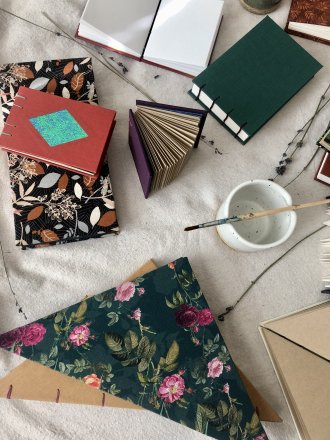
Like a lot of her peers, Stickney took a break from art after graduation. She made work inconsistently, without a clear focus, for years. It wasn't until the pandemic that she felt the pull back.
"That's when I picked up bookbinding again and dove headfirst into book arts with intention," she said. "My practice started to change, and I felt I had my creative voice back."
She still paints and draws for herself, but her professional focus shifted to book arts and ceramics, a direction she didn't plan for and has come to love.
An internship built the foundation
Stickney traces the shift back further, to an internship at the Kalamazoo Book Arts Center, a nonprofit studio and gallery space, that started while she was a student in Jeff Abshear's Writing About Art class. A connection to the Kalamazoo community that still exists for fine arts students today.
"I had no idea that interning there would change my life," she said. "It was there I learned about bookbinding, paper arts, typesetting, teaching classes, running a store and scheduling programming. I didn't realize it then, but they set me up to understand the full spectrum of responsibilities in running a creative nonprofit."
That range, production, retail, education and operations, is the same range she now manages as a business owner. She stays in touch with several of her WMU professors today, and also names Cat Crotchett and Sydnee Peters as mentors that helped shape her career in the art world.
Starting a book arts business
Parallax Book Press started as a way to reach a wider audience with what she was already making, in a more commercial format. Drawing on her own experience as a working artist, Stickney designs sketchbooks, journals and tools using high-quality papers, fabrics and threads.
Early on, she applied to a major regional art fair with no prior experience selling her work. She got in.
"It was a steep learning curve, but I loved it, and now I do art fairs regularly," she said.
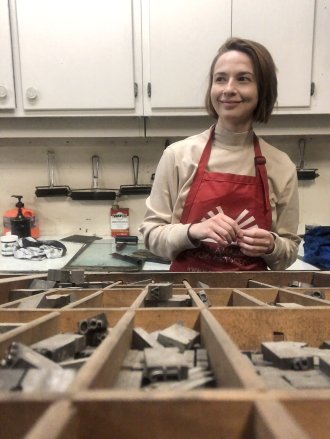
Stickney treats her creative practice and her business operations as separate functions, with dedicated time for each. Studio time is for making. Admin time, the unglamorous work of applying to shows, maintaining a website, applying for grants and scheduling classes, is what keeps the business, and the art, moving forward.
She also holds a separate day job unrelated to her creative work.
"By having a non-creative, whatever job, I actually get a lot of my ideas when my mind has a break," she said. "I keep a notebook on me all the time to write down ideas, then develop them further during my studio time."
By her own measure, she has arrived at a place she wasn't sure she'd reach as a student: consistently entering and getting into shows, teaching regularly, producing new work and pursuing grant and project funding.
"I had to learn that by doing," she said, "and now it is second nature."
Advice for the next generation
Stickney was once the nervous high schooler weighing whether art could be a real career. Her advice points students toward the breadth of the field: libraries, museums, galleries, outreach, nonprofits and programming roles, all connected to a studio art foundation even when the connection isn't obvious at first.
She also points to the job skills built into art training that translate directly to the workforce: project and time management, maintaining studios and shared equipment, managing project budgets, staying on top of deadlines and correspondence and holding respectful conversations during critique.
"You can do it, baby artist," she said.