

Ask, don’t answer: WMU professor uses AI tools to boost student engagement
In 2022, generative AI chatbots took the world by storm. Their ability to answer questions on anything from Dostoyevsky to data science in an instant was shocking, exciting and, for many, frightening. Now, in 2026, chatbots have become part of ordinary life. But in Dr. Rodrigo Aranda’s classroom, they’re being put to a use that’s anything but ordinary.
An opportunity for AI
Department of Economics Chair Dr. Michael Ryan says one of Aranda's many strengths is helping students understand why economics matters through an involved, hands-on and motivational teaching style. So, when AI tools burst onto the scene, Aranda saw a golden opportunity to take that approach even further.

Research has shown that actively recalling information, rather than simply recognizing a correct answer, can strengthen long-term knowledge retention. That's why general-purpose chatbots like ChatGPT — designed to produce answers as quickly as possible — aren't necessarily effective teachers. Recognizing an opportunity, Aranda decided to build his own large language model (LLM) to enhance his classroom efforts.
With funding from two internal grants — the WMUxAI Teaching Innovation Grant and the WMU Office of Faculty Development Instructional Development Grant — and in collaboration with nearly a
dozen students, he developed OpenSocratic, an innovative economics chatbot trained solely on course material that serves as a personalized, 24/7 tutor.
"I would love it if after every week of class, I'm able to sit down for 10 to 15 minutes with each of my students and go over everything that they learned in class," says Aranda, assistant professor of economics. "But I don't have time to do that. It's mathematically impossible. But with AI, I can do it, and I can personalize that experience."
Aranda stresses that OpenSocratic is not a homework-completing machine. Instead, it draws on the Socratic method, using dialogue and open-ended questions to guide students toward their own conclusions. When a student asks a question, OpenSocratic won't simply hand over the answer. Instead, it responds with questions that move them closer to solving it themselves.
Real results
It quickly became clear that the chatbot wasn't just a shiny new piece of tech — it worked.
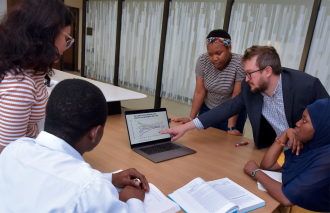
Students gained confidence with challenging concepts, articulated their understanding more clearly and reported stronger long-term retention, Aranda says.
"It is groundbreaking stuff," Ryan says. "He is having students interact with AI in a way that's helping them learn, helping them use the tool properly and then helping them recognize places where they don't know the material as well as they should and then guiding them on how to do that."
By combining emerging technology with strong liberal arts principles, Aranda’s students are not only performing better in their economics classes but also gaining the technological skills they need to enter a workforce increasingly influenced by AI.