
WMU partners with community to support K-12 education
The mission of the College of Arts and Sciences to ignite a passion for learning and discovery reaches well beyond WMU. Each year, faculty, staff and students from across the college partner with members of the broader community to bring engaging and accessible educational opportunities to learners of all ages.
Last November, the Department of Mathematics hosted the first-ever Kalamazoo Math Carnival, which attracted over 400 K-8 students from over 60 area schools. These students and their families gathered to explore mathematical concepts through a variety of creative games and activities.
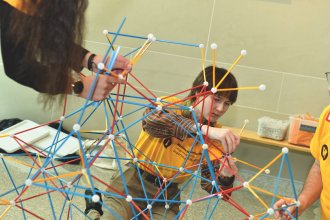
At first glance, the 30 activity stations hardly resembled the mathematics teaching some students encounter in classrooms. Instead of simply solving equations or memorizing formulas, the participants enjoyed card games, demonstrations of math applied to animation, logic puzzles, a barn raising using a geometric model and even the creation of a community polytope sculpture made from plastic sticks.
“The genesis [of the Kalamazoo Math Carnival] was to form a space for experiencing math in a way that complements what kids are learning in school but show them that math can have lots of different flavors,” says associate professor Dr. Mariana Levin, who organized the event.
She hoped to help students and their families see past math’s reputation as a difficult subject by appealing to their sense of curiosity.
“Math is a human construction, and we get to be a part of that,” says Levin. “It’s constructive. It’s creative. There’s an aesthetic piece. There’s wonder, and I think the wonder is very important.”
The event was just as educational for participants as it was for the aspiring math teachers from WMU’s elementary education program who facilitated the activities. The WMU students spent a month rehearsing for the event, so that they would be prepared to walk children through the steps of each activity while encouraging independence and critical thinking.
WMU alumni and area organizations including The Montessori School, Kalamazoo Valley Community College, the Julia Robinson Mathematics Festival, the MiSTEM network and the MathHappens Foundation also contributed to the carnival’s success by helping to provide and run activity stations.
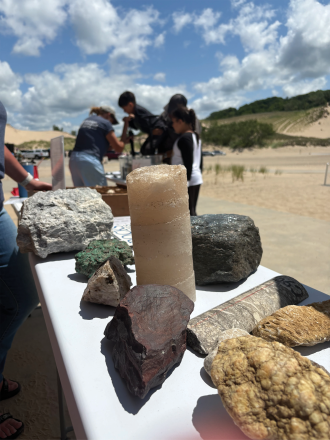
The Department of Geological and Environmental Sciences is also passionate about providing creative enrichment through hands-on learning. For years, it has collaborated with the Michigan Geological Survey to administer CoreKids, a program designed to generate awareness of and interest in the geosciences among K-12 students.
CoreKids offers schools and nonprofit organizations free educational programs and resources, including rock and fossil samples and technological tools.
“It doesn’t do anyone any good to make information if no one can get access to it,” says Lisa Wininger, the manager of outreach and education for the Michigan Geological Survey. “We’re dedicating time and resources to getting resources that anyone can use.”
It’s a win-win solution: teachers get learning tools designed by experts in the field, and the CoreKids team gets students excited about earth science.
“Teachers are busy people, and they have so much on their plates,” says Wininger. “We incorporate 3D printing and GIS mapping, and we can provide that all inclusive.”
This past year, she collaborated with geologist and WMU doctoral student Rosa Carolina Ayala Calvo to design “The Stories Fossils Tell,” an elementary school science unit that teaches students to analyze fossils and use their findings to reveal information about Michigan’s geologic history. They worked directly with elementary students and teachers to develop the unit. Feedback and pilot sessions helped to shape an engaging activity, for example, by intentionally incorporating students’ interest in dinosaurs.
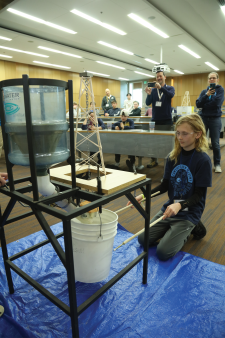
Science Olympiad is another opportunity for WMU to support middle and high school students interested in the sciences. For over 20 years, the College of Arts and Sciences has partnered with the College of Engineering and Applied Sciences to host a regional Science Olympiad competition. Last March, approximately 750 students from nine counties, together with coaches and supporters, gathered for an action-packed day on WMU’s campus. Teams of middle school and high school students competed in more than 40 events across a breadth of scientific disciplines. The events, which change each year, are designed and run by WMU students, staff and faculty as well as alumni and community members. This year, more than 200 volunteers helped to make the event a success.
But Science Olympiad isn’t just a place for competitors to show off their scientific prowess. It’s a chance for them to learn teamwork and to make great memories on WMU’s campus while connecting with the WMU students, staff, faculty and alumni who volunteer to facilitate the competition.
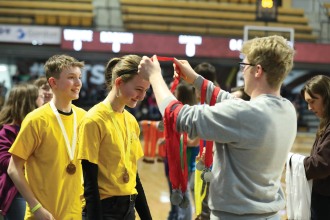
Steven Case, manager of recruitment and outreach for the College of Arts and Sciences, is always amazed by the excitement teams bring to the awards ceremony.
“You’d see them jump up when their names were called,” he says. “There was a buzz.”
Next year, WMU will host not only the regional Science Olympiad competition in March, but also approximately 2,000 participants in the state finals competition in April.
The Department of History has long served as host for its own version of Science Olympiad. Since 2015, the department has hosted the annual district competition for Michigan History Day, a competition in which students from grades three through 12 present projects individually or as a group to a panel of judges. Over 100 students participated in the 2026 competition last March after completing months of research at libraries, museums and via oral interviews. Participants choose their own topics, competing in project categories that include exhibits, papers, performances, websites or documentaries. The top three finishers in each age division and category are invited to the state competition, with the top two entries in the junior and senior divisions at the state level receiving an invitation to compete at National History Day.
“It gives students an opportunity to explore the past in the medium they’re most interested in,” says associate professor Evan Kutzler, who helped plan this year’s event.
He believes that the most important part of History Day is exposing students to the peer review process. Each student receives feedback on their work from a panel of judges comprised of history faculty, students and community members. Those who advance to the state and national levels refine their work based on these comments.
“We’re encouraging revision,” says Kutzler. “We’re encouraging improvement along the way.”
History Day is designed to foster broader interest in the study of the past and to teach critical thinking skills that are applicable across fields of study.

“I hope that it creates an appreciation for the work that goes into what we consider to be historical content and that it would make students better consumers of that information and better thinkers,” says Kutzler.
The event also offers students a chance to engage with professional historians. Members of the Zhang Legacy Collections Center, the Kalamazoo Valley Museum and local organizations such as the Daughters of the American Revolution served as judges last year, providing students with valuable insights from content experts who bring a diverse range of real-world professional history experience.
“It’s an opportunity to celebrate Western’s connection to the community,” says Kutzler.
Whether helping students fall in love with history, math or the sciences, the College of Arts and Sciences is creating a lasting impact on learners in Kalamazoo and beyond.