

Alumnus expanding access to sustainable, affordable homes

Affordable housing developer Matt Hollander — born and raised just miles from WMU — didn’t arrive at Western until age 22, after studying for a year at another college and spending a few years working. He also didn’t arrive with a plan or a major.
“I thought I’d take classes until I figured out what I wanted to do. Then I met up with a couple of really great professors in anthropology and history and I was hooked. I ended up taking several classes with each of them,” he says, recalling professors Charles Hilton and Lynne Heasley.
While Hollander’s dual major in anthropology and environmental studies might not suggest an obvious path to his current line of work, he credits his time as a Bronco in the College of Arts and Sciences with providing skills and knowledge that have served him well.
“Those classes really taught me how to write, which I do a lot in crafting messages to different stakeholders. One day it might be to the state or federal government, another day it might be a group of residents who live near a project we're trying to develop,” he says. “I also learned a lot about applied math and science through environmental studies, which is basically applied problem solving using science as a backdrop.”
His father was also a strong influence on his eventual career. Before founding Hollander Development in 1979, Joseph Hollander was a real estate attorney and served as deputy director of operations for the Michigan State Housing Development Authority, an agency created to expand the state’s supply of affordable housing.
“I grew up learning about affordable housing finance driving around the state with my dad,” Hollander says, adding that he also worked doing landscaping and maintenance for his father’s company starting at age 15.
“I’ve come to realize that I got a degree at Western, and I got another degree in the car. There are very few programs nationally that teach affordable housing development because it's such a specialized field.
It took me a while to realize how fortunate I was to have had that informal education, and I got a really good one,” he says.
After earning his bachelor’s degree in 2008, Hollander initially planned to attend graduate school and pursue a career in renewable energy development. Instead, Hollander’s immediate future took a somewhat different course. He worked at a bicycle shop, as a part-time research assistant and helped run a WMU campus campaign to establish the first student fee in Michigan used to fund campus sustainability programming. The successful campaign helped to establish, in 2011, the Office for
Sustainability. The Office was initially led by Harold Glasser, who hired Hollander as his first staffer. After three years as coordinator of sustainability projects, Hollander heeded a request from his father to return to the family business.
“I figured I would learn about development by working in affordable housing and then go on to develop solar energy and wind projects. What I didn't realize was that the humanities education at Western had rooted a little bit deeper than I thought. The combination of doing projects with sustainable features paired with affordable housing, which has this social context to it, became really appealing, and ultimately I decided that I'd rather do that,” he says.
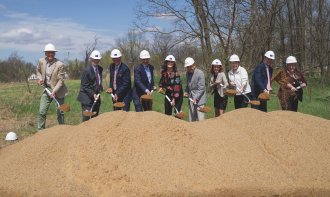
Today, with his father retired, Hollander is president of Hollander Development, which continues to operate a portfolio of affordable housing across the state of Michigan. Hollander is also senior developer and part owner with Jason Muniz (MBA ‘16) of Kalamazoo’s Edison Community Partners (ECP), launched in 2023. Perhaps unsurprisingly, environmental sustainability is a throughline of his company’s work, and ECP was recognized in 2025 by the Michigan Sustainable Business Forum as one of its Sustainable Businesses of the Year for its green building leadership.
“Those of us with the least are often forced to live with the most pollution and highest utility bills from our changing climate,” said Hollander in accepting the award. “We believe that everyone, no matter their income, deserves a safe, decent, resilient place to live.”
In April, Michigan Gov. Gretchen Whitmer joined other stakeholders to break ground on the William Schma House, an affordable housing development in Kalamazoo for people working to sustain long-term sobriety. A mile away, 70 one- and two-bedroom apartments are under construction at The Legacy Senior Living, in partnership with the Mount Zion Baptist Church. In Battle Creek, ECP is working in partnership with Battle Creek Unlimited and the W.K. Kellogg Foundation on Riverbend at Capital, an 80-unit workforce housing project that will include a licensed early childhood center.
Hollander first met Governor Whitmer when she visited in 2021 to hold a press conference on affordable housing at The Creamery, a mixed-use Hollander Development complex with 48 apartments for extremely low- and moderate-income households. The Creamery is home to Edison Community Partners, a small business accelerator, retail space and an innovative electric vehicle car-share program. A partnership with YWCA Kalamazoo also allowed The Creamery to incorporate The Dreamery, an on-site early childhood center.
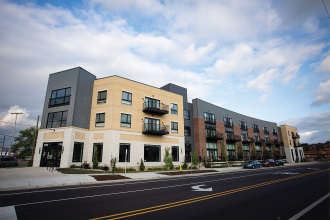
“We're very proud of it,” says Hollander. “We’ve been working a lot in Kalamazoo in recent years, primarily because we have the Kalamazoo County Housing millage, which allows us to do more here than we can in other locations around the state.”
After the housing developments are occupied, the company works with a third party to manage them.
“Though we don't own the projects outright, we're responsible for making sure they operate the way they were intended. When you put as much time and effort into developing something, you want to make sure it's successful long term. We build them, and we keep an eye on them pretty much forever,” says Hollander. “We are still involved with several projects that are more than 30 years old.”
“I've been working on Schma House for eight years, and the Battle Creek project for almost the same length,” Hollander says, noting that the planning phase often takes longer than construction. “I really want to see those projects built, occupied and starting to help people.”
When his most recent projects do open their doors, Hollander is looking forward to spending more time with his wife and school-age sons. Does he expect to host his own ad hoc training program in his car for his sons?
“I'm certainly going to offer it. Whether or not anybody listens to me is probably a different story,” he laughs.