
WMU multimedia film lab amplifies community stories through collaborative storytelling
Western Michigan University's Dr. Lusike Mukhongo is redefining service learning through an on-campus film lab, showing students that storytelling is more than just production, but rather a collaborative and relational process between community partners and filmmakers.
The Community-Engaged Digital Storytelling (CEDST) Lab is a grant-funded lab run by Mukhongo where students are paid to work on a variety of multi-media projects — without the time constraints of a classroom. The lab spans a range of media practices, including photography, podcasting, digital storytelling, interactive media design, and documentary production.
A non-extractive, non-intrusive approach
At the heart of the CEDST lab is ethical storytelling — reimagining it as a community-centered process that examines how stories are made, shared and remembered. The lab explores critical questions such as how to select stories, adapt techniques to cultural contexts and edit sound and visuals without erasing nuance.
“Our lab is strictly nonextractive and nonintrusive,” Mukhongo says. “We actively avoid taking or exploiting community stories for institutional or individual gain. We respect the boundaries, privacy and cultural sensitivities of our collaborators.”
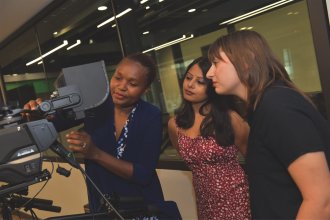
The lab strives to move beyond just documentation towards true collaboration, where communities shape the stories that they want to tell — on their own terms and in their voices.
“Ethical storytelling transforms more than just narratives; it transforms power. It shifts the role of the audience from passive viewer to co-creator, and the role of storyteller from extractor to facilitator of dialogue,” Mukhongo says.
Where 24/7 news cycles scramble for the fastest turnaround over depth, a community-engaged approach produces work that honestly captures a community’s essence.
“In constantly chasing the next flashy thing, we forget all the nuances that lie underneath,” Mukhongo says. “In the mundane is where the story is. Those are the spaces I love. When you think there’s no story, just sit there. Go back twice or thrice, and you’ll see an amazing story emerge.”
Partnership with the Southwest Michigan Journalism Collaborative
CEDST Lab students are creating multimedia content for the Southwest Michigan Journalism Collaborative — a group of 12 media, education and community partners working to strengthen local journalism in the greater Kalamazoo area. When the lab produces a piece, it's shared with all collaborative members, and any outlet is able to publish it.
“The partnership with the CEDST Lab at Western and the Southwest Michigan Journalism Collaborative has been really positive — and mutually beneficial,” says Melissa Clynes, project manager for the Southwest Michigan Journalism Collaborative (SWMJC).
She continues: “The collaborative news and information members are able to use the student work, both videos and long-form stories, which enriches our coverage in the region. The students engage with community members through reporting and have an opportunity to have their work published, which builds their portfolios.”
In fall 2025, three students — Chidalu Nnorukah, Sasha B. Wilson and Matthew Smiley Studier — led a multimedia project on the struggles students face with off-campus housing, published in Bridge Michigan and on the SWMJC website.
In spring 2026, the same group worked on a new SWMJC project highlighting local small businesses and equitable community development.
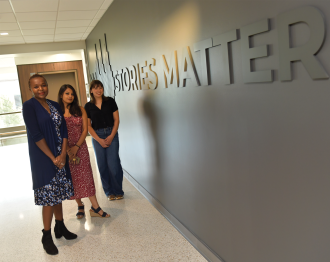
“We do not know the backstory of how these people came together, the struggle of building a business, what they give back to the community, and how they impact the people that live nearby. That is the angle we are taking [to report on] equitable community development,” Mukhongo says.
The two spring 2026 pieces cover Sarkozy Bakery and Can-Do Kalamazoo and were published in New/Nueva Opinión, the only Spanish-language newspaper in Southwest Michigan. The articles were translated by Jesús Grillo, co-publisher of New/Nueva Opinión.
Alongside media production, the lab develops toolkits and guides to help support researchers, educators and artists so that they can apply nonextractive storytelling approaches in their own work.
Where media careers take off
The lab provides a launchpad for students’ digital media and storytelling careers. In a competitive job market, a strong portfolio is the greatest asset, and published work signifies an even higher caliber of experience.
“Whether they use it in Kalamazoo or go to different cities, they can prove that they can make films, and they know how to make films in a respectful way,” Mukhongo says.
In a media landscape that often prioritizes speed, the CEDST Lab stands as a reminder that the most powerful stories are built on trust, time and commitment to the communities they serve.
Students, media makers, educators, or researchers working with communities are welcome to visit the CEDST lab, explore its guides and checklists by Dr. Mukhongo or visit the CEDST lab on the third floor of Moore Hall.