

Grant advances bacteria research while training future scientists
Dr. Benjamin Koestler, an associate professor in the Department of Biological Sciences at Western Michigan University, has been awarded a three-year grant totaling $533,000 from the National Institutes of Health National Institute of General Medical Sciences to advance studies on Shigella, the bacterium responsible for dysentery.
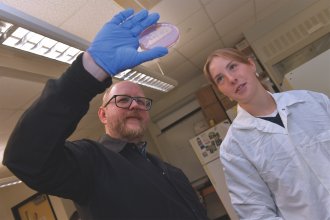
The NIGMS project builds on work Koestler has conducted with WMU undergraduate and graduate students since he joined the university in 2019. His research group is especially interested in understanding how the pathogenic Shigella manages to survive in harsh environments within the human body. The bacterium infects hundreds of millions of people worldwide each year. The Centers for Disease Control and Prevention estimates that Shigella infects nearly half a million people every year just in the U.S., leading to nearly $100 million in direct medical costs. Currently, there is no available vaccine. Compounding the problem, Shigella has shown a growing resistance to antibiotics, raising concerns among public health experts about diminishing treatment options.
Koestler’s research aims to uncover how Shigella withstands acidic conditions, such as those found in the stomach — an essential step in its ability to cause infection. Recent findings from his group revealed that the bacterium uses a signaling molecule known as cyclic diguanylate to regulate amino acid metabolism, a process that appears to enhance its acid resistance.
By investigating this mechanism further, Koestler and his team hope to identify new biological targets for drug development,
potentially opening the door to more effective treatments for dysentery. Koestler states, “The work represents a critical step toward addressing both the immediate and long-term challenges posed by Shigella, particularly as antibiotic resistance continues to rise.”
Another important component of the grant is its focus on student training, particularly at the undergraduate level. The project will fund one graduate and three undergraduate student researchers, providing them with hands-on experience studying bacterial genetics and biochemistry. Koestler observes, “Engaging undergraduate students directly in laboratory research is essential to their development as scientists. Through this work, students [will] gain experience with modern techniques and methods while building practical skills they can carry into future careers.”
Equally important, research opportunities like these allow students to apply the scientific method to real-world problems — an essential foundation of scientific inquiry. By contributing to ongoing investigations into Shigella, undergraduate researchers not only support efforts to better understand a global health threat but also develop the critical thinking and problem-solving skills necessary to develop the next generation of scientists and innovators. Students in Koestler’s research group also have the opportunity to serve as peer mentors and to develop their professional skills as part of a team.
“I was able to mentor incoming students in the lab. I discovered that I loved seeing students gain an understanding of the project and share a passion for science,” says Gurleen Kaur, who worked as an undergraduate research assistant in Koestler’s lab. Kaur has since graduated from WMU with a bachelor’s degree in biomedical sciences. She is currently serving as a post-baccalaureate fellow with the National Institute of Allergy and Infectious Diseases, applying knowledge gained working with Koestler to studies of HIV-infected cells.