

Honors English 9/10 Summer Homework
Welcome, new ATYP student! Please read this entire page CAREFULLY as soon as you receive the link. Former students will tell you that procrastinating with your summer homework causes undue stress down the road. It's also a good idea to look over your summer schedule with the adults in your life to plan around vacations, camps, etc. so you know exactly when you'll be completing this summer homework. We are so excited to meet you in the fall!
Your summer homework consists of four parts. Here is a checklist to print out to help you keep track of everything. We will break down each piece below.
- Intro & Edpuzzle Videos
- Readings
- Annotations (times 2)
- Key Passages written assignment (times 2)
If you finish an assignment early, feel free to submit it early. This causes less of a backlog for the instructor giving feedback.
- Intro & EdPuzzle Videos
- EDPUZZLES: Students will begin by working through a series of short Edpuzzle videos. Once you have created your account in Edpuzzle, you can join the class using the code gobcazh. Make sure that we can tell who are you by using the same login name each time (first and last name). You will begin your summer homework by watching the introductory video in Edpuzzle. Watch carefully as it contains specific instructions on formatting your papers, etc. Then complete the lessons listed, beginning with "ATYP Note taking with Mrs. Carr (Qs)" on EdPuzzle. Be sure to follow all of the instructions on this page carefully before turning in your first written assignment. ALL VIDEOS DUE BY Sunday, June 28.
- We will be able to monitor your progress on the modules. You can take the quizzes up to three times to get all the answers correct.
- Readings
You will need to read TWO selections before class begins in the fall. You will also select a recommended text that will be read during the first three weeks of class. Please read the first two novels and email your Key Passages by the noted deadlines to @email.
These readings will provide the basis for discussion, group work, and presentations during our first unit. Read carefully, complete the reading notes and written homework below mindfully, and be sure to refresh/reacquaint yourself with both texts before we meet in September. This schedule asks you to read about one book every 4 weeks; know thyself and thy summer schedule, and plan accordingly!
Book List
- Required Reading: The Time Machine by H.G. Wells: ISBN 9780141439976 (Due by Sunday, July 12)
- Required Reading: Challenger Deep by Neal Shusterman: ISBN 9780061134142 (Due by Sunday, August 9)
- Recommended: Choose one work from the following list and bring it to class the first day. You do NOT need to have read this book by the first day.
- Persepolis 1 by Marjane Satrapi: ISBN 9780375714573
- Clap When You Land by Elizabeth Acevedo: ISBN 978-0062882776
- Other Words for Home by Jasmine Warga: ISBN 9780062747815
Annotations:
Annotations:
This is otherwise known as marking up your book! You might not have ever done something like this before, and that's okay. For some of us book nerds, writing in our books might be even seem disrespectful! But books want you to engage with them, and annotation is a great way to do it. Research shows that annotating while reading helps us better retain what we're reading and engage with the text on a deeper level. It's a great tool for literary analysis, and gives you a helpful resource to return to later, when you are asked to write about these works in the first unit essay. Think of it like a kind of one-stop-shop notetaking. Annotating is a technique we will be practicing all year, so here's your first chance to try it out. The introductory video you watched earlier will give you a visual model for what annotations might look like. We will spot check your annotations in both your novels on the first day of class.
Here are some further instructions:
- Gather some materials. This might include pens, pencils, highlighters (in as many colors as you like), sticky tabs, or post-it notes. Have these with you every time you read!
- As you read, pause every 15-20 pages. Then, go back and complete the following annotations for that chunk of text:
- Page synopsis: When something important (a dramatic plot point, introduction of a new character, shift in tone, etc.) happens, write a few words summarizing the event at the top of that page. (Attempt to write a sentence or two on each page)
- Underline key quotes/lines. This might include notable or interesting dialogue from a character, a particularly well-written sentence (or one you just really liked), or a passage that relates to one of the significant events from your page synopsis. (Attempt to underline text on almost every page)
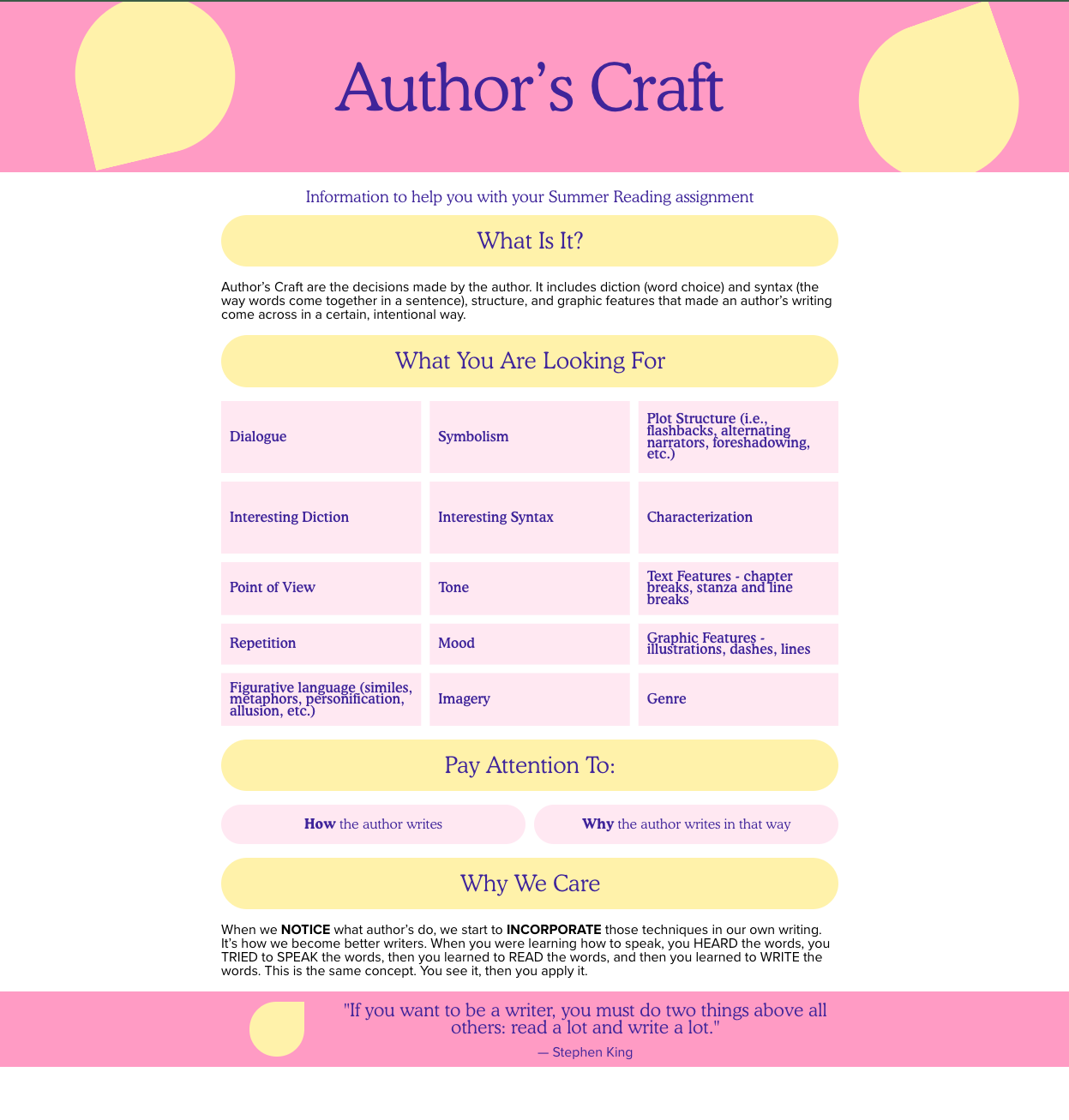
- Identify elements of Author's Craft you notice the author utilizing. Check out this infographic to give you ideas about Author's Craft. Make sure you underline or circle the text example and note the type of AC in the margins. (Attempt to identify an example on each page or every other page)
- Jot down questions. Did something confusing happen? Are there unsolved mysteries? Is a character acting strangely? Are you not sure what a particular word or passage means? You can write questions OR big question marks. Just make sure it's clear what it is you have a question about. (Utilize this as often as necessary. You should have at least one question every chunk of 10 pages or so)
- Rinse and repeat every 15-20 pages. Aim for having some kind of annotation or mark-up on every single page (though it is okay if you miss a few).
- Remember that you're turning the book into a handy dandy reference guide for your future self. Ask yourself: What parts of this text will I want to easily find later?
- If you get caught up in reading (it happens!), pause and flip back through what you've just read and make some notes.
Key Passages
For the last part of your summer homework, reflect on three key passages for each novel. For each passage, please provide the page number and the first sentence of the passage so we know what you're looking at. Then, write two paragraphs to accompany each passage:
- In the first paragraph, discuss the passage’s importance or significance within the overall novel. Avoid using first person words like "I", "my," "me," "we," and "our." You might discuss characterization, character development, plot, foreshadowing, or other literary devices or elements of author’s craft. These responses should vary (i.e. don't talk about foreshadowing every single time). Aim for 3-5 sentences per paragraph according to the PEEL method you learned in the videos.
- In the second paragraph, connect the passage to something in your personal life: experiences you've had or witnessed, feelings you relate to, connections to other books or movies you’ve read/watched, etc. You can use first person pronouns (“I,” “me,” “my”). Make sure the tie to the anchor text is clear. These responses should vary (i.e. don't talk about a connection to a movie every single time). Aim for 3-5 sentences per paragraph according to the PEEL method you learned in the videos.
To be very specific: that means you’re writing six paragraphs per book for two books. That’s 12 paragraphs by summer’s end in addition to the videos and annotations. Utilize this Key Passages Template to make it easy on yourself!
Details:
Make sure to format your Key Passages according to the guidelines below. Take time to actively check these items in your word processor (Google Docs, Microsoft Word, etc.):
- typed,
- 1.5 line spacing,
- Times New Roman font with 12-point font size,
- 1” margins,
- Headers and titles as shown in the templates,
- You should have a separate document for each book. File Names should follow this general structure:
- First and Last Name - Summer - Novel’s Title Key Passages
- Example: Joe Coffee - Summer - The Time Machine Key Passages
Further Notes About the Readings:
- ATYP English 9 uses Grammar Girl Presents: The Ultimate Writing Guide for Students (Fogarty, 2019 - ISBN 9781250217516 or any other edition) as a classroom textbook. While ATYP will provide a copy for anyone who needs one during their first year, we highly recommend that students purchase their own copy to keep for future reference. You are welcome to purchase the book wherever you can find it. Students will purchase/borrow a handful of novels later in the year, but this book is used early in September. If you plan to buy it, you will want to have it in hand the first week of class.
- Parents should be aware that some of the recommended texts contain mature content. We encourage students to discuss what they’re reading with their parents. While ATYP faculty agree that our students are ready for this content, we understand each family is different in its beliefs. To review the books, we suggest looking for the titles on goodreads.com or commonsensemedia.org.
- Writing in a physical book is a requirement of the annotations assignment. It’s absolutely OK to purchase used copies—but see if you can find copies that don’t have other people’s annotations in them.
- In the spirit of supporting local business…please consider purchasing your texts from a local store! We have given our titles to this is a bookstore/Bookbug and Kazoo Books so they can help you. In addition, there will be a special book purchasing day on Saturday, June 6, at this is a bookstore, 3019 Oakland Drive, Kalamazoo. The store will donate a percentage of the purchase amount for that day back to the program if you tell them that you’re purchasing for ATYP. This is also a great time to buy your summer beach reads!
- Zhang Scholarship recipients can have summer reading novels purchased for them. The ATYP office will send an email about providing the books. If you are not a scholarship recipient but purchasing the texts is a hardship, please contact the ATYP office. We will help!