

Professor explores the Vietnam War through music in interdisciplinary course and Bruce Springsteen research
KALAMAZOO, Mich.—At the top of the HNRS 3303 syllabus is a quote from Bruce Springsteen’s “No Surrender” that reads: “We busted out of class / Had to get away from those fools / We learned more from a three-minute record / Than we ever learned in school.”
Playwright, English professor and lifelong rock fan Dr. Steve Feffer has taught the Lee Honors College course “The Vietnam War in Rock and Soul” for nine years. He immerses students in music from the war, which lasted from 1955 to 1975, to teach them its historical and cultural context. He loves “preaching the gospel of rock, soul and blues” and sharing the joy of music with his students.
“I didn’t fall in love with rock and roll because I sat in class and read something,” says Feffer. “I went to see bands. I heard shows. I listened to records.”
Each morning, he kicks off class with artists such as Elvis Presley, Johnny Cash, Muddy Waters, Aretha Franklin and, of course, Creedence Clearwater Revival. He samples the vast array of songs soldiers turned to for comfort and self-expression, not just those like “Fortunate Son” that define the nostalgic popular image of the 1960s through movies and the songs at the top of the charts. He wants his students to understand the complexity of the war and its perceptions, both in the U.S. and overseas.
“There’s the notion of the Vietnam War being a catch-all for a political mistake, or an endless war,” says Feffer. “There's far more specifics and nuances within that, even within the anti-war movement itself.”
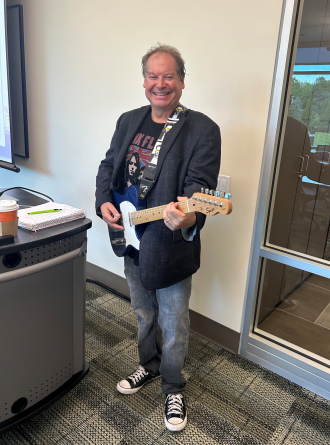
He also teaches students how soldiers listened to their music. Feffer explains that before radios and records were common in Vietnam, many formed bands and rewrote popular songs to describe their situations. His students reenact this tradition by performing parodies of songs such as Bob Dylan’s “Blowin’ In The Wind” and The Shirelles’ “Soldier Boy” about their daily lives as Broncos. Some bring in guitars, saxophones, or harmonicas, while others keep the beat by squeezing rubber chickens or banging on tables. For the grand finale, Feffer brings his guitar and closes with his own song.
“I try to let it have its own curious energy, a rock and roll energy,” Feffer says. “It’s loud. I feel like we need to listen to the music the way it’s meant to be listened to.”
He is adamant that the Vietnam War’s music is not “relegated to the dustbins of nostalgia.” Rather, he wants students to appreciate its artistry and current relevance.
“I think that is a marker of great art,” Feffer says. “We can hear it almost differently every time we hear it, and it speaks to us in the present in a way that perhaps we didn't even realize. I don’t want the meaning for me of a certain song to be locked into a certain place in the past when it can speak to me at a certain time in the present.”
Feffer emphasizes the Vietnam War’s continued relevance by encouraging students to look for its timeless themes such as patriotism, PTSD and longing for home in music created after the war. His favorite part of the class is when students share their own playlists, demonstrating their understanding of the soldiers’ experiences through a diverse blend of their favorite genres.
“I want everyone in the class to have a voice,” Feffer says.
These assignments inspired him to pursue his current research project: a book following the Vietnam War through a 25-song Bruce Springsteen playlist.
“By tracking Springsteen’s songs in America, we're continuing to grapple with some of the unresolved impacts of the war,” Feffer says. “We could look at it through the lens of his musical and personal journey.”
He argues that Springsteen has sung about Vietnam from the start of his career in the 1960s. Feffer traces the war in his writing from Springsteen’s early work to his 1981 benefit concert, which saved the organization Vietnam Veterans of America from bankruptcy, and through to the present day. One of Springsteen’s great contributions is the notion that citizens can support veterans while criticizing wars, Feffer says. Although some fans feel these messages have been lost in the triumphant sound of the hit “Born In The USA,” Feffer believes that Springsteen’s platform as a mainstream rock star has been crucial in spreading awareness for veterans’ issues by making them accessible to the public.
“It’s the performative element of having one of the biggest rock stars on the planet singing a song that is about the plight of a veteran who returns home from Vietnam, can't get a job, feels abandoned by the VA, feels trapped by the current economic conditions, and here's stadiums full of people raising their fists and chanting,” he says.
As a playwright, Feffer has a deep appreciation for Springsteen’s use of activism through art, as well as his theatrical concerts.
“They’re part religious revival, rock and roll road show, community gathering and history lesson. It’s all those things. We laugh, we cry, we get outraged. We get close to people … That’s the kind of spiritual journey that he takes you on, and I hope the class becomes a journey,” he says.
Feffer’s class is hard to forget. Recently, a past student emailed him from a café in Vietnam to say she was listening to one of his playlists from the class.
“I think art can change people's lives, and I certainly feel that way because it's changed mine,” says Feffer.