

Out of the classroom, into orbit: WMU physics department supports NASA’s Artemis program with spaceflight materials research
Watching Artemis II launch four astronauts toward the moon was an awe-inspiring moment for people around the world. Most could only wonder what it felt like for those involved — but a team of researchers at WMU had a pretty good idea.
In 2024, WMU’s Department of Physics completed a major NASA-sponsored research project in support of the Artemis and Lunar Gateway missions, contributing critical data to help ensure the reliability of spacecraft systems operating beyond Earth’s orbit.
The project centered on irradiation testing of spacecraft cables used in the Gateway lunar module’s propulsion and power systems. As spacecraft travel through the Van Allen radiation belts, they encounter intense streams of high-energy protons that can degrade materials and jeopardize mission safety.
A multidisciplinary effort
The collaboration was made possible through the leadership of Dr. Phil Ugorowski, a WMU physics alumnus, who, while working with NASA, identified the University’s 6 MV tandem Van de Graaff particle accelerator as uniquely
suited for the required testing.
The project was led by a multidisciplinary team of staff, faculty and students in the Department of Physics.
Dr. Asghar Kayani, department chair and director of the accelerator laboratory, provided scientific leadership and oversight. Josh Byers, machine shop manager, designed and fabricated custom hardware — including a heated sample holder capable of reaching 200 degrees Celsius — to replicate the thermal conditions spacecraft cables experience in orbit. Benjamin Gaudio, the department engineer, ensured that the cables were properly connected to the sample holder’s heating elements.
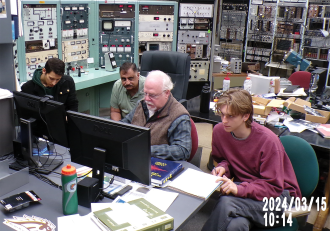
A defining feature of the project was undergraduate student involvement alongside faculty and staff researchers.
From May to July 2024, three students — Lucas Rudegeair, Andrew Libiran and Jett Thomas — had the transformative opportunity to contribute directly to NASA-relevant research.
“Our department is deeply committed to providing students with meaningful, experience-driven research opportunities,” Kayani says. “Projects like this show them that they can contribute to nationally significant scientific work long before they complete their degrees.”
"A large portion of the undergraduate research involved preparing calculations for the particle accelerator. They assisted with experimental preparation, data collection and analysis, all while collaborating with top-tier professionals in the field."
The power of experience-driven learning
Lucas chose WMU specifically for its hands-on research opportunities, so it’s no surprise he sought ways to get involved when he got to campus. What he didn’t anticipate, however, was that it would be for NASA.
“I got introduced to Dr. Kayani, and he basically said, ‘We’re not really doing a research project right now, but we’ve got this other project we’re about to start, and you could probably join that if you want,’” Lucas says.
He continues: “I was like, ‘Cool, what is it?’ and Dr. Kayani said, ‘Oh, you know, we’re doing some stuff with NASA.’”
His answer was obvious. From then on, Lucas was immersed in the once-in-a-lifetime opportunity with two other undergraduate students, Andrew and Jett. The project brought hands-on learning to a whole new level, as the three navigated the excitement and challenges of a high-stakes research project.
“One thing that I had to overcome is that during a lecture, if you don’t understand something it’s really easy to hide in the background and tell yourself, ‘I’ll look through my notes and learn it at home because the only thing on the line is your own grade,’” Libiran says.
“But when you're working on a project with other people and it's a NASA project, the stakes are a little bit higher. You have to learn how to get over your fear of asking for clarification and maybe that fear of looking incompetent.”
Without the safeguards of a classroom setting, student researchers were held to a high bar. Despite this, they recall feeling "on par" with the team, while still being given room to learn and grow throughout the project.
“You wouldn’t be second guessed. They would take what you said as fact — and sometimes we were wrong. It was a bit nerve racking at first, like ‘These guys are professionals and they aren’t doubting us right now!’” Jett says. “We had a folder called undergraduate failures, and every time we made a mistake we put it in there to remind ourselves not to make it again.”
Fostering Connections
Connecting with, learning from and working alongside industry professionals was intimidating — but incredibly rewarding.
“Being able to work with professional equipment and engage with colleagues in a way that felt meaningful — that was the most important part,” Jett says.
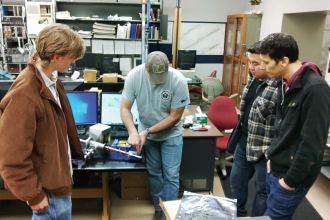
Collaborating with a team of not only physicists, but engineers, financiers and machinists provided new insights into how research is done in the context of an entire project, and how to view work through the perspectives of other content experts.
“We got to sit in on the Zoom meeting where Dr. Ugorowski, the NASA physicist, presented our work to his colleagues. And sitting in that meeting, you see all the other moving parts that are working on the project,” Libiran says.
Not only did the project foster connections between students and industry researchers, but within the Department of Physics. As many institutions have struggled to reengage people after COVID, the project helped rebuild a sense of community among WMU phyiscs students.
“The hands-on learning got you showing up. When I was out of class, I wouldn’t go home — I would go to the [particle accelerator lab] and work with the team,” Jett says. “It was a very enjoyable experience. I'm very grateful to have been there for it.”
Life-changing experience
Nearly two years after the research project concluded, Artemis II launched to the moon in April 2026. And although the Lunar Gateway project was ultimately halted by NASA, Lucas still describes the experience as “life-changing.”
“It was honestly so surreal. You watch the takeoff, you’re watching them while they’re actually in space, and you sit there like, ‘Oh my goodness, I was a part of that mission!’” Lucas says.
All members of the project team were recognized with NASA and Artemis mission badges in acknowledgment of their contributions to one of the most ambitious space exploration efforts of the century.
“Watching our students earn NASA and Artemis mission badges was incredibly rewarding,” Kayani says. “It’s a reminder that when we invest in hands-on learning, our students rise to the challenge.”
The Artemis program represents a renewed global commitment to exploration and long-term human presence beyond Earth. WMU’s role in this project highlights the University’s research capabilities, the expertise of its faculty and staff and the transformative opportunities available to its students.
“It’s really remarkable knowing, regardless of what I do moving forward, what field I go into, I can always say I played a little role in space exploration history,” Libiran says.