
International Education: Balancing Collaboration and Innovation with National Security
For more than a century, the United States and Western Michigan University have partnered with countries around the world to welcome international students to campus. These students enrich our classrooms, strengthen cultural understanding, and contribute to global collaboration and innovation.
International students play a vital role in STEM and many other fields, helping to expand the nation’s talent pipeline and drive research breakthroughs. Their presence also generates significant economic benefits at the national, state, and local levels.
At the same time, shifting immigration policies and other barrier have made it challenging to recruit and retain global talent. These obstacles not only affect higher education but also influence the national security concerns related to educating international students in some subject areas and allowing access to particular research labs.
This event will explore these themes, highlight the value international students bring to WMU and beyond, and discuss the evolving landscape of global education. Open to campus and the community!
Guiding questions to be addressed by panelists:
- Should the U.S. continue to promote robust higher education collaboration with other countries/allies to attract talent, ideas and innovation?
- If so, how does the U.S. protect its national security interests as it pertains to international education?
Refreshments provided
Open Q & A follows
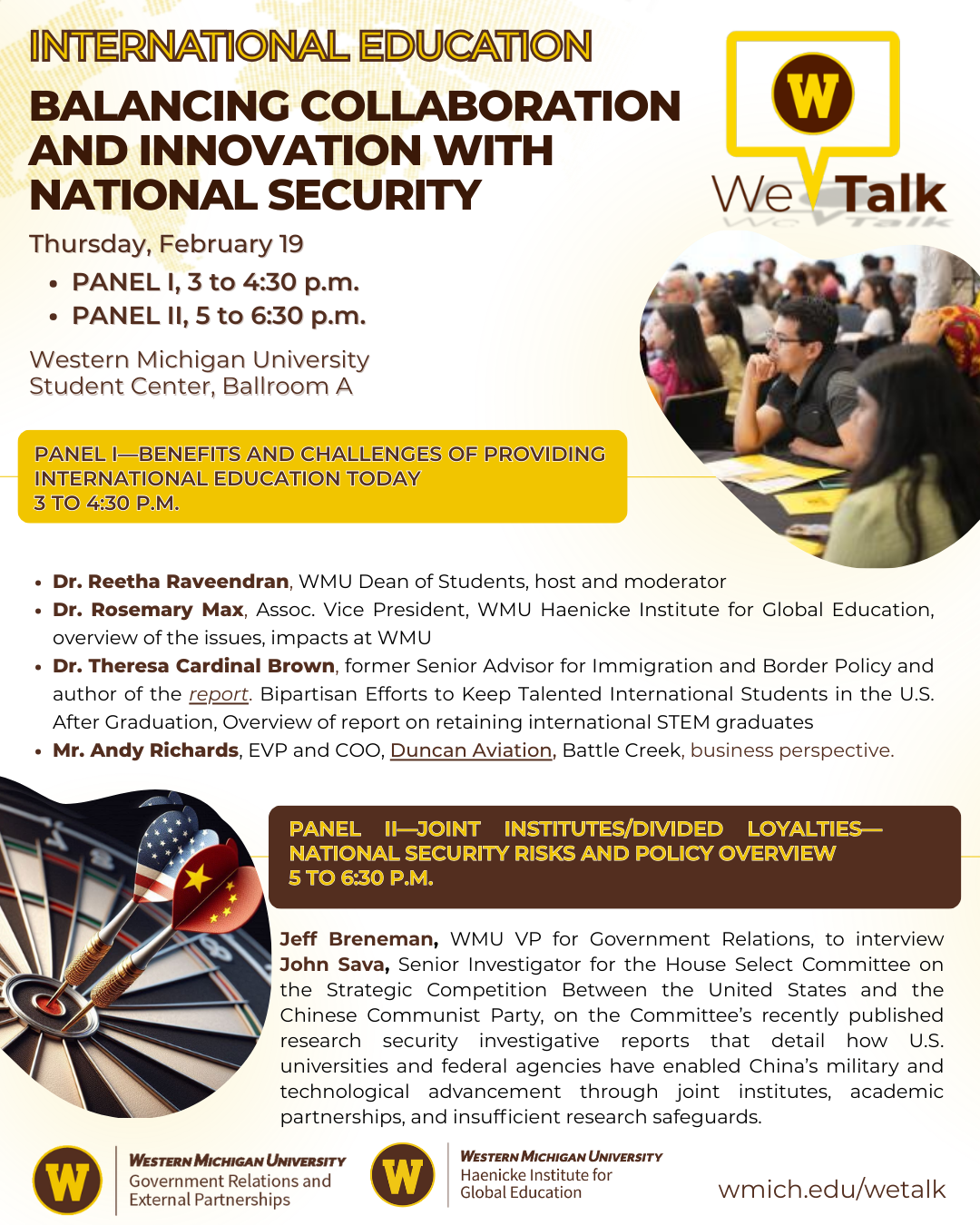
PANEL I—Benefits and challenges of providing international education today
3 to 4:30 p.m.
- Dr. Reetha Raveendran—WMU Dean of Students, host and moderator
- Dr. Rosemary Max, Assoc. Vice President, WMU Haenicke Institute for Global Education, overview of the issues, impacts at WMU
- International Student testimonial—tbd, a WMU graduate or post-graduate international student in a STEM field.
- Dr. Theresa Cardinal Brown, currently holds appointments as an Immigration Fellow at the George W. Bush Institute and the National Immigration Forum and is the author of the report, Bipartisan Efforts to Keep Talented International Students in the U.S. After Graduation. Read report.
Mr. Andy Richards, EVP and COO, Duncan Aviation, Battle Creek, business perspective.
PANEL II—Joint Institutes/Divided Loyalties—National Security Risks and Policy Overview
5 to 6:30 p.m.
Jeff Breneman, WMU VP for Government Relations, to interview John Sava, Senior Investigator for the House Select Committee on the Strategic Competition Between the United States and the Chinese Communist Party, on the Committee’s recently published research security investigative reports. These reports detail how U.S. universities and federal agencies have, enabled China’s military and technological advancement through joint institutes, academic partnerships, and insufficient research safeguards.
Mr. Sava leads the Committee’s investigative and legislative efforts on research security, foreign influence, technology transfer, and intellectual property theft. He is widely recognized within the U.S. intelligence and law enforcement communities as a leading expert on the People’s Republic of China’s technology transfer apparatus and the defense research and industrial base. Mr. Sava previously served as a Special Agent with the Naval Criminal Investigative Service (NCIS), where he conducted counterintelligence investigations and operations focused on threats at the intersection of academia and research institutions. The Select Committee is chaired by Congressman John Moolenaar (R-MI).