

The Department of Geological and Environmental Sciences celebrates 60 years of excellence
KALAMAZOO, Mich.—The Department of Geological and Environmental Sciences recently celebrated six decades of academic excellence, research innovation and community engagement through a series of events on campus.
“The Department of Geological and Environmental Sciences has long been known for providing exceptional opportunities for undergraduate and graduate students to engage in hands-on research with world class faculty,” Dr. Carla Koretsky, dean of the College of Arts and Sciences said. “Our graduates are making a difference across the globe.”
About The Department of Geological and Environmental Sciences
The department has grown tremendously since its humble beginnings in 1965, when founding chair Dr. Lloyd J. Schmaltz established the program and launched its first undergraduate major in geology.
As the program expanded over the following decades, so did its milestones. The department became one of the first at the University to offer a doctoral program, initially focused on hydrogeology and later broadened to a Ph.D. in Geosciences. This trailblazing step strengthened the department's research focus, which has continued to flourish over the years.
In the early 1980s, faculty member Dr. Bill Harrison founded the core research lab, amassing a collection of rocks drilled from Michigan’s subsurface, a foundational effort that would lead to the monumental transferal of the Michigan Geological Survey to WMU. Around the same time, the department developed a focus on hydrogeology and began to offer summer classes; a precursor to the nation's oldest continuously running Hydrogeology Summer Field Camp program.
Another landmark milestone came in 2011, when the Michigan Geological Survey was transferred from the state to WMU. About 30 states have a Geological Survey, which is charged with mapping, identifying, and archiving natural rock, mineral, energy and water resources for the public good. Housing the MGS at WMU provides students and faculty opportunities to participate in applied research projects that would not otherwise be available, enriching the department’s impact and service to the field.

Today, the department has evolved into a nationally recognized center for geologic and environmental research and education, with expertise spanning hydrogeology, remote sensing, sedimentology, Michigan Basin geology, carbon capture and sequestration, and more. Building on the foundation of Dr. Schmaltz and the second chair, Dr. Tom Straw, the department continues to offer course-based trips to the Upper Peninsula, Kentucky and Ohio, Wisconsin, and other geologically notable locations. The Geology Club plans additional trips, and has traveled to see the geology of Iceland, the US southwest, Arkansas, Chile and Ireland in recent years.
The 60th Anniversary Celebration
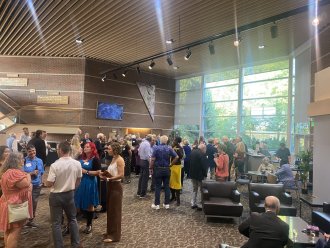
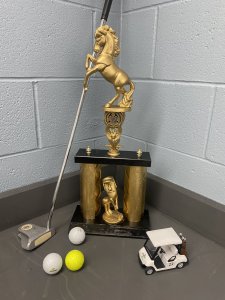
The 60th anniversary celebration brought together emeritus, current faculty and staff, and alumni to celebrate the department and highlight the work being done in prepping students with knowledge, skills and passions through geoscience research. The anniversary celebration featured a variety of activities, including campus tours, a banquet at the Fetzer center, a golf scramble, a winery tour, the CommUniverCity football game, and more.
Students presented their research at a poster session held in Rood Hall. Topics included student-led projects focused on groundwater contamination, climate modeling, and Michigan’s glacial history. Attendees also participated in field equipment demonstrations and guided tours of lab facilities, including the Michigan Geological Repository for Research and Education.
Additionally, students were recognized during a ceremony held at the Dinosaur Park on WMU’s main campus. The Geological and Environmental Sciences Department Alumni Achievement award winner, Thomas Hanna, also spoke during the event. The department emphasized its commitment to experiential learning, with programs that integrate fieldwork, internships, and partnerships with the local community.
The department is looking ahead to significant growth, including expanded research in climate resilience, upgrades to its geospatial technology labs and the development of a new $6 million facility for the Michigan Geological Survey, with construction beginning fall 2025. As the field of geosciences evolves with emerging technologies, new discoveries and AI-enhanced research, the department is embracing these changes through initiatives such as critical-minerals projects that explore new resources in historic mine waste—work that also provides valuable research opportunities for students.
A major current focus is fundraising to expand scholarships and endowments that support travel and field courses, as many students struggle to afford the extra costs of meals, gear and transportation. To help ensure all students can participate in these essential field experiences, the department aims to raise $60,000 in honor of its 60th anniversary.
“The Department has been more than just an academic experience since its founding - we are a community of scholars curious and excited about how the Earth works, and dedicated to providing students with real-world, hands-on learning alongside faculty and alumni who have had impactful careers across the world,” Dr. Heather Petcovic, chair of the department says.
To learn more about the Department of Geological and Environmental sciences visit https://wmich.edu/geology
For more WMU news, arts and events, visit WMU News online.