

WMU professor among researchers to identify rising landslide risk in Southern California
STANFORD, Calif.—Climate change could make historically rare tropical storms in Southern California produce significantly more precipitation in the next few decades, and when they strike, landslides are likely to become a bigger risk across the region, according to new research in Nature Climate Change.
The study, published June 10 by scientists from Western Michigan University, Stanford University and Massachusetts Institute of Technology, finds exposure to landslide risk is likely to grow fastest among low-income households.
“Our results revealed that the heavy rainfall risk associated with hurricanes cannot be neglected in the region at present and could increase substantially in the future under a warming climate,” says study co-author Dr. Laiyin Zhu, associate professor in Western's School of Environment, Geography and Sustainability.
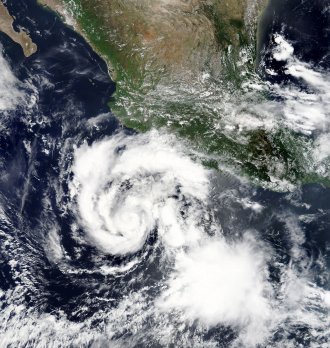
Tropical cyclone risk has long been overlooked in Southern California because the storms have been relatively rare. In the summer of 2023, Hurricane Hilary demonstrated the damage these storms can cause when its remnants swept gale-force winds and torrential rain into the region. The record-breaking rainfall caused closed roads, flash floods carried away cars, and landslides caked homes in mud, costing more than $900 million in damages.
“Hurricane Hilary reminded people that Southern California is not immune to tropical cyclones and related flooding and landslides,” said Dr. Yuan Wang, assistant professor of Earth system science at the Stanford Doerr School of Sustainability and a senior author of the new study.
Understanding ‘grey swan’ storms in Southern California
In the United States, hurricanes have mostly imperiled people living near the Atlantic and Gulf coasts, where emergency alerts are well established, and people have learned to board up their windows and pile sandbags around storefronts. People living in Southern California tend to have less experience with tropical storms.
Scientists refer to this type of unusual, high-impact storm as a “grey swan,” a term coined by co-author Kerry Emanuel in an earlier study. Whereas a “black swan” would be an extremely consequential and nearly unforeseeable event, “grey swans” can’t be precisely predicted from historical data but can be anticipated based on available physical knowledge of the climate system.
For Wang, who lived in Southern California for years, the genesis for the new study was personal. He had moved away only months before the storm that began as Hurricane Hilary hit and saw images of muddied homes and flooded streets in his old neighborhood.
Knowing that scientists were still unsure how much worse such storms could become in a warming climate, Wang brought researchers together to focus on the future of storms like Hilary in the state and to understand the scale of the risk when the next one strikes. “The question is not whether or not we will have a hurricane in Southern California, but how large the risk can be,” he said.
How warming oceans connect to extreme rainfall
Warm waters fuel hurricanes, and Southern California has long enjoyed protection from the cool ocean temperatures in the northeastern Pacific. But temperatures in the Eastern Pacific have risen in recent decades, providing energy to the atmosphere. Climate patterns such as El Niño can warm surface temperatures across much of the Pacific even further, creating conditions favorable to storms.
Warmer air also holds more moisture and contributes to greater atmospheric instability. When those storms reach the coast, California’s mountains force air upward. As it cools at higher elevations, the moisture condenses and can produce heavy rainfall.
Climate change is intensifying Southern California’s flash floods, drought, and wildfires. When heavy rain falls, dry, unstable soil can’t absorb it. Streets flood, and slopes slip away. “The condition can shift from one extreme to the other very quickly,” Wang said.
Wang and a group of experts in cloud physics, extreme weather, and geography set out to investigate the chain of factors, from storm formation over the Pacific to people living on Southern California hillsides, and account for conditions of climate change.
“Many of the greatest risks from climate change result from the emergence of events that are more extreme than the historical climate that our infrastructure and disaster management systems were designed for,” said study co-author Dr. Noah Diffenbaugh, the William Wrigley Professor and Kimmelman Family Senior Fellow in the Doerr School of Sustainability.
More people and places threatened by landslides
The scientists used climate models to replicate large-scale conditions, then applied a technique called downscaling to generate thousands of possible storms and track which ones might reach Southern California, and how intense the precipitation could be.
The average Eastern Pacific sea surface temperature could rise 2.7 degrees Celsius from 1985-2014 to 2071-2100, according to the new climate model projections, making extreme rainfall events twice as likely to strike Southern California.
Historically, storms capable of producing more than 100 millimeters (about 4 inches) of rainfall like Hurricane Hilary have a probability of hitting California approximately once a century, commonly called a 100-year storm. The scientists found that the probability could double with continued climate change. Different models produced varying estimates, and risks are lower in scenarios with lower emissions and less warming, Wang noted, but all consistently pointed in the same direction. “Heavy rainfall induced by tropical cyclones will be more likely to happen.”
Wang and colleagues fed their rainfall estimates into a landslide model. Every California county tested shows growth in the total area exposed to landslides between 2000 and 2050. The results indicate that more than 75% of Los Angeles County will face exposure to severe landslide risk if greenhouse gas emissions continue under one of the more extreme but realistic climate scenarios. Other densely populated counties, including Orange, San Diego, and San Bernardino, also show large increases in the percentage of their populations living in high-risk landslide zones, especially in mountainous areas.
Landslide risk may rise fastest among low-income households
The scientists mapped where slopes were most likely to give way and overlaid those hazard maps with population and income data. They found that low-income households in 2000 were more likely than wealthier households to live in landslide-prone areas. As populations shift and climate change drives heavy rainfall from “grey swan” tropical cyclones, the disparity is expected to widen.
By 2050, exposure of households with less than $50,000 annual income living in zones with the highest landslide risk could nearly triple, while exposure of wealthy households in these zones will increase by less than half. “There’s a steep fractional change for those low-income households,” Wang said. “This is something we didn’t expect in the beginning.”
Zhu said the findings highlight a potential need for governments and communities to consider implementing forecasting tools and preparation strategies, such as rezoning areas to improve safety, and educating the public about the changing risks and how to protect their homes.
The study highlights that the kind of intense precipitation that occurred when Hurricane Hilary dissipated over Southern California in 2023 could become even more likely in the future as global warming continues, intensifying a threat to this part of the country that has largely been ignored until now. “The key is to put this issue on people’s radar,” Wang said.
This article was adapted from a press release originally published by the Stanford Doerr School of Sustainability.
For more WMU news, arts and events, visit WMU News online.