

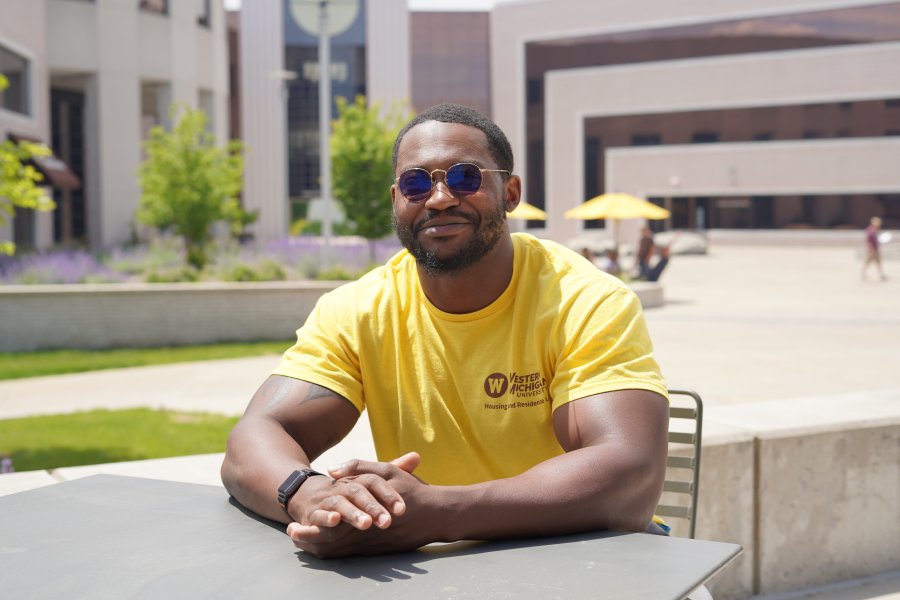
Trae Bell, counseling psychology Ph.D. candidate at Western Michigan University.
Western has provided me with the opportunity to learn the inner workings of higher academia and build strong professional connections with great people. Through my dissertation committee and the faculty here, I feel thoroughly prepared to navigate the academic system and potentially become a professor myself one day.
Q&A with Trae
How has your experience working in WMU’s clinic shaped your training? I spent three years working at the clinic on the counseling psychology side, which provided incredibly comprehensive training. During my time there, I conducted patient intakes, ran individual counseling sessions, and facilitated group therapy. I was also able to gain hands-on experience in a clinical supervisory role by overseeing another counselor who was actively conducting therapy.
You mentioned making valuable connections at Western. How has the university community supported your professional journey? Western has provided me with the opportunity to learn the inner workings of higher academia and build strong professional connections with great people. Working with Residence Life has been fantastic, and I have had great interactions with mentors like Dr. Adkison-Johnson, who is very involved with the department. Through my dissertation committee and the faculty here, I feel thoroughly prepared to navigate the academic system and potentially become a professor myself one day.
Can you share what your doctoral dissertation focuses on? My dissertation centers around an identity concept called "somebodiness". Originally, I studied this psychological concept with older Black males aged thirty-five and up, but I believe the framework can be applied to other populations. I am getting ready to propose my dissertation soon, which shifts the focus toward creating and applying this sense of "somebodiness" specifically for Black male adolescents.
What initially inspired you to pursue psychology and counseling? My path into the mental health field started through my own experience with depression. I was a college football player at the University of Mary Hardin-Baylor, a Division III school, when a severe car accident nearly cost me my life. Because my identity was entirely tied to being an athlete, losing that outlet caused a major identity crisis. A mentor suggested I try the free counseling offered at my university, and through therapy, I learned things about myself and my identity that I had never realized before. That experience was so transformative that I immediately went to my advisor and switched my path to psychology, which led me through my bachelor's, two master's programs, and now my Ph.D. at Western Michigan University.
How did you find your clinical focus in working with children and adolescents? During my master's program, I completed an internship doing play therapy with three- and four-year-olds at a preschool. I also gained extensive experience doing Applied Behavior Analysis (ABA) work with clients ranging from two to twenty-five years old. Through these experiences, I discovered a strong passion for this population, particularly for Black children who often lack mental health outlets or a professional to talk to who looks like them. A major goal of mine is to provide support for Black male adolescents, helping them process their mental health and giving them a safe space to speak openly.
What does your current work in local schools look like? I currently work with middle school students as part of the Gear Up program. During my time here, I have worked at Linden Grove Middle School, Prairie Ridge Elementary, and Maple Street. I conduct both group and individual sessions, helping students navigate heavy issues like divorce, abuse, or having incarcerated parents. I keep sessions interactive to build skills naturally; for example, we frequently play UNO. It serves as a great tool to practice number and color comprehension, sequencing, taking turns, and managing the emotional frustration that comes with losing.
What unique social challenges are you observing in today's youth? There are noticeable developmental and socialization delays caused by the isolation of COVID-19. Many older students are currently functioning with the social skills they had four or five years ago before the pandemic started. Furthermore, technology and social media are drastically shifting career aspirations; instead of traditional roles, many younger kids now strictly want to be influencers or online creators. Because they are communicating mostly through screens, they are getting much less practice with in-person communication and interpersonal skill-building.
There is a lot of discussion about the future of AI in mental health. What is your perspective? I do not believe AI can ever replace the human element of therapy. Therapy relies heavily on true empathy, physical posturing, and reading body language—nuances that a robot cannot authentically recreate. While an AI chatbot can pull generic therapeutic responses from the internet, it cannot truly empathize with a client's lived experiences or provide genuine human connection.