

When language becomes liberation: WMU alumnus explores the power of English
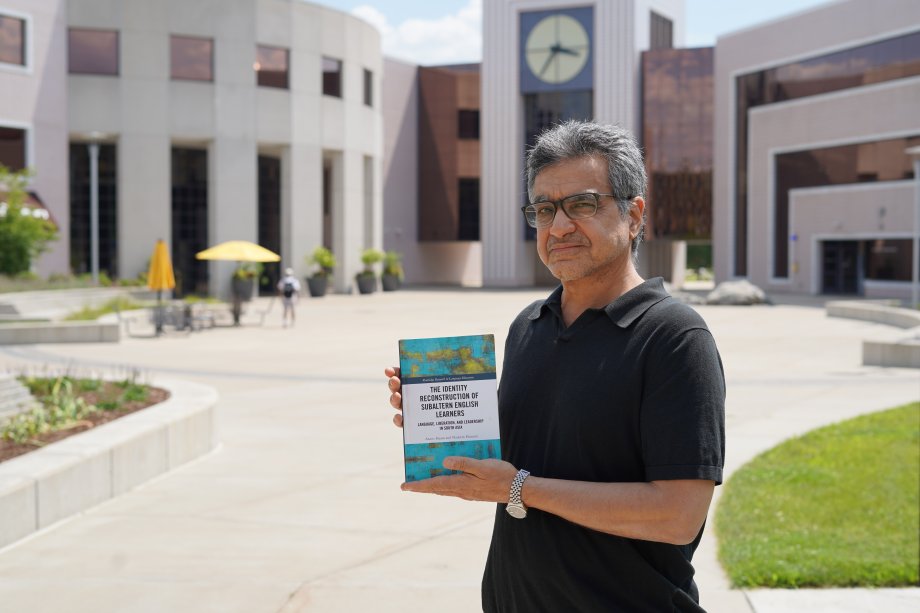
KALAMAZOO, Mich.—For many people, learning a second language is viewed as a practical skill, one that can open doors to employment or international travel. To Western Michigan University alumnus Dr. Aamir Hasan, Ph.D.’20, learning a second language is a necessity. Outlined in his dissertation turned book, The Identity Reconstruction of Subaltern English Learners: Language, Liberation and Leadership in South Asia (Routledge 2026), he argues that learning English serves as a pathway to dignity, leadership and opportunity for millions of marginalized people around the world.
Drawing on years of research and his own experiences teaching in Pakistan, Hasan introduces a new concept he calls “liberative motivation.” At its core, the concept suggests that many people learn English not simply to communicate but to overcome social and economic barriers.
“They are trying to liberate themselves,” Hasan says. “The minute they learn English, they are free. People start treating them differently. They get job opportunities. They are invited into spaces of privilege, access and opportunity.”
Research rooted in lived experience
Before pursuing his doctorate in Western’s College of Education and Human Development, Hasan spent years teaching students from dramatically different socioeconomic backgrounds in Pakistan. First teaching at one of the country’s most prestigious schools, he had students speaking fluent English and routinely attending Ivy League schools upon graduation. Then he moved to an all-girls inner-city school where English was taught one hour a day by non-English-speaking teachers—or, in other words, teachers who had limited speech ability in the language.
“They used to teach what we could call ‘library English,’ so it was more based on theory than performance,” explains Hasan. “Then I started teaching them English properly, and I kept seeing that kids who were picking up the language were acting differently and behaving like leaders.
“One of the girls I taught at that school went through medical school because she learned English, got a residency in the U.S. and now is working at the biggest hospital in the world, the Texas Medical Center in Houston. So that’s where this question was born: Does English create leadership?”
Hasan continued to explore this idea during his master’s program at Harvard University and found that research on second-language acquisition had not been explored in depth past Western contexts. Theories and learning frameworks were limited and didn’t consider the motivations of second-language learners in non-first-world countries who were seeking something more than career advancement or material gain; rather, they sought liberation.
A new contribution to language education
Building on his idea through his doctoral dissertation at Western, Hasan introduces the concept of liberative motivation—the desire to be fully human. It is this motivation that drives people in impoverished countries, like the ones he studied in South Asia, to learn English and liberate themselves from the barriers and socioeconomic silos that keep them at the bottom of society.
“These people I studied somehow discovered some spark in them to say, ‘I need to be free. I need to liberate myself from this humility that I face all the time. And there’s only one path,’” Hasan says. “So lack of English is this huge wall around them, which unless they can break through, they are condemned to lives of indignity and lack of opportunity.
“The best jobs they can get without knowing English are just subsistence-level jobs, you know? Nobody is going to give them a living wage where they can send their children to school or get a holiday. So that is where this term comes from—it’s from my real-life experiences and validated by the research.”
The book makes a further theoretical contribution through the development of the “Subaltern Self-Determination and English Acquisition Framework.” This model integrates the core psychological needs of autonomy, relatedness and competence with second-language motivation, illuminating how these dimensions interact with subaltern identity, leadership development and self-esteem. In doing so, it offers a nuanced perspective on the psychological and identity-related processes that shape English language acquisition among subaltern learners.
English as a human right
One of Hasan’s most ambitious arguments in the book is that access to English should be viewed as a basic human right. Using Maslow’s hierarchy of needs as an example, he argues that without English, it isn’t possible to satisfy all the levels and achieve self-actualization.
“Without English, you can’t get a job, you won’t have food, you won’t have safety, and knowing the feeling of belonging is not going to happen. You’ll never self-actualize,” says Hasan. “If we are keeping English away from people, then we are really denying them something very powerful.”
Taking action, Hasan has been presenting his research to conferences and is building a mission-driven organization, English-for-All, to support English learners and instructors.
“I am very committed to this idea that you teach people English and then try to get them into becoming English teachers,” says Hasan, “so that it goes from one to 10, and 10 to 100, and 100 to 1,000, and proliferates that way.”
“The Identity Reconstruction of Subaltern English Learners: Language, Liberation and Leadership in South Asia” is now available through Amazon, Barnes & Noble, Routledge, and other retailers in hardcover and digital formats. The paperback will be available shortly as well.
For more WMU news, arts and events, visit WMU News online.