
WMU alumna Jacqueline Kelly brings mental performance coaching to Boston Legacy FC
KALAMAZOO, Mich.—Jacqueline Kelly, B.S.’92, began her career focused on making athletes physically stronger. More than two decades later, the Western Michigan University alumna is helping professional athletes strengthen something that can be much harder to measure: their minds.
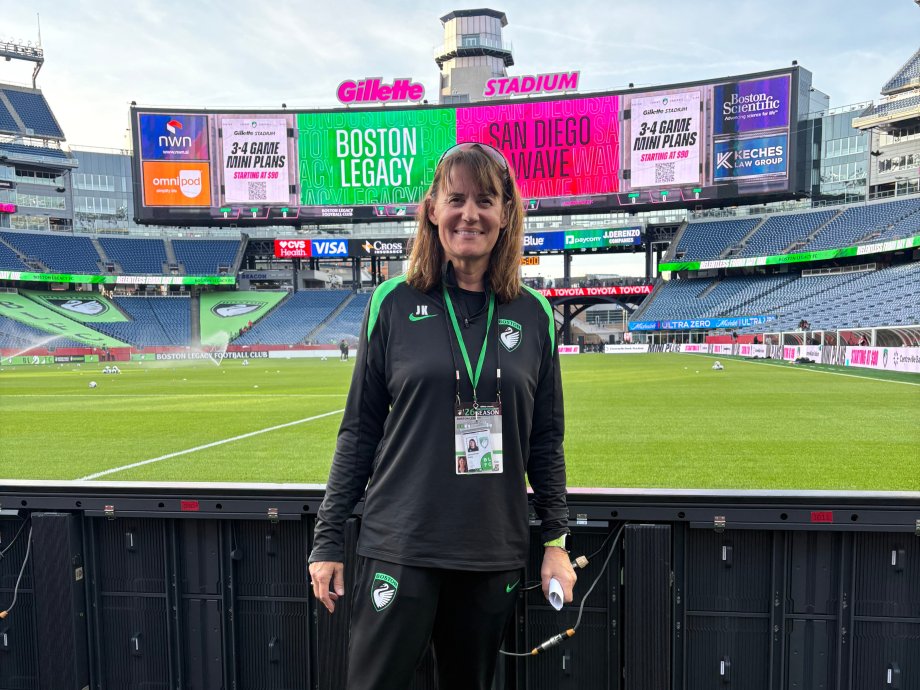
Kelly, a graduate of the College of Education and Human Development’s exercise science program, is now the mental performance coach for Boston Legacy FC, a professional team in the National Women’s Soccer League. In her role, she helps athletes identify the mental roadblocks that can stand between them and their best performance.
“I say that mental performance is you figuring out what it is that you need to do to become your total best self, your highest performer,” Kelly says. “What is your biggest roadblock? Is it your confidence? Is it your nerves? Is it anxiety? Is it your self-doubt? How do we remove those roadblocks and give you the skills that you need?”
Finding her path at Western
Before attending Western, Kelly studied at Kalamazoo Valley Community College to be a youth pastor and was part of the basketball team. During her second year, KVCC’s athletic director began talking with her about possible careers and introduced her to Western’s exercise science program—opening an entirely new professional direction.
At the time, personal training was still developing as an industry and women faced significant barriers in becoming strength and conditioning coaches. Rather than discouraging her, Kelly says, hearing how difficult the career path might be made it more appealing.
“I was always up for a challenge,” she says. “It wasn’t like he [the athletic director] was saying I couldn’t do it, but he was saying that it would be a difficult road. And it was a very difficult road.”
Western gave Kelly the support and foundation to take on that challenge.
She remembers the exercise science program as a close-knit community where faculty took a personal interest in their students. One biomechanics professor, she says, “changed my life,” while her academic advisor helped guide her throughout the program.
“When I got to Western, it was like they really cared about you,” Kelly says. “I still kept in touch with a lot of the instructors at school. So I always felt like if you were doing something, you could call and talk to them or reach out or go back.”
Her education also extended beyond the classroom. Unsure of exactly where exercise science would take her, Kelly completed a cardiac rehabilitation internship and took advantage of opportunities to learn skills such as EKG testing as she considered a career in exercise physiology.
From physical strength to mental performance
Kelly’s career eventually included work at universities, including the University of Louisville and Michigan State University, before family circumstances led her in a different direction. After having four children, including two sons she adopted from Haiti, Kelly needed more flexibility to support her family. She opened her own gym, working as a personal trainer and strength and conditioning coach.
Over time, however, she began noticing something physical training alone could not address. Some clients seemed to respond to coaching immediately, while reaching others required a completely different approach. Kelly had developed an interest in mindfulness and the connection between the mind and body, but she felt she needed more education to understand both.
“I just felt like I wasn’t educated enough to speak on all the parts, the mind-body,” she says.
About 15 to 20 years after completing her undergraduate education, Kelly returned to school and earned a master’s degree in psychology from California Southern University. She later became a certified mental performance consultant.
Her gym eventually became a place where clients could work on multiple dimensions of performance. Kelly incorporated strength and conditioning, mental skills, and sports hypnosis into her work. Then, after roughly 20 years of running the business, another transition arrived.
Her four children had graduated and left for college. Kelly sold her business and her Colorado home, moved to Arizona and initially planned to slow down. That lasted about three days.
“Apparently, owning your own gym and having four children, you’re not ready to be retired,” she jokes.
An opportunity to return to high-performance sports followed. After considering different options, Kelly chose the chance to become embedded with a team (Boston Legacy FC) and experience the daily environment of professional athletics rather than working with athletes only periodically.
“I’ve worked with a lot of teams as a strength and conditioning coach and a mental performance coach,” she says. “But I never traveled with them. I wasn’t ever embedded in all of those teams. So I thought it would be another cool thing to try out.”
Measuring the mental side of sports
One of the biggest changes Kelly has witnessed during her career is the growing ability to measure mental performance. Unlike strength and conditioning, where progress can be tracked through measurements such as weight, strength and other physical markers, she says mental performance was once much harder to quantify.
“When I first started, it was so subjective,” she says. “‘Oh, you feel better. Great, I must be doing a good job.’ Now we’re coming up with ways to measure, so it’s a lot more exciting and validating.”
At Boston Legacy FC, that includes mental performance questionnaires designed to assess areas such as resilience. Players completed assessments during preseason and again midway through the season, with another round planned for the end of the year. Kelly says the team has already seen significant improvement in how players score themselves over the course of the season.
The team has also explored technology that could provide additional insight into cognitive performance. Kelly says Boston Legacy FC has used brain-training tools while looking at questions related to concussion recovery. They’re also using monitors to analyze health metrics such as sleep, muscle strength, hydration and more.
“Having a degree in exercise science has helped me in this position because I’m in every meeting with the performance team, the medical team and the coaches,” says Kelly. “I understand the lingo, and I’m not missing out on anything related to player health and performance.”
I have a lot of certifications and education related to what I’m doing with Boston Legacy FC, but I don’t think I would have continued to pursue this career if it weren’t for my foundation at Western and the professors that made it home.
Becoming ‘unfragile’
Kelly is also sharing lessons about resilience outside professional sports through her new book, “Becoming Unfragile.”
The title of the book comes from a phrase with deeply personal roots. Kelly says her two adopted sons from Haiti experienced significant hardship before joining her family. As they became talented young athletes in the U.S., they later encountered racism and discrimination. Kelly wanted to give them a way to remember what they had already overcome.
“‘You guys are the most unfragile people I’ve ever met. You can’t let this bother you,’” she remembers telling them.
Kelly’s family began writing the word unfragile on blank T-shirts, which her sons wore underneath their jerseys to remind them of this. Years later, the idea became part of Kelly’s effort to share the lessons that helped her navigate difficult periods in her own life.
“I’m just fulfilling my purpose for still feeling like I can share something that allowed me to get through something that was really hard,” she says.
Through every stage of that journey, Kelly says, Western has remained part of her identity.
Her career has taken her from Michigan to Kentucky, Colorado, California, Arizona and now Boston. Yet the relationships she formed as a Bronco continue to stand out.
“I still wear my Western Michigan shirts everywhere, and I’ve never met better people than I did while I was in school,” she says. “And I mean that from the bottom of my heart.”
For more WMU news, arts and events, visit WMU News online.