Apply-Explore Call To Action
Stats Grid
100%
of mathematics graduates are working or continuing their education
94%
of graduates working full time have a job related to their degree
98%
of Broncos had instructors who made them excited about learning
Pursue a B.S. in teaching and learning mathematics
The Bachelor of Science in teaching and learning mathematics prepares you to understand mathematics from both a learner's and a teacher's perspective. You will study mathematical theory while learning how adolescents develop mathematical ideas, where misconceptions arise and how different teaching approaches can support understanding. Coursework in teaching methods and educational technology gives you opportunities to design learning activities, assess student reasoning and communicate concepts for a secondary-school audience. Field experiences allow you to observe and practice these skills in educational settings. After completing the bachelor's degree, you may apply to WMU's Master of Arts in Teaching in secondary education; successful completion of that graduate program can lead to recommendation for Michigan teacher certification.
What you'll learn
You will study geometric structures and explore how transformations can help explain geometric relationships. Methods courses examine curriculum, materials and activity-based approaches for teaching mathematics, with attention to how learners develop and communicate mathematical understanding. You will also use computing technology to support problem-solving and concept development in grades 7 through 12. Through field experiences, you will assess student thinking, practice teaching techniques and use evidence of student understanding to guide instruction.
Student Quote
As I have progressed through my mathematics journey, I have found Western to be a welcoming and uplifting place to learn and grow. The department is close-knit and friendly, and being a part of a small community has given me the opportunity to explore my interests right alongside the faculty
Where you'll be after graduation
This major is designed for students who plan to become middle or high school mathematics teachers through WMU's post-baccalaureate Master of Arts in Teaching pathway. Graduates have worked as mathematics teachers and tutors, and the degree can also support further study in mathematics education.
WMU’s Career and Student Employment Services helps you explore career options, connect with employers and prepare for the job market through personalized career advising, resume and cover letter reviews, mock interviews, internship and job search assistance, and career fairs. These resources help you identify opportunities that align with your interests and career goals while building the professional skills needed for long-term success.
What others have achieved
What others have achieved


Making the most of your learning experience
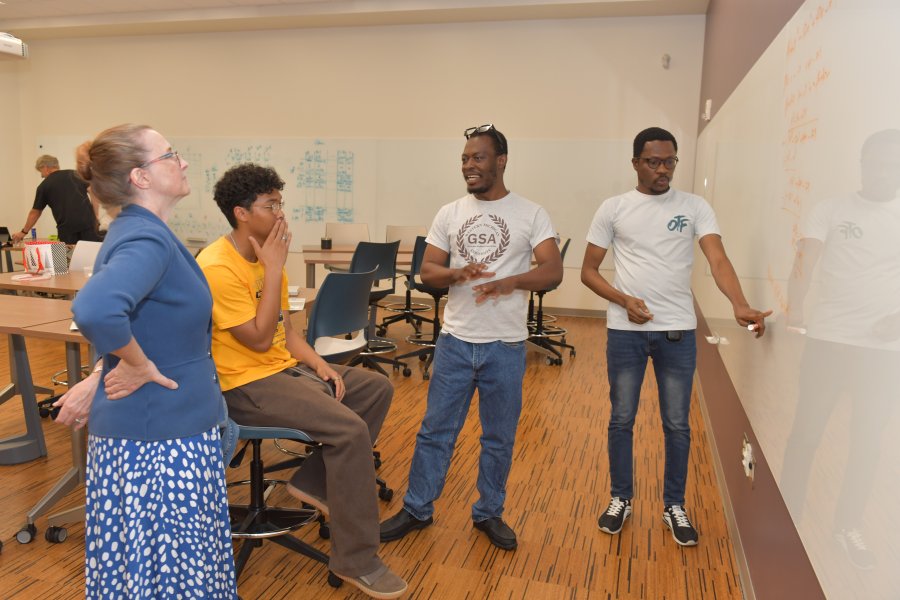
WMU offers a variety of experiential learning opportunities that reinforce classroom concepts through hands-on application and community engagement. Collaboration with peers is an important part of learning, and the Math Club extends that engagement beyond the classroom through talks, activities and social events that connect you with the broader mathematical community. You are also encouraged to participate in seminars with graduate students and faculty. Field experiences give you opportunities to assess student thinking, practice teaching techniques, use technology to deepen understanding and design and implement lessons in local schools. You can also participate in outreach events such as the Math Carnival for K-8 students and families. Academic support resources such as the Tutor Lab and Learning Assistant Program provide assistance in early mathematics courses, while opportunities to support other learners can help you develop leadership and teaching skills.
What scholarships are available for a teaching and learning mathematics degree?
The Department of Mathematics is committed to supporting student success. Through the kindness and generosity of our donors, we award more than $300,000 annually in scholarships. New students majoring in mathematics are automatically considered for departmental scholarships, and continuing students can seek additional funding opportunities through Scholarship Universe.