

Unlocking history through digital scholarship
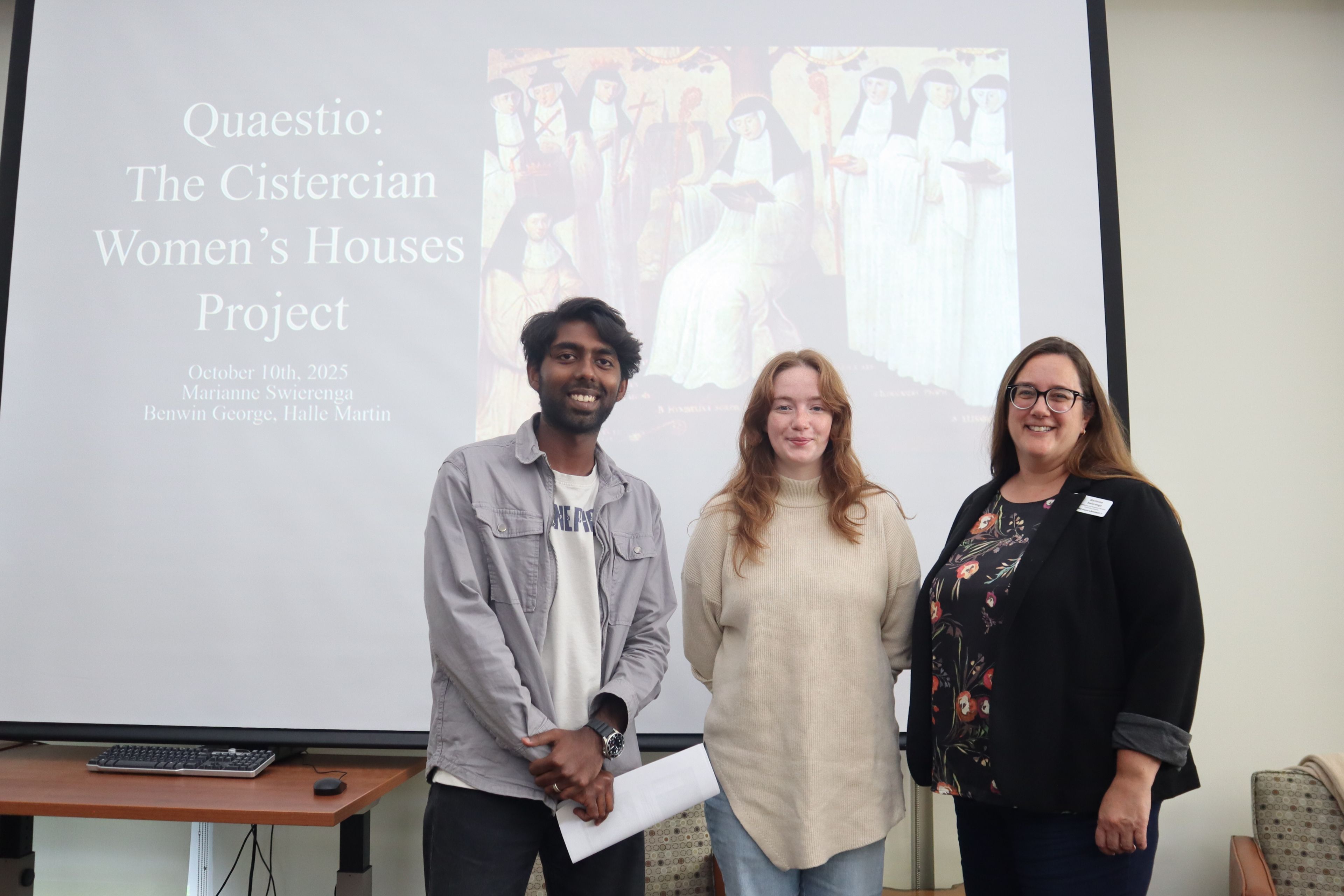
Benwin George (left), Halle Martin (center) and Marianne Swierenga (right) present their Cistercian Women’s Houses project at the Medieval Research Group’s Quaestio event in October 2025.
KALAMAZOO, Mich.—A digital humanities project is taking a new turn thanks to new applications of a technology many people know—a wiki. Librarians Marianne Swierenga and Dr. Sue Steuer, along with intern Halle Martin and student employee Benwin George, are developing an interactive wiki to help researchers access unpublished 19th-century research on Cistercian women’s houses.
Scholar Leopold Janauschek spent over 50 years researching and documenting the Catholic Cistercian order, including the locations of known Cistercian houses. He published his findings on Cistercian men’s houses, but died before any further findings could be shared on the women’s houses.
Janauschek’s research was discovered at Heiligenkreuz Abbey by Frank Sasama, a German researcher, who later partnered with Western’s former Center for Cistercian and Monastic Studies and University Libraries to make them more accessible. Since then, several interns have worked to translate and prepare the notes for sharing.
The interactive “semantic wiki” in development will allow users to access translated notes, maps and background information about the women’s houses.
A semantic wiki is an extension of a traditional wiki, such as Wikipedia, that enables teams to use structured data to organize pages. Structured data means “it can be more easily searched, aggregated, queried and used in geographic visualizations like maps,” according to Swierenga, cataloging and metadata librarian.
“We chose to use the wiki format because it's a collaborative space, customizable, and the software is free and open source,” Swierenga says.
“It's been very much a collaboration,” she adds. “Each student brings their expertise. Computer skills, languages, medieval and monastic history—a great mix [is] needed for a digital humanities project.”
Martin, a doctoral student studying history at Western, helped our library team with translation and background research.
“My role in this project has been to help develop this website from a researcher's perspective, providing input on how best to represent our data,” says Martin.
Part of Martin’s work has been to fill in what has changed since the 19th century and what is missing from Janauschek’s research. Even locations documented in his notes may have been disrupted or destroyed by wars and conflicts in Europe. The number of languages Janauschek used to record his notes also presents a challenge, Martin explains.
While Martin dug into Janauschek’s notes, Swierenga worked closely with George, a graduate student in computer science, to develop layouts and features for the wiki.
“We've very much been exploring the software to see how best to use it, and Benwin has been great, experimenting with layouts and features, rolling with all my new ideas and requests,” Swierenga adds.
George, Martin and Swierenga presented their progress at a Medieval Research Group event in October 2025. Work on the wiki continues with hopes of launching in 2026.
“This project has helped me work towards a future in my field,” Martin says. “Digital humanities is a growing field which is allowing us to communicate the histories of culture in more creative and lasting ways, and this project aims to do just that.”
For more WMU news, arts and events, visit WMU News online.