
Breathing new life into historical collections through data harvesting
KALAMAZOO, Mich.—The University Libraries has been digitizing our distinctive collections to make them more accessible to researchers worldwide. This summer, we began transforming the digitized Kalamazoo County Poorhouse ledgers into research-ready datasets thanks to the help of Collections as Data Intern Patricia Sebastian.
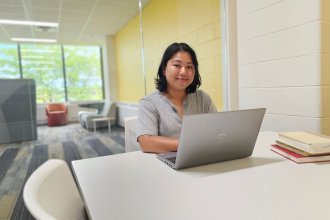
Sebastian transcribed the Kalamazoo County Poorhouse ledgers and collected historical information to provide context and enhance users’ research experience. Sebastian worked closely with Daria Orlowska, data librarian, and Lynn Houghton, regional history curator, to prepare the dataset and complete background research.
The ledgers contain handwritten accounts of people who lived at the Kalamazoo County Poorhouse from 1885 to 1912, including their names, ages and the reasons for their stay.
Poorhouses were county-run facilities that provided shelter and support for people in need in the 19th and early 20th centuries. Conditions in poorhouses could be harsh, with strict rules and possible work requirements—often manual labor on farms or in other environments.
Kalamazoo County appropriated funds in 1831 to support people experiencing poverty, purchasing land for a farm before selling it and opening the “County Home” in 1848. The home was located between Comstock and Galesburg. Reasons listed in the ledger for residents’ “cause of pauperism” included alcoholism, desertion, old age, medical conditions, injuries, poverty and pregnancy.
Sebastian shared that reading the ledger and staff notes resonated with her previous social work experience. Before pursuing her master’s degree in library and information science at San José State University, Sebastian worked with individuals living in shelters.
“Through this ledger, we get a small but insightful glimpse into the lives of people who are often absent in history,” Sebastian says.
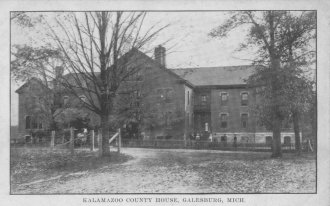
In the U.S., poorhouses declined during the 1930s as more federal programs, such as the Social Security Act, were created to support people in need. By the 1930s, the County Home in Kalamazoo had become a residence for older people until its closure in 1971, according to Houghton. The site was later developed into River Oaks County Park after the buildings were demolished in 1974.
The ledgers documenting the intake of residents and costs of running the home were eventually deposited in the Regional History Collections at the Zhang Legacy Collections Center. As a dataset, the information in the ledgers is more accessible to researchers interested in poorhouses and life during this period.
“It makes this information available to a wider group of researchers [and] those who want to find out about people who were sent there, including ethnicity, duration of stay, reasons for them being there,” says Houghton.
The Libraries' ongoing Collections as Data projects enhance access to information in our physical and digital collections and may inspire researchers.
Research-ready outputs—such as the Poorhouse Ledgers datasets—improve access to a collection that previously resided in preservation areas and "existed only as a scanned image," according to Orlowska.
“Combining the datasets with landing pages and educational resources contextualizes the collection, allowing scholars to recognize research potential and instructors to see connections to learning outcomes,” she adds.
Orlowska uses historical datasets to help teach data literacy to the Western community, demonstrating the utility of these collections while equipping students with the skills they need. She is currently working with four undergraduate students to finish Sebastian’s work by transcribing the remaining ledgers into shareable datasets.
"We are breathing new life into a holding that our community might have never found out about,” she says.
Working with interns new to data librarianship has helped Orlowska refine her data literacy lessons, while also providing students with valuable work experience.
“My goal was to learn as much as I could about librarianship in a university setting,” Sebastian says. “I’ve learned so much, but broadly speaking, this has helped me think of data management and data in a new way.”
For more WMU news, arts and events, visit WMU News online.