
Student fieldwork reimagined through virtual reality
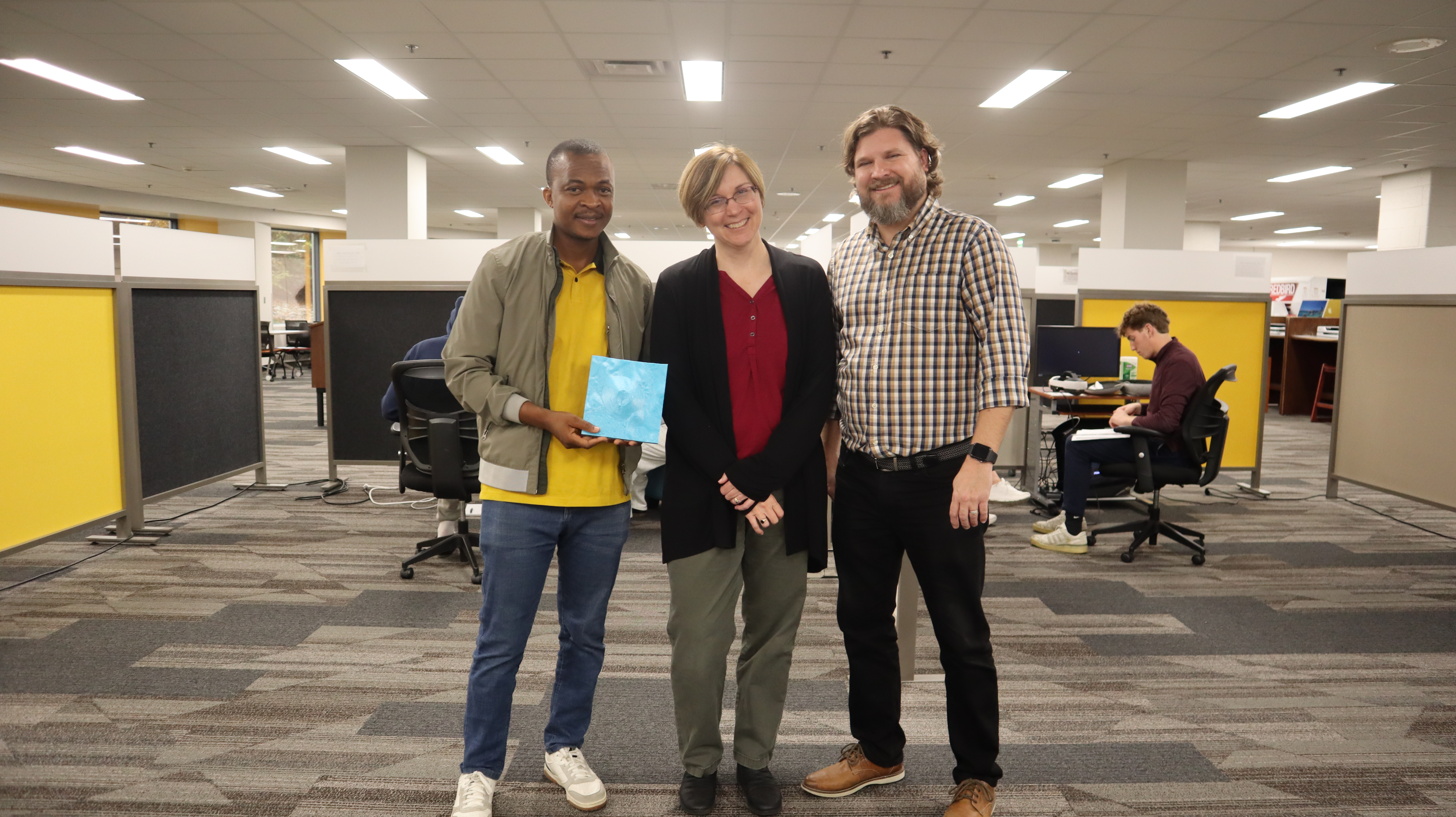
Fredrick Magi (left), Dr. Heather Petcovic (center) and Alex Teal (right) partnered to bring GEOS 1000 to the Tech Lab for virtual fieldwork.
How can undergraduates gain fieldwork experience without going outside? Virtual reality provides a hands-on alternative.
KALAMAZOO, Mich.—Students in GEOS 1000 (Dynamic Earth) participated in a new kind of field experience through a pilot project led by Fredrick Magi, doctoral student in Science Education, and Dr. Heather Petcovic, chair of the Department of Geological and Environmental Sciences, in collaboration with Waldo Library’s Tech Lab.
The GEOS 1000 pilot combined 3D printing and virtual reality (VR) to help students taking the Western Essential Studies course learn about topography maps and give them an engaging fieldwork experience without leaving campus. This hands-on approach lets students explore terrain they would otherwise only see on topographic maps.
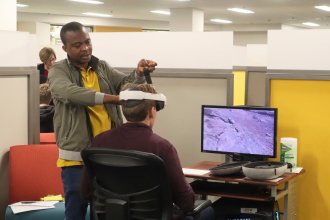
Magi was inspired by his experiences as a classroom teacher in Nigeria, where he used VR headsets and applications to teach about the solar system.
“I observed a significant improvement in students’ conceptual understanding of Earth and space science concepts, as well as their engagement,” Magi says.
Now a doctoral student at Western’s Mallinson Institute for Science Education, Magi’s research focuses on measuring the impact of immersive technology on student learning outcomes, interest and motivation in geoscience.
Magi partnered with Alex Teal, emerging technology specialist, to bring GEOS 1000 to Waldo Library’s Tech Lab. The Tech Lab features ten VR stations, dedicated space for course activities, and technical support from Teal and his team.
“The VR Tech Lab has completely transformed what is possible instructionally. Without it, space and equipment constraints would make this type of immersive experience impossible,” Magi says.
“We were thrilled to partner with Fredrick and Dr. Petcovic to move this from concept to fully-formed project,” Teal says. “It’s exciting to introduce students to multiple aspects of the Tech Lab and to bring a complicated field exercise from halfway around the globe to the heart of our campus."
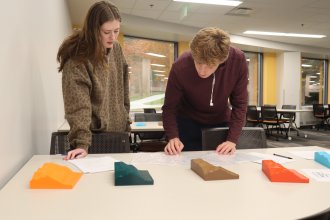
The course assignment includes three elements: two-dimensional paper elevation maps, 3D-printed models, and a virtual reality application that lets student teams take measurements in an immersive environment. According to Magi, the goal is for students to predict elevations, collect data in VR and refine their predictions based on their findings.
“Instead of asking students to imagine what a landscape looks like from contour lines alone, VR allows them to actually walk through the terrain. That shift from imagining to experiencing is what makes the learning so powerful,” Magi adds.
The GeaVR app allows students to virtually explore the Mount Etna 1809 crater in Italy. The site was selected for its “dramatic elevation changes, clear volcanic topography and strong visual connections between 3D landforms and 2D contour patterns,” says Magi.
Magi worked with graduate teaching assistants Aylin Yildirim and Justin Honer to prepare materials for the assignment. Teaching assistants Doaa Hegazy, Ahmed Alshakr and Alaa Hawamdeh helped deliver the lesson in the Tech Lab.
Thirty-five students participated in the pilot during the fall 2025 semester. Student reactions have been overwhelmingly positive, with comments such as “this is my best lab ever” and “this lab makes me want to be a geoscientist,” according to Magi.
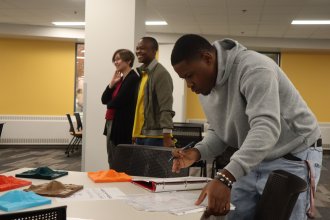
Magi used student feedback and observations to refine the lesson for future courses. In spring 2026, nearly 60 students in GEOS 1000 and GEOS 1300 (Physical Geology) will participate in the innovative lesson. GEOS 1300 is a more technical course for geoscience and civil and construction engineering majors, adds Petcovic.
“We want to see whether the lab is engaging for science majors as well as for non-science students,” Petcovic says.
The Tech Lab offers more than 175 VR applications across a wide range of disciplines and experiences. Faculty and instructors interested in creating a VR experience for their courses are encouraged to contact Alex Teal for more information.
“We're always looking for new partners and possibilities in the Tech Lab,” Teal says.
For more WMU news, arts and events, visit WMU News online.