Students looking at plane

Aviation Flight Science Degree

Looking for state-of-the-art training in the skies and world-class facilities as well as resume-worthy internship experiences that will lead to a lifetime of career opportunities? An aviation flight science degree at Western is right for you.Move from zero flight experience to degree completion and career-readiness. Fly out of the Battle Creek Executive Airport at Kellogg Field at one of the nation’s top flight schools. Begin your training in the private pilot course on the second-longest runway in the state and the third-busiest airport in Michigan. Test your skills as a student at one of our partner airlines. 

Pride points

Over 85 years

of aviation education

Top 6 in the world

ranked aviation program

—Study International

Best for vets

ranking each survey year since 2010

—Military Times
Skip to content

Pursue a B.S. in Aviation Flight Science

An aviation flight science degree from Western can take you around the globe through the largest, most well-known airlines, airports and aviation companies in existence. You could join fellow Western Michigan University graduates flying passengers and goods across the world. The mission of the Aviation Flight Science Program (AFSJ) is to provide industry with a professional aviator who serves as a responsible leader within an organization. Graduates will exhibit high levels of technical skill, leadership ability, teamwork, and global awareness that will make them effective problem solvers in a diverse and safety-oriented aviation industry.

What you'll learn

The aviation flight science program prepares students for professional pilot careers, emphasizing leadership and management skills alongside technical expertise. The curriculum includes a broad range of subjects from basic sciences to airline operations and global navigation. Students gain hands-on experience with modern aircraft and flight systems and can participate in research. 

Graduates will possess strong technical skills, leadership abilities, and global awareness, earning FAA Commercial Pilot certification and the qualifications to be effective leaders in the aviation industry. Students will have the opportunity to connect with many pathway programs during their time here at Western, and have the ability to strengthen their resume for their future career.

student flying a plane

Student Quote

Being surrounded by individuals who support me and who relate to my experiences and encourage my growth, has meant more to me than I can fully express. I will always be grateful.
— Ella Hanson, Junior, Aviation Flight Science

Where you'll be after graduation

Graduating with a degree from Western Michigan University College of Aviation opens up a dynamic trajectory built on experience-driven learning and industry demand. The combination of specialized academic preparation and hands-on learning ensures that Broncos seamlessly transition from the classroom into highly impactful, meaningful careers. Many recent flight science alumni have gone to work for main-lines like Delta, United, American, while others choose to fly corporate, for companies like Stryker and Executive Jet Management. The sky's the limit!

Don't believe us? Just ask CoA graduate, Cole Dillon, who is a current captain at SkyWest. You can read about his story and many Bronco alumni by visiting the link below! 

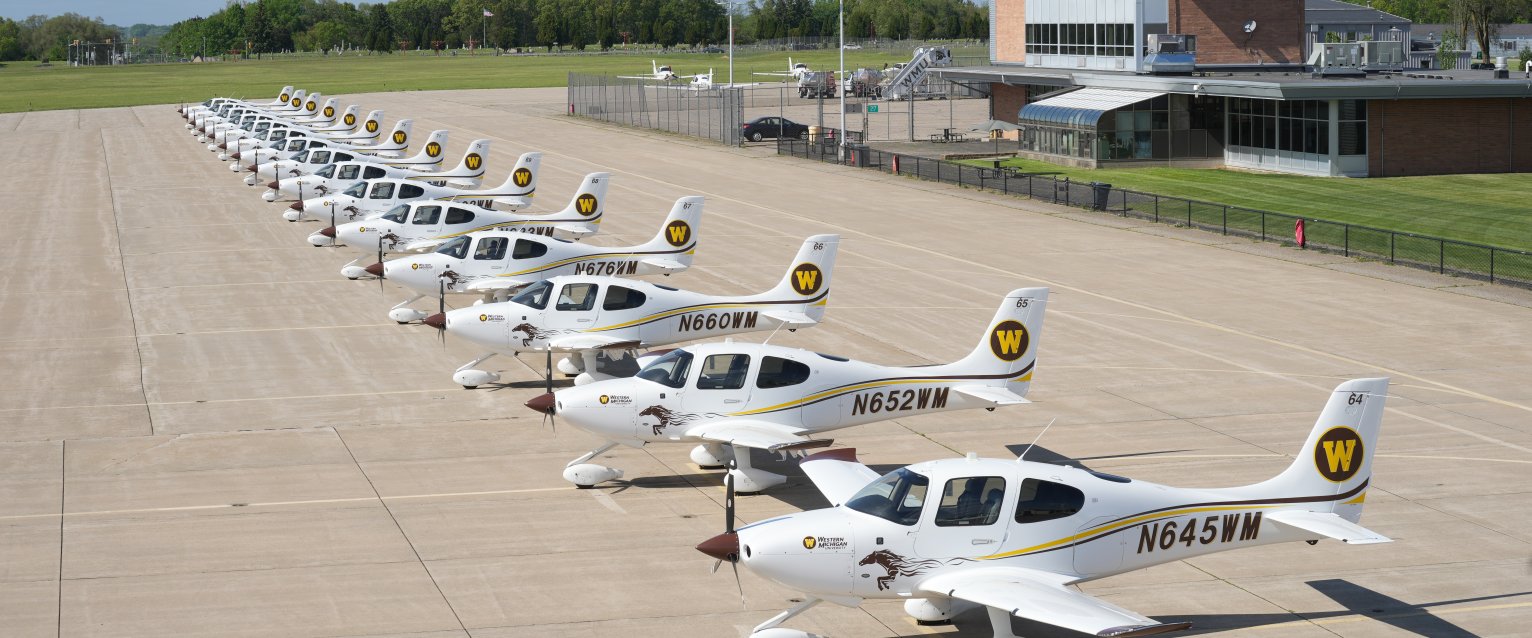
Planes lined up

Additional admissions requirements

Additional admissions requirements

Due to the strong interest in our program, we have implemented a rigorous and structured application process to ensure that individuals who apply, are truly committed to pursuing a career in aviation.
Frequently asked questions

In regard to obtaining a private pilot's license before attending WMU, the answer to that question is very mixed. For some students, the experience is productive; for others, it hasn't helped put them in a better position.  

The first question in regard to obtaining a private - will it help accelerate my acceptance into a flight slot? The answer is: it may help, but only a very little. To dissect this, it is important to understand how we prioritize flight slots. The criteria for a flight slot is based on two things: 1. WMU GPA (if we had spots for new students, we would use their HS GPA.) 2. the number of credit hours successfully completed. The only exception to this, if a student has their private pilots license (but it must be complete and in hand at the time the student submits their flight application), they do receive five bonus points. While this isn't huge, if we have two students that are equal, the five points may help the person with the private.

The next question - will this speed up my progress through the WMU flight program? The answer to this is: maybe. It is best to understand that WMU trains students to become professional pilots. As a result, our flight curriculum and labs are incredibly rigorous. We also train following the Federal Aviation Administration's part 141 regulations, which hold the pilot and the training entity to higher standards.  Most students who obtain their private pilot's license at a local flight school train using the part 61 regulations, which are not as strict, and do their ground school online or self-study. As a result, some students come to us with marginal knowledge and skills. When a student comes to us with their PPL, the first flight class they do will be our private pilot transition course. The purpose of this course consists of three objectives:

  • Complete a skill evaluation, making sure the student is operating at the part 141 level
  • Orientate the student to the process and procedures that we operate under at WMU.  Our operations perform very similarly to those at a large airport.  In addition, we operate at a controlled airport, which can be very new to some students.
  • To familiarize and learn the operations of our Cirrus SR20, which are equipped with a very complex avionics platform, Garmin Perspective+.

When doing the transition course, the syllabus is a minimum of 10 to 11 lessons, approximately four to six weeks long, and a minimum of about $7,583. Depending on the skill set and proficiency of the student, and the knowledge they have acquired in obtaining their PPL, some students hit the minimums, while others take six to eight months, and spend three times more. 

One thing to add, recently, we seem to be seeing more transition course students struggle than we have previously. We believe this is due to the fact that the number of training providers doing proficient work may be diminishing due to lack of staff, resulting in marginal training quality becoming the norm far more than it has been in the past.   

Our suggestion is to evaluate and investigate the local flight schools you may be considering. We suggest anybody seeking training in the part 61 environment shop carefully and ask lots of questions about success rates, instructor turnover, ground schools and total experience on the course for others who have completed it. As an aside and while this is definitely an outlier (we have only seen it once), we actually have had a student who arrived with private pilot certificate in hand, did very poorly in the transition course and repeated the entirety of their private pilot training here. We suspect there may be extenuating circumstances associated with that situation, but it has happened and is certainly far from an ideal outcome. 

At WMU, we aim to get our students flying as soon as possible. While we cannot guarantee an exact start date, we are pleased to share that our flight training backlog has been significantly reduced. As a result, we expect most students to begin flight training within the first year after the completion of their first semester: which could be spring, or summer semester of their first year, or fall semester of their second. However, please note that the aviation industry can be volatile, so these plans may change unexpectedly. Rest assured, our goal is to get every student flying as quickly as possible, regardless of industry changes. 

Yes! We strongly recommend that students stay during at least one of our summer semesters to take advantage of Michigan’s best weather and continually progress the student’s flight training. WMU also offers academic courses throughout the summer semesters. Summer I is roughly May-June, while Summer II is roughly July-August.

This depends on the student and their desire to learn. The average is 2.5-3 years to obtain the private pilot license, instrument rating, and commercial multi-engine license with single engine add-on rating. However, depending on flight availability, weather, and students, this timeframe can vary.

There are over 40 planes in our fleet, consisting mainly of Cirrus SR-20s.

  • 32 Cirrus SR-20s Gen7 Equipped with the Garmin Perspective+
  • 9 Piper Seminoles
  • 1 American Champion Super Decathlon
  • 1 Piper Super Cub on Floats
  • 2 Cessna 150s

Check out our aircraft

The Cirrus is our primary training aircraft and is used in the private and instrument courses, while the Seminole is used for the Commercial multi-engine course. There are three required flights during the commercial portion of your training in the Super Decathlon. Our Sky Bronco Precision Flight Team uses the Cessna 150s for competition and practice.  

Scholarships

What scholarships are available for the College of Aviation?

You can find the updated list of the latest College of Aviation scholarships on Scholarship Universe. When applying for scholarships, it is important to follow the directions carefully. Scholarship selection committees are very particular, and attention to detail is usually one of the first sorting criteria followed. For more resources and scholarships related to Western, visit the link below!