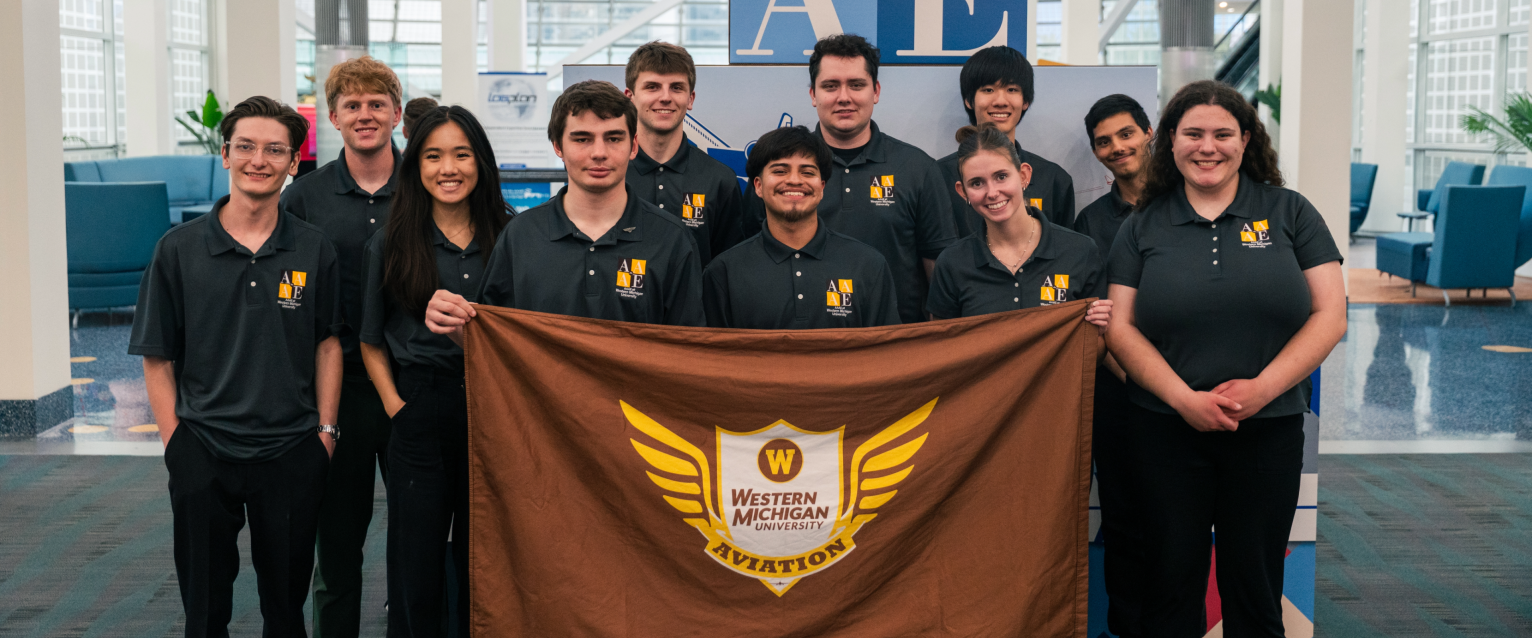
Students at AAAE conference.

Aviation Management and Operations Degree

Western Michigan University's Aviation Management and Operations (AMOJ) program is the ultimate backstage pass to a multi-billion dollar industry. Students will dive into the many sides of the aviation industry and what makes it tick. Come with us to discover where this degree can take you!

Pride points

Over 85 years

of aviation education

Top 6 in the world

ranked aviation program

—Study International

Best for vets

ranking each survey year since 2010

—Military Times
Skip to content

Pursue a B.S. in Aviation Management and Operations

The Aviation Management and Operations program at Western Michigan University's College of Aviation focuses on preparing resilient, engaged, and competent professionals for meaningful careers in the aviation industry. Through a deliberately developed curriculum of aviation-specific knowledge, leadership growth, and ethical practice, students garner skillsets to manage operations across airports, and commercial and general aviation services.
 

What you'll learn

This degree is designed to prepare tomorrow’s aviation business leaders, today. As a graduate of this program, you will be poised to obtain a position in airline or airport management, operations management, safety management, aviation/aerospace administration, aviation dispatch, airport or network planning, or many others. Your coursework will include a focus of aviation-specific management courses. You will also build a solid foundation in business theory and practice, which will prepare you for easy entrance into most accredited Master of Business Administration programs.

Student sitting in plane.

Student Quote

I have learned all about the operational focus of an airline at my internship with Envoy and Western Michigan University's College of Aviation.
— Kevin Klimas, Senior, Aviation Management and Operations

Where you'll be after graduation

Graduating with a degree from Western Michigan University College of Aviation opens up a dynamic trajectory built on experience-driven learning and industry demand. The combination of specialized academic preparation and hands-on learning ensures that Broncos seamlessly transition from the classroom into highly impactful, meaningful careers.

Don't believe us? Just ask CoA graduate, Dave LaPorte, Denver International Airport's Chief Operating Officer. You can read his story and see for yourself at the link below!

College of Aviation.

Switching major to Aviation Flight Science

Switching major to Aviation Flight Science

During the end of the Fall semester, the College of Aviation will review all of the data necessary to determine the number of major changes that will be allowed for the upcoming year. Please visit the link to learn more about this process.
Frequently asked questions

Classes will be split between WMU’s main campus in Kalamazoo and the aviation campus in Battle Creek. Related courses and essential studies will be held on main campus, in addition to some introductory level aviation classes. As students advance through the program, more classes will be held at the aviation campus. All flight training will be held at the Battle Creek Executive airport. For tech ops students, all labs (which make up the majority of the classes) are held at the aviation campus. Additional required classes, such as chemistry, physics, and essential studies courses are held on the main campus. For management and operations students, there will also be a number of classes held in WMU’s Haworth College of Business, in addition to classes at the aviation campus and essential studies on main campus. WMU’s residence halls are located in Kalamazoo on the main campus.

We no longer offer a program specific to air traffic control. WMU used to be one of 15 AT-CTI schools, but in 2012, the FAA changed their hiring process to require only 1) a four year bachelors degree or 2) three years work experience or 3) a combination of the two. There is no aviation requirement to be hired. We thought it was unfair to offer the program to our students when there is no guaranteed job after graduation. If you are interested in becoming an air traffic controller, we recommend the aviation management and operations program, which qualifies you to apply for air traffic control, but also offers additional career opportunities. 

Yes! Recently we have implemented a 15-credit program for UAS (Unmanned Aircraft Systems). Check it out here!

The University offers two other UAV-related graduate certificates. The Certificate Program in UAVs Applications in Geological and Environmental Sciences gives students a comprehensive understanding of the available geophysical and remote sensing sensors mounted on UAVs, and training on their applications in addressing geological and environmental problems. It consists of four classes. The Certificate Program in Geospatial Applications of Unmanned Aerial Vehicles emphasizes obtaining and analyzing airborne imagery to yield accurate 2D maps of the Earth's surface land cover and vegetation health, and 3D surface models. It consists of three classes.

The graduate certificates are offered by the departments of Aviation Sciences, Geological and Environmental Sciences, and Geography in partnership with the Extended University Programs office. Both of WMU's UAV-related certificate programs require nine-credit hours of classes and feature a combination of online, face-to-face and hybrid--online and face-to-face--instruction. They are open to anyone with a bachelor's degree. Students may enroll in either program at any point in the year.

Here at the College of Aviation, we offer an Aviation Administration, Graduate Certificate Program, but do not offer a Master's option. Western Michigan University has a number of graduate programs available to students, however not in the College of Aviation. A complete list of WMU's graduate offerings can be found here

Scholarships

What scholarships are available for the College of Aviation?

You can find the updated list of the latest College of Aviation scholarships on Scholarship Universe. When applying for scholarships, it is important to follow the directions carefully. Scholarship selection committees are very particular, and attention to detail is usually one of the first sorting criteria followed. For more resources and scholarships related to Western, visit the link below!