
Lessons That Don’t Appear on a Checkride: Nick Garrod reflects on flying, learning, and what really matters after 20 years in aviation

With the best part of two decades in professional aviation under his belt, Nick Garrod is in a good place to offer some advice to those on the brink of embarking on a similar career path.
Quality-of-life factors should have priority over financial ones in choosing what directions to follow in charting that career.
The 2010 graduate from the WMU College of Aviation admits that in his chosen industry, "You have the potential to make a lot of money. My biggest advice is -- Don't chase the money.”
"I know many pilots," he says, "who make $300,000 a year, but they miss a lot of holidays, birthdays and other special events. This can put a lot of strain on a relationship which leads to a higher than normal rate of divorce. If you can balance it all, great! But if you have to choose between a great schedule or more money, I suggest you choose the great schedule."
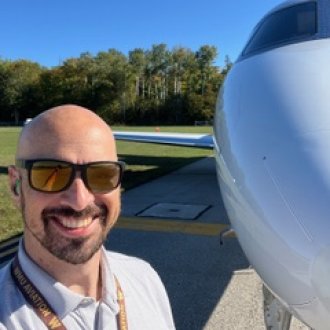
A senior captain flying for the corporate flight department located in southwest Michigan, Garrod said his job "has me home way more than I'm away, and my salary pays the bills, with some money left over, which is more than enough."
Raised in Coloma in the southwest corner of Michigan, Garrod had determined a tentative career path upon his 2006 graduation from Coloma High School. Flying radio-controlled planes as a childhood hobby, he thought being a real-life pilot seemed exciting.
"But as I got older," he says, "I never considered that was something I could do, so I pursued other interests." Those interests took him to Tri-State University in northern Indiana where, as a freshman, he majored in civil engineering and played college football at that level.
The fates were at work. Torn ligaments in a shoulder delivered the message that football was no longer an option, and it also dawned on him that civil engineering was not his cup of tea.
So, what to do? One strategy was to listen to his parents, who are both WMU graduates, as is a grandfather. "They had nothing but good things to say about Western" and, another selling point, its Kalamazoo campus was close to Garrod's roots.
And, by the way, Western was home to a renowned aviation program. "While I didn't fully know I wanted to be a pilot," Garrod says, "I knew I didn't want to be an engineer. Any field in aviation sounded fun and interesting, and I initially chose aviation business as my field of study." That, too, changed after a course in macro-economics (not exactly stimulating) and conversations with students majoring in aviation flight science.
"Flying sounded like fun," he says, "and I couldn't believe it was something they would let 19-year-old me do. I signed up for my first flight lesson and as soon as the wheels left the ground, I was hooked."
There was still much more to learn. And thanks to instructors Brett Zirnus and Todd Protacio, he did. "Brett fueled my love of aviation and was patient when I was struggling with self-doubt," Garrod says. "Without his motivation, I would have quit. Todd helped me become a better pilot. He held me to higher standards and wanted my flying to be near perfect. All this set the foundation for the pilot I am today. I'm always trying to be a little better than the last flight, and I have Todd to thank for that."
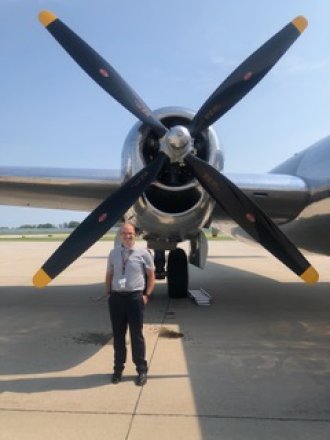
A favorite course focused on the aerodynamics of flying, and the physics that allow a plane to go aloft. "It's amazing how different-shaped wings affect how a plane flies," he says. "I'm still a little bewildered how it all works."
It's that bewilderment that stays with Garrod to this day. "The more you can learn about everything happening around your plane," he says, "the better you can understand how to control it and make it do exactly what you want it to do."
During his days on campus, there were Alpha Eta Rho activities and their networking opportunities, Bronco football and hockey games, his first solo (a memory that seems like it happened yesterday), and "just walking around campus.” Good days and good times. Now came the career launching.
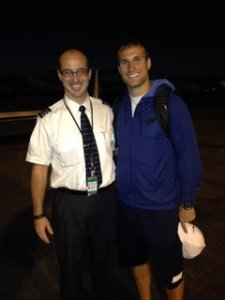
Garrod's professional debut was at the small airport near Allegan just northwest of Kalamazoo, taking sky divers up in a Cessna 182. "When I was offered the job," he recalls, "I was so excited that I never asked what the pay was. My girlfriend (and future wife) couldn't believe that I didn't care about the pay. I was just happy to have a job. I learned to work with people who were more scared to fly than jump out of a plane, to do weight and balance quickly, avoid weather and do some formation flying."
He also worked for the fixed base operator in Allegan, Garrod was among those who tackled tasks outside of their assigned responsibilities. "Along with fueling airplanes and helping with purchases," he says, "I assisted the airport mechanic on the field, mowed the grass, replaced runway lights, and got to see what all goes into keeping an airport running."
After also serving as an instructor at that airport, he headed to California for similar teaching duties at airstrips near Carlsbad and El Monte with their busy airspace and mountainous terrain. Lessons learned there included dealing with people with different backgrounds, perspectives and goals, and customizing modes of instruction to meet their needs
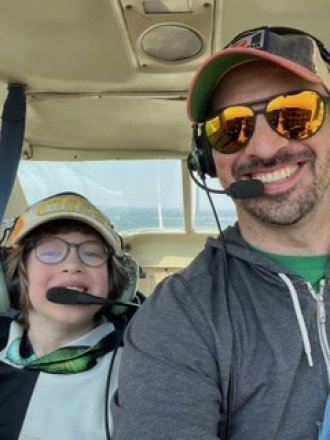
Garrod then took advantage of a pilot-training relationship his alma mater had with what at the time was known as Pinnacle Airlines. Meeting all of the criteria, the 23-year-old found himself serving as a first officer flying a CRJ200 from 2011 to 2014. "The most important thing I learned was to ask for help," he says. "Classmates, instructors and captains all helped me pass my jet-type ride and molded me into a safe, proficient pilot. They taught me how to work as a crew."
The next four years took Garrod to Northern Jet Management, also headquartered in Grand Rapids, where he worked his way up to training captain for the Lear 40s and 70s. He called it "a big change" from the world of airlines. "I was now dealing directly with customers," he says, "and being the captain, the flight attendant, the flight planner and the baggage handler, all in one.”
"I really enjoyed helping new first officers learn what it took to fly in the charter/corporate world," he says, "and repeat what earlier training captains did to help me. Helping mold first officers into captains was fun. I learned a lot about myself, how to be patient and understanding, like Brett and Todd were to me, and how to lead by example."
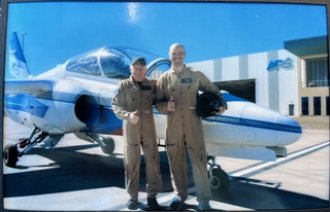
By 2018, Garrod was wearing the uniform of a senior captain for the corporate flight department. "I made the switch because the many overnights required in my Northern Jet duties were not the best with a newborn in the house," he says about what also involved his first experiences with a turbo-prop and non-glass airplane. "I felt like I was learning to fly all over again. Fortunately, I was paired with another corporate pilot with many years of experience.
"This job has me working closely with managers to the chief executive officer and with many company representatives," he says. "People skills are important as I sometimes have to tell top people that we can't get them to their meetings or vacations. I keep learning what it takes to keep our department running, about the ins and outs from our chief pilot and director."
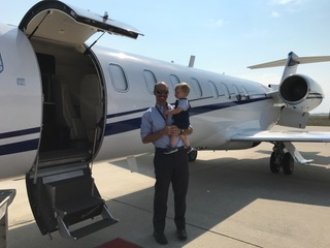
Garrod has a bit more advice for those following in his footsteps -- never turn off your learning button. "Everything in aviation changes quickly and it can be a lot of work staying on top of things," he says about what is needed for staying a proficient pilot. Also, freely communicate with others in the profession, from mechanics to dispatchers. "The more you learn about aviation as a whole, the better," he says.
Garrod is not forgetting how he got to his current status. "WMU aviation is the reason for where I am," he says. "The direct-hire program really accelerated my career and let me start flying jets a lot sooner than I thought I would be able to. Trying to give back to WMU and help students is just a drop in the bucket compared to what WMU did for me. I like to connect with students and pass on knowledge about the industry and about things I wish I had known going through college."
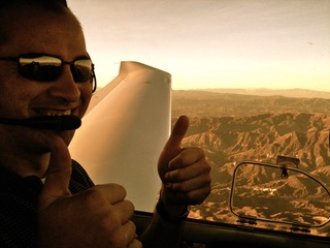
He's also a walking billboard for what the College of Aviation has to offer with a Bronco logo adorning what he wears and the car he drives. "I constantly brag that WMU is the best flight school in the country," he says. Never turning down an opportunity to network with current Western students, "I want them to succeed at least the same way I did."
When Garrod is not at home as a hobbyist preparing baked goods or brewing beer, he is playing hockey or out on the slopes with his wife and 10-year-old child as there is a lot to do in the Grand Rapids community.
But he is never far away from his professional avocation. "Aviation is cool," he says. "Even after 15-plus years of flying, I still find myself watching airplanes as they race across the sky."